Zander lure fishing: the beginner's guide to landing your
Zander have a reputation as a difficult fish. In reality, they're mostly demanding on precision: the right depth, the right retrieve, the right moment. Once those basics are in place, they become far more consistent. Here's a clear guide to get started.
Understanding the zander
The zander is a low-light hunter that lives near the bottom, on hard ground: gravel, drop-offs, holes, bridge piles, sunken wood. Unlike pike, it doesn't throw itself at everything that passes: its bite is often subtle, a simple "tap" or a feeling of heaviness. Learning to detect it is the first real skill.
The basic gear
- Rod: 2.10 to 2.40 m, 10–30 g power, fast tip action (to feel the bottom and set the hook sharply).
- Reel: size 2500–3000 spooled with braid (essential for sensitivity).
- Leader: 25–30/100 fluorocarbon. Add a steel or titanium leader if pike are around, otherwise you'll get cut off.
The lure that catches the most zander
To get started, remember a single rig: the soft plastic (finesse or 9–12 cm shad) on a jig head. Simple, effective, universal.
The weight of the jig head is the key variable: it should let you touch the bottom in 2 to 4 seconds after the cast. Too light and you feel nothing; too heavy and the lure swims poorly. In a river with current, go heavier; in a calm lake, go lighter.
Zander are caught in contact with the bottom. If you don't feel your weight touch down, you're fishing too high.
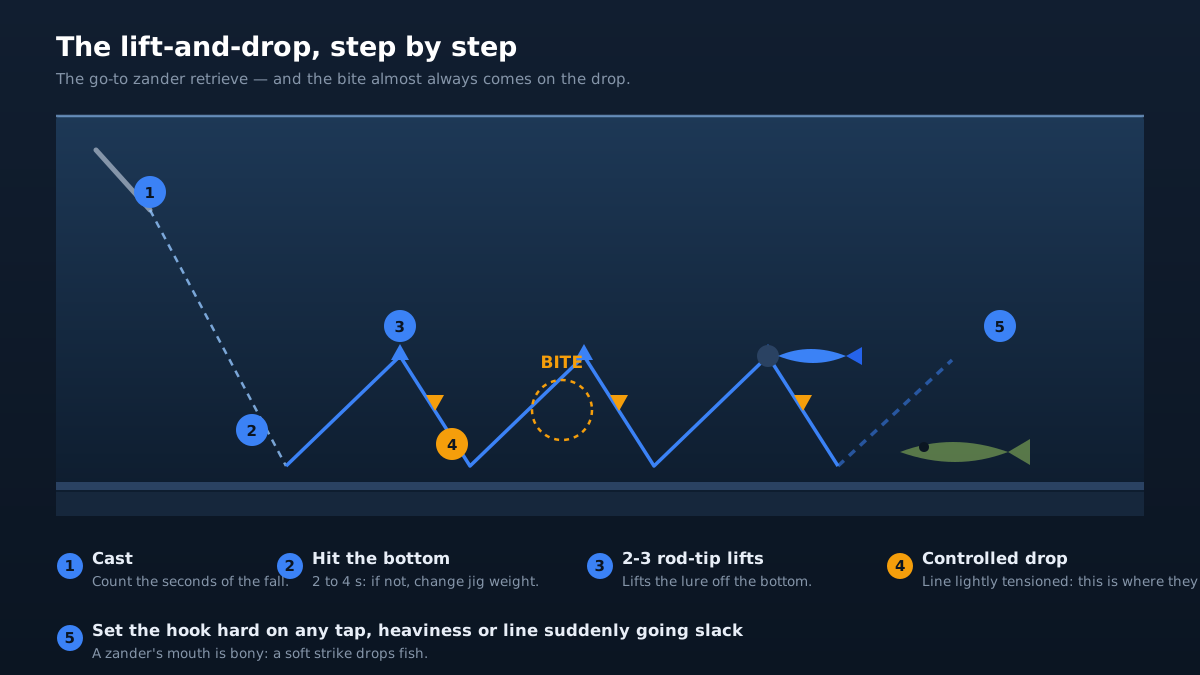
The retrieve: the straight "lift-and-drop"
This is the go-to action for zander, and it's perfect for beginners:
- Cast and let it sink to the bottom (count the seconds).
- Give two or three lifts of the rod tip to lift the lure off the bottom.
- Let it drop back down while keeping the line slightly tight.
- The bite almost always comes on the drop: watch for the slightest resistance or the line suddenly going slack.
- Set the hook firmly as soon as you feel anything unusual.
Alternate with a slow straight retrieve, keeping the lure just above the bottom when the fish are active.
When and where to fish
- Best times: dawn and dusk, night, grey and overcast days. Zander hate bright sun.
- River spots: drop-offs, slack-current areas, downstream of bridges, holes.
- Lake spots: edges of holes, plateaus, submerged trees, the fringes of deep zones.
Slightly stained water after rain is often excellent: the zander feels confident and hunts for longer.
Choosing your jig head weight
This is the question that comes up most. Rather than memorising a single figure, start from depth and current, then adjust by feel:
- Calm lake or pond, 2 to 4 m: 5 to 10 g.
- Edge of a hole, 4 to 8 m: 10 to 15 g.
- Big hole or deep lake, 8 to 15 m: 15 to 25 g.
- River with moderate current, 3 to 6 m: 12 to 20 g.
- Large river, strong current, 5 to 10 m: 20 to 35 g.
The test is always the same: if your lure takes more than 4 seconds to reach the bottom, go heavier; if it drops like a stone without swimming, go lighter. In cold water, drop one step down — a slower fall gives the zander time to make up its mind.
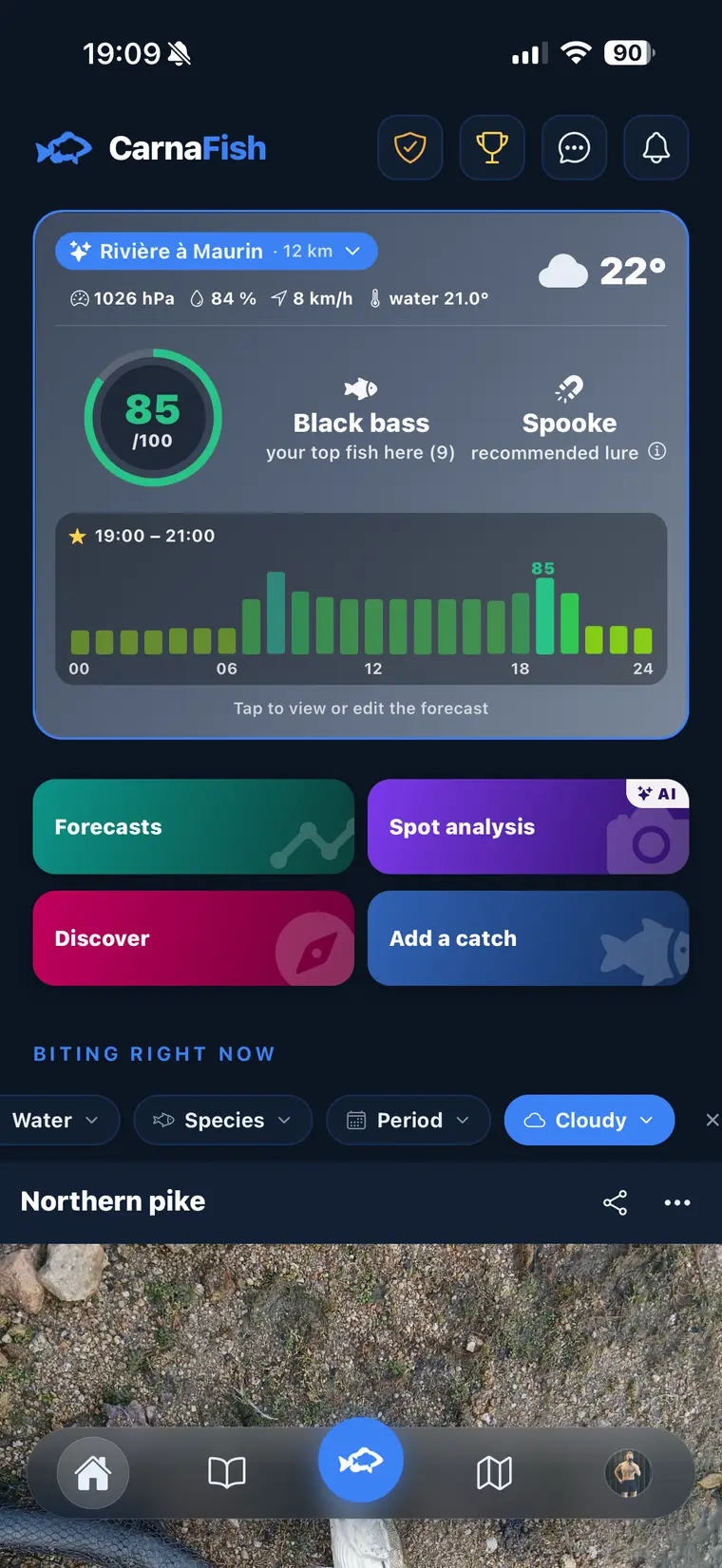
Not sure what to tie on?
Photograph your spot: CarnaFish reads the scene, cross-checks the conditions and gives you the zone, the lure and the retrieve. Free on iOS and Android.
Zander season by season
- Spring: after spawning, fish move back onto plateaus and shallower zones. Slow retrieve, smaller lures (8-10 cm), lies in 2 to 5 m.
- Summer: zander go deeper and become distinctly more nocturnal. Holes during the day, edges and plateaus at dusk. This is when picking the right window matters most.
- Autumn: the best season. Fish group up and feed hard before winter. Size up your lures (12-15 cm) and cover water.
- Winter: zander pack onto deep zones, often in tight shoals. Very slow retrieve, long pauses, lighter jig heads. When you find one, there is rarely just one.
Fishing for zander at night
This is the most under-used window, and often the most productive in summer. Zander move up onto shallow zones to hunt, sometimes in less than a metre of water.
- Scout your mark in daylight. You need to know where the snags are before dark, or you'll spend the evening pulling free.
- Slow everything down. Slow straight retrieve, wide and well-spaced animations: zander home in with the lateral line, not by sight.
- Target lit water. A bridge, a quay, a street lamp concentrates fry and therefore predators — right on the light/shade line.
Vertical jigging from a boat
If you have access to a boat, vertical jigging is the most efficient way to cover deep water. The principle: the lure stays directly below the boat, 20-50 cm off the bottom, while you drift over zones marked on the sounder.
The animation comes down to small 20-30 cm lifts followed by a controlled drop. The bite registers instantly — it's the technique that teaches you fastest what a zander actually feels like.
Beginner mistakes to avoid
- Fishing too high: if you don't feel the bottom, you're passing above the fish.
- Setting the hook softly: a zander's mouth is hard, you need a sharp, wide hook set.
- Insisting at the wrong time: in the midday sun, change your time slot rather than persisting.
- Ignoring the conditions: weather, light and water level change everything from one trip to the next.
That last point is exactly what wastes the most time. Before you start, learn to read your fishing spot to spot the drop-offs and holes where zander hold. And with CarnaFish, the AI fishing app, you photograph your spot: the app cross-checks the conditions of the moment to tell you where to insist, which lure type to favour and which retrieve to try — a real shortcut when you're starting out. Tempted by pike too? See our guide to choosing a pike lure.
Key takeaways
- Soft plastic + jig head in contact with the bottom = 90% of zander.
- The bite is felt on the drop: stay focused, set the hook hard.
- Fish at dusk and in overcast weather.
- Match the weight to the depth and the current.
FAQ
What lure should I use to start zander fishing?
A soft plastic (finesse or shad of 9 to 12 cm) on a jig head. It's the simplest and most effective rig. The head weight is the key variable: it should let you reach the bottom in 2 to 4 seconds after the cast.
How do I feel a zander bite?
The bite is subtle and almost always comes on the drop: a simple "tap", a feeling of heaviness or a line that suddenly goes slack. Fish with braid for sensitivity, keep the line lightly tensioned on the drop, and set the hook hard as soon as you feel anything unusual.
What time should I fish for zander?
At dawn and dusk, at night, and on grey, overcast days. Zander hate bright sun: on a sunny midday, it's better to change your time slot than to keep at it.
Do I need a steel leader for zander?
For zander alone, a 25–30/100 fluorocarbon is enough. But if pike are present on the spot, add a steel or titanium leader, otherwise you risk being cut off on a strike.
What size soft plastic for zander?
9 to 12 cm to start with, which covers the vast majority of situations. Drop to 8-10 cm in spring and in cold water when fish are lethargic, and size up to 12-15 cm in autumn when they are feeding hard and you're after the bigger fish.
Can you catch zander from the bank?
Yes, and it's how most anglers start. Look for marks that give you depth within casting range: bridge piers, quays, jetties, below weirs, outside bends on rivers. Lack of depth is offset by fishing early, late or at night, when zander move up.
What colour lure for zander?
Two families are enough: natural (white, grey, roach patterns) in clear water, and bright or fluo (chartreuse, orange, opaque white) in stained water or at night. Colour matters far less than depth and retrieve — only change colour once you've confirmed you're actually fishing in contact with the bottom.
When is the best season for zander?
Autumn, without hesitation: fish group up and feed before winter, which makes them easier to locate and more aggressive. Spring after spawning is also very good. Summer stays productive but forces you to fish early, late or at night.
Go from theory to fish
CarnaFish reads your spot from a photo and gives you the game plan: zone, lure, retrieve. Free on iOS and Android.