How to read a fishing spot: the method to find where the
The best lure in the world is useless if it fishes where there are no fish. Knowing how to read a spot — understanding where predators hold and why — is the skill that sets consistent anglers apart. Good news: it can be learned, and a large part of it is read by eye, before you even cast.
Why predators hold in specific places
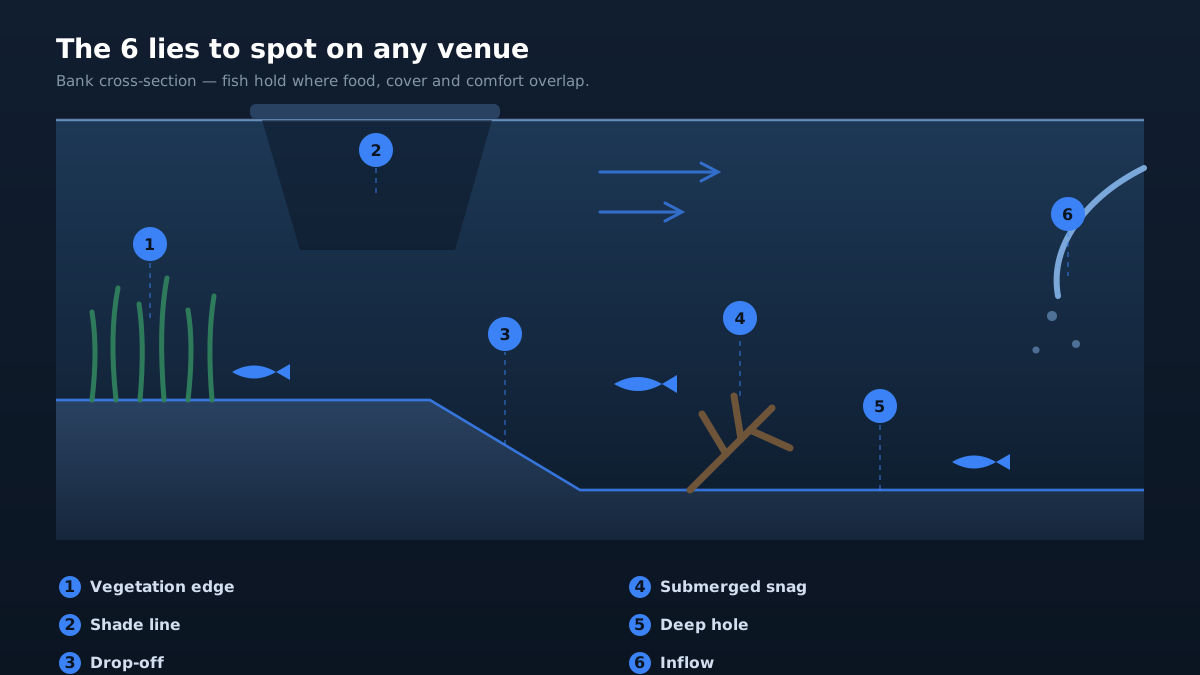
A predator looks for three things: food, a hiding place to ambush from, and comfort (current, oxygen, temperature). Almost every good lie ticks at least two of those boxes. Your job is to spot them.
The 6 types of lies to look for
1. Edges and vegetation
Weed beds, lily pads, reeds: they shelter prey and offer an ideal ambush spot. Pike love weed-bed edges; perch hunt along strips of vegetation.
2. Drop-offs and depth changes
A drop-off (where the bottom plunges suddenly) is a highway for fish. Zander hold tight to it, moving up onto the plateau to hunt then dropping back down. Spot them on the map, with a sounder, or by changes in water colour.
3. Obstacles and structure
Submerged trees, rocks, bridge piles, pontoons: anything that breaks the uniformity concentrates fish. An isolated obstacle in the middle of nowhere is a predator magnet.
4. Current variations (river)
In a river, look for slack water: downstream of an obstacle, back-eddies, a slow seam alongside a fast seam. Predators hold there to attack without fighting the current.
5. Shade and light zones
In sunny weather, predators sit in the shade (trees, bridges, edges) and look towards the light. Shade/light transition zones are obvious hunting spots.
6. Confluences and inflows
An inflow, a confluence, an outfall: it stirs up food and oxygenates the water. These points concentrate activity, especially in summer.
Reading the conditions of the day
The same spot doesn't fish the same depending on the moment. Three parameters change everything:
- Light: bright sun → fish in the shade and deep; overcast sky → they hunt more widely and for longer.
- Water level and colour: rising, staining water pushes fish towards the edges; low, clear water makes them wary.
- Season and temperature: they dictate depth and aggression. Depending on the species you're after, dig deeper with our guides: which lure for pike, zander lure fishing for beginners, perch lure fishing, bass on lures and sea bass from the shore.
A good lie at the wrong time gives nothing. The lie tells you where, the conditions tell you when and how.
A 4-step method before you cast
- Observe the surface and the banks: vegetation, obstacles, swirls, surface activity.
- Identify 2 or 3 likely lies based on the 6 types above.
- Cross-check with the day's conditions (light, water, season).
- Start with the most promising lie, with the right lure at the right depth — and insist before moving.
What if the analysis did itself?
Reading a spot takes experience, and even good anglers miss details. That's exactly what CarnaFish, the AI fishing app, does: you photograph your spot, the AI analyses the scene (edges, structure, shade, water type), cross-checks it with the weather and the conditions of the moment, and returns a concrete game plan — which zone to target, which lure, which retrieve, how long to insist.
A way to learn to read the water faster… and catch more fish starting today.
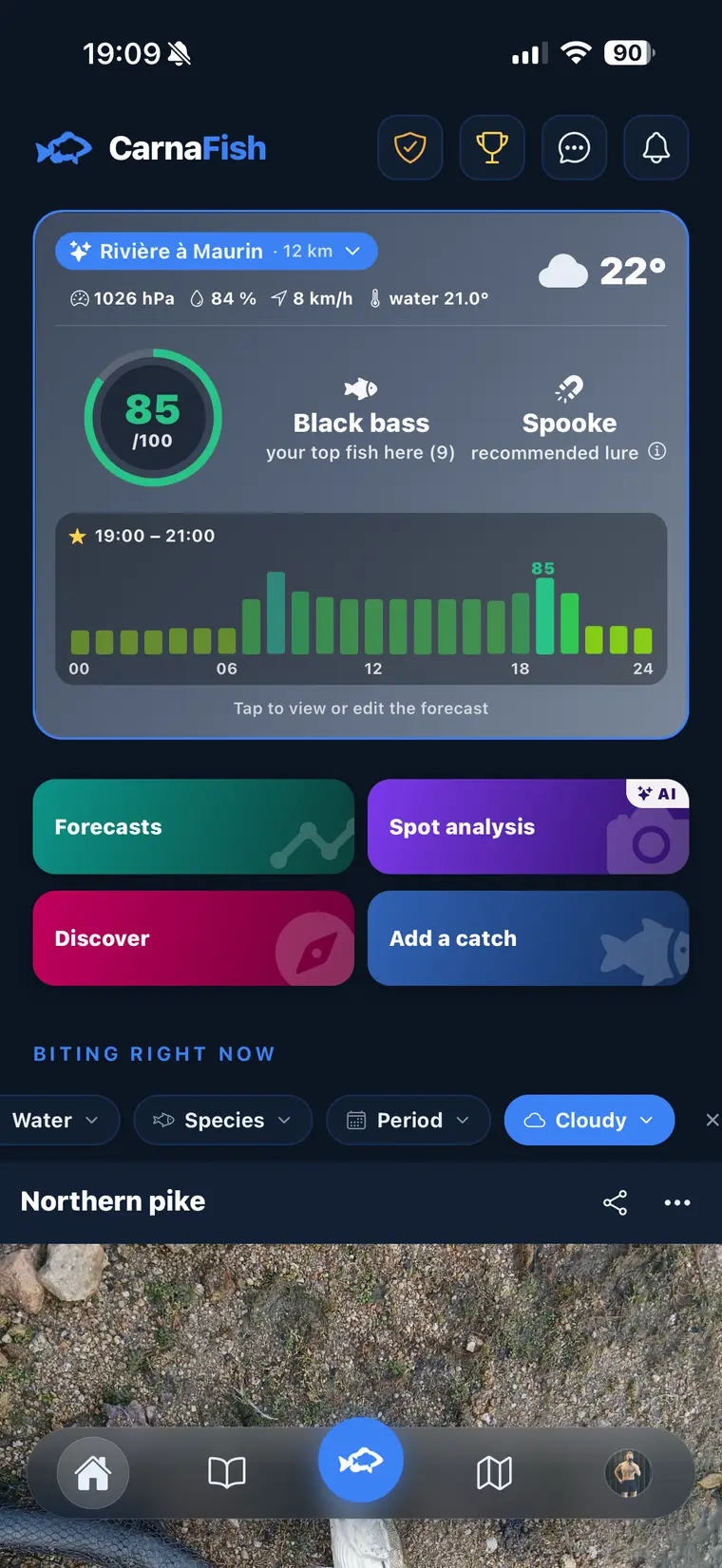
Not sure what to tie on?
Photograph your spot: CarnaFish reads the scene, cross-checks the conditions and gives you the zone, the lure and the retrieve. Free on iOS and Android.
Reading water you've never fished
Arriving on unknown water is the most intimidating exercise, and yet the most mechanical. A simple method stops you going round in circles:
- Walk the bank before you set up the rod. Ten minutes of observation saves you two hours. Note the access points, the snags and the water you can realistically fish.
- Start with the most obvious lie. The weed-bed edge, the fallen tree, the rocky point. If fish are active, that's where they'll be.
- Cover water before you fish fine. A search lure (crank, spinnerbait, fast straight retrieve) tells you within twenty minutes whether fish are there and switched on.
- Write down what worked. The lie, the time, the tide or water level, the weather. That accumulation is what turns unknown water into reliable water after three sessions.
The most common reading mistakes
- Fishing the middle. Beginners cast long, into open water. Predators are on the edges and the structure, often only a few metres out.
- Confusing pretty with productive. A clear, comfortable bank is rarely a good lie. The best lies are cluttered, awkward to reach and annoying to fish.
- Ignoring depth. Spotting a great edge counts for nothing if you present your lure three metres above the fish.
- Judging on a single pass. A lie that's empty at 2 pm can be full at 8 pm. The lie doesn't change, the activity does.
- Forgetting the wind. The bank the wind blows onto concentrates plankton, therefore fry, therefore predators. It's usually the least comfortable side, and usually the one that produces.
Adapting your reading to the type of water
On rivers, the current does the work: look for seams, the downstream side of obstacles, outside bends and slack water. A predator sits in the calm, right beside the flow that brings it food.
On lakes and ponds, structure and depth are in charge: drop-offs, plateaus, sunken wood, weed-bed edges. With no current to concentrate prey, food gathers around the cover.
On canals, everything is linear and uniform — so any irregularity counts: a pontoon, a lock, a piling, a widening, a change in vegetation. They're the only reference points on the venue, and they almost always hold fish.
On the coast, the tide replaces river current as the number one factor: it decides not only the lie, but above all the moment that lie becomes fishable.
Key takeaways
- Look for food + cover + comfort: good lies tick at least two boxes.
- 6 key lies: edges, drop-offs, obstacles, currents, shade, inflows.
- The lie says where, the conditions say when and how.
- Observe and reason before you cast.
FAQ
How do I know where the predators are in a body of water?
Look for spots that combine food, cover and comfort: weed-bed edges, drop-offs, submerged obstacles, current slack, shaded areas and inflows. An isolated obstacle in open water, or a sharp drop-off, are magnets for pike, zander and perch.
Can I read a good spot without a fish finder?
Yes, a large part of it is done by eye: vegetation, swirls, visible obstacles, water colour and level, light and shade. A fish finder mainly helps confirm drop-offs and depth, but observing the bank already tells you most of what you need.
What is the best time to fish a spot?
The lie tells you where, the conditions tell you when. Overcast skies, a slight rise in water and fading light (early morning, evening) are often the most active windows. In bright sun, target the shade and the depth.
Can CarnaFish analyse my spot for me?
Yes. You photograph your spot and the CarnaFish AI app analyses the scene (edges, structure, water type, shade), cross-checks it with the current weather and suggests a zone to target, a lure and a retrieve. It's an aid to reading the water, not a guarantee of a catch.
How do I approach a venue I've never fished?
Walk the bank before you even set up the rod: ten minutes of observation saves two hours. Start with the most obvious lie (weed-bed edge, fallen tree, rocky point), cover water with a search lure to find out quickly whether fish are active, then fish finer. Afterwards, write down what worked — lie, time, weather, water level. After three sessions, unknown water becomes reliable water.
Should I cast far from the bank?
Rarely. It's the most widespread beginner mistake: casting into open water when predators are holding on the edges and the structure, often only a few metres out. Fish the margins and the nearby snags first, before reaching for distance.
How is reading a river different from reading a lake?
On a river, the current is in charge: look for seams, the downstream side of obstacles, outside bends and slack water — fish sit in the calm, right beside the flow that brings them food. On a lake, with no current to concentrate prey, structure and depth decide instead: drop-offs, plateaus, sunken wood and weed-bed edges.
Does the wind affect which lie to choose?
Yes, and it's very often underestimated. The bank the wind blows onto concentrates plankton, therefore fry, therefore predators. It's generally the least comfortable side to fish, and almost always the one that produces.
Go from theory to fish
CarnaFish reads your spot from a photo and gives you the game plan: zone, lure, retrieve. Free on iOS and Android.