Queen Tackle Tungsten Finesse Peanut Football Jig: the mini bottom jig
Before tying this one on, it helps to know if the spot actually calls for it. CarnaFish reads the scene from a photo.
Some days bass refuse anything above a certain size. Clear water, blue sky, fishing pressure: the fish are sitting on rocky bottom and will not come up. That is exactly the ground of the Peanut Football Jig, a football jig stripped back to the essentials, which Queen Tackle designed with smallmouth bass in mind while stating it will interest any bass it meets.
Small, but not watered down
The word peanut is not marketing decoration: this is a deliberately miniaturised jig. And that is precisely what makes it a finesse lure rather than a smaller version of an ordinary one. A standard football jig relies on the bulk of its skirt to build a crawfish silhouette, at the risk of being refused by a wary fish. This one cuts the bulk, not the density, and becomes a credible mouthful for a fish that has already seen three conventional jigs go past since dawn.
The model is sold under the Tungsten name. The description does not go further into the head's composition, but on this kind of jig the point of tungsten is well known: for a given weight, a more compact head, so less volume in the water and far crisper bottom feedback through the rod. On gravel or rock you feel the difference between a stone and a patch of sand, which genuinely changes how you read the spot.
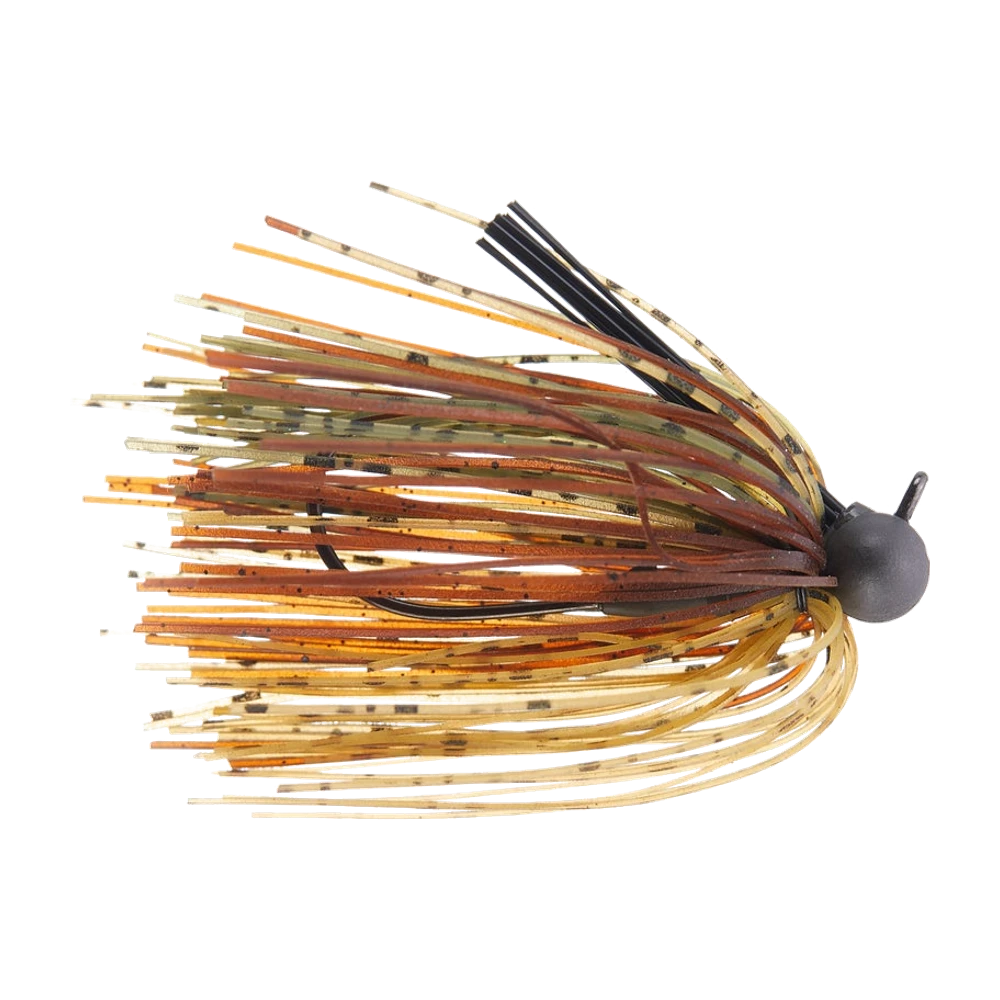
In the product photo the head is a small matte black ball with a flat line tie, no eyes and no decoration. The skirt mixes brown, rust, pale green and tan strands flecked with black, and the fine black fibre weed guard stands out clearly above it. The hook stays entirely hidden by the skirt. That is an observation from a product photo, not a specification.
A thin skirt, wire-tied and scented
The description insists on three skirt features: it is thin, it is wire-tied, and it is coffee-scented. All three matter.
A thin skirt flows and quivers on every hop along the bottom where a thick skirt simply opens and closes as a block. On a lure worked in slow motion, that quiver is what fills the dead time between two pulls, and it is often during that dead time that the bite comes.
Wire-tying, rather than a rubber collar, stops the skirt rotating or sliding after a few fish. It is a difference you cannot see in the shop and see very clearly after a season.
The coffee scent is the model's quirk. Queen Tackle does not say what effect it expects from that smell, and it should be taken for what it is: a stated product feature, not a demonstrated performance. What can be said in measured terms is that a scented lure encourages a fish to hold on a fraction of a second longer, and on a late finesse hookset that fraction is not nothing.
The light wire hook, and what it demands
The stated hardware is a 3/0 Mustad light wire hook, described as sharp enough to set on a simple reel-set. That detail is not trivial: a light wire hook penetrates with very little energy, so it does not need a violent strike — and above all it will not take one. A hard jig-fisherman's strike on light wire means an opened hook and a fish that comes off halfway through the fight.
The right method is a progressive set: you feel the weight, you reel while dropping the rod, then lift firmly without ripping. Fluorocarbon in 0.20 to 0.25 mm, a drag set fairly soft, and above all a rod that is not a broomstick.
If you are not sure you have a bite, do not strike: reel gently until you feel resistance. Fishing finesse on the bottom, nine bites out of ten are stones, and the only way to tell them from a fish is to load up slowly. A reflex strike into nothing loses contact with your spot and you have to start the whole drift again.
Three ways to fish it
The maker lists three uses: dragging, skipping and flipping light cover. They do not ask the same things.
Dragging is the heart of it. You put the jig on the bottom and pull it very slowly with the rod, pausing for one to two seconds at a time. The football head is made for this: its shape makes it tip and roll over irregularities instead of wedging in them. It is the retrieve to favour on a rocky break or a gravel flat.
Skipping is for sliding the jig under a dock or a low branch. The reduced size helps, and the thin skirt creates less drag than a thick one, which makes the bounce easier. Flipping, finally, stays limited to light cover: the weed guard is described as thin, and a thin guard protects against a stray weed or branch, not a dense mat. That is a real limit of this lure, and the logical price of a light wire hook you must not overload.
The classic mistake
Rigging too big a trailer. A full-size craw on a miniature jig destroys the balance: the lure sinks more slowly, the skirt disappears behind the trailer, and you lose the whole point of the compact format. Stick to a small craw or creature with short appendages. If you really want bulk, take a jig built for it, such as the Dirty Jigs Tour Level Finesse Football Jig.
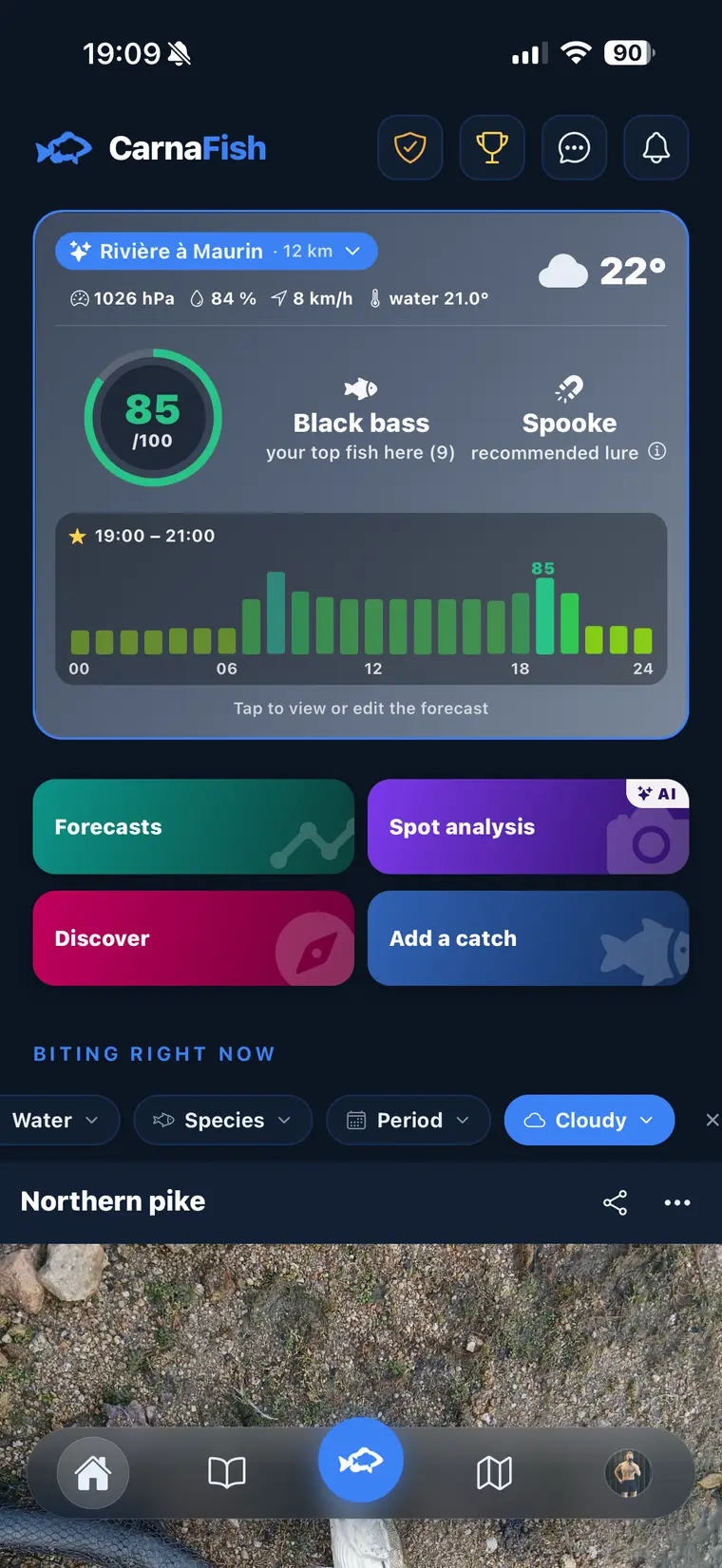
Not sure what to tie on?
Photograph your spot: CarnaFish reads the scene, cross-checks the conditions and gives you the zone, the lure and the retrieve. Free on iOS and Android.
Colours by bottom type
- Clear water, rocky bottom: green pumpkin with a touch of orange, exactly the family of shades in the photo. It is the default crawfish dress, the one that never lets you down.
- Silty bottom or slightly stained water: brown and rust, to stay in tone with the bottom without vanishing completely.
- Sand and pale gravel: tan and translucent shades, which avoid an over-contrasted silhouette on a light bottom.
A finesse jig dropped on the wrong bottom will catch nothing, however well it is rigged. That is exactly what CarnaFish saves you: one photo of the spot, and the AI suggests the zone, the depth and the lure type that suit the conditions. To build the method around it, our guide to getting started with bass fishing covers the spots and how to read the bottom.
What to remember
- A deliberately miniaturised football jig, built for clear water and educated fish, not for heavy cover.
- A thin, wire-tied, coffee-scented skirt that quivers through the pauses instead of opening as a block.
- A 3/0 Mustad light wire hook: a progressive set is compulsory, a hard strike will open it.
- A thin weed guard: light cover only, and that is this model's acknowledged limit.
FAQ
Which weight should I choose?
The maker's description publishes no weight or length grid, although several sizes are offered for sale. Check the exact reference before buying, and think in terms of depth: the right weight is the lightest one that keeps bottom contact in the day's wind and current.
What is the coffee scent for?
Queen Tackle states a coffee-scented skirt without saying what effect it expects, and it should be read as a stated product feature. The general value of a scented lure is to encourage a fish to hold on a little longer, which helps on a late hookset.
Can it be fished in dense weed?
No, and that is not what it is for. The weed guard is described as thin, and it protects against a stray weed or branch, not a compact mat. For heavy cover you want a flipping jig with a thick guard and a heavy wire hook.
Do I need a trailer?
A small craw or short creature complements the jig well, adds a little resistance on the fall and extends the silhouette. Avoid bulky trailers: they cancel out the point of the compact format and hide the skirt.
How do I set the hook with light wire?
Progressively. You feel the weight, you reel while dropping the rod to load the line, then lift firmly. A sharp, violent strike opens a light wire hook, especially on low-stretch fluorocarbon.
How is it different from a ned rig?
A Zman TRD Ned Rig is a compact soft plastic on a round head, with no skirt and no weed guard, relying on the body's buoyancy. The Peanut Football Jig keeps a skirt, a weed guard and a football head that rolls over the bottom: it covers the same finesse ground with a crawfish silhouette rather than a worm.
The full bass lure guideSeason-by-season strategy: which family of lure, when, and why.Go from theory to fish
CarnaFish reads your spot from a photo and gives you the game plan: zone, lure, retrieve. Free on iOS and Android.