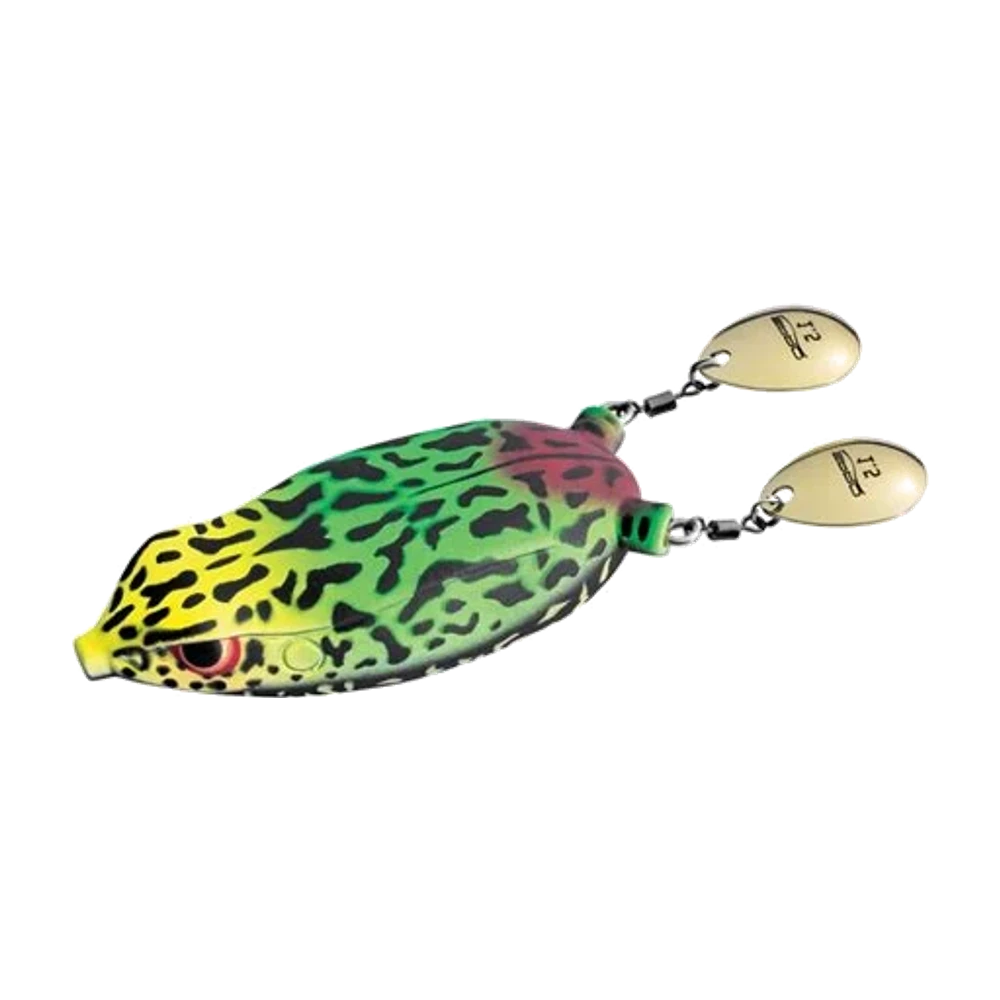
SPRO Bronzeye Frog: the frog that crosses lily pads without fouling
Not sure this lure fits YOUR spot today? CarnaFish tells you in 10 seconds, from a photo.
Lily pads and floating weed mats concentrate bass and pike in summer: shade, cooler water, plenty of prey, and above all no fishing pressure, because most lures are unusable in there.
The frog is the only tool that gets you in. The Bronzeye is one of the most complete models in the category, and it illustrates well what makes a good frog.
What makes it weedless
Three design elements.
The body is hollow and soft. It does not grab vegetation, it slides over the pads, and it collapses when a fish bites — releasing the hook points.
The hooks lie flat against the body. Two double points, laid along the back, invisible to the vegetation. They only come clear at the moment the body is crushed.
The nose is pointed and the back is smooth. Nothing that can catch on a stem or a leaf. The frog slides from one pad to the next instead of wedging itself in.
The retrieve, according to what you are on
On the mat, the frog does not swim: it slides. Move it forward in short 20 to 30 cm draws, hopping it from one leaf to the next. Pause at every hole of open water — that is where the strike happens.
In an opening, switch to walking the dog. Rod tip low, small wrist taps: the frog zigzags on the spot in the gap without moving forward. This is the most productive retrieve of all: you keep the lure directly above the exact point where the fish is holding.
Along the edge of the weed, a slow steady retrieve with pauses. The frog leaves a visible wake that the fish follows until it makes up its mind.
On the water: when you reach a hole of open water in the mat, stop everything and leave the frog still for three to five seconds. Those holes are ambush stations. A frog that crosses without stopping passes over the fish without giving it time to come up.
The hookset, the real difficulty
This is where 80% of frog bites are lost, and the cause is always the same: setting the hook too early.
When the fish explodes on the surface, it often does not have the frog in its mouth yet — or it has grabbed it without crushing it. An immediate hookset rips the lure straight out.
The correct sequence:
- See the strike. Do not move.
- Count one full second. It feels very long in the heat of the moment, but it is essential.
- Check the line is tight — if the fish has the lure, you feel the weight.
- Set the hook violently, rod up and back, reeling as you go.
The hookset has to be powerful: it must collapse the hollow body, free the points, then drive them through the jaw. A soft hookset does none of that.
The tackle is not negotiable
This is probably the most demanding lure fishing there is in terms of gear.
- A powerful casting rod, H or XH, 2.00 to 2.20 m. You need the power to set the hook through vegetation and pull the fish out of the mat.
- 0.40 to 0.50 mm braid. Never fluorocarbon or mono: the stretch kills the hookset and the vegetation cuts thin lines.
- A fast casting reel, to pick up slack instantly on the hookset.
An under-gunned setup gives you hooked fish that go back into the weed with your lure.
Not sure what to tie on?
Photograph your spot: CarnaFish reads the scene, cross-checks the conditions and gives you the zone, the lure and the retrieve. Free on iOS and Android.
Maintenance
The hollow body fills with water over the course of several fish, through the hook holes. A frog full of water loses its buoyancy and its action.
Squeeze it out regularly, head down. And when the holes get too wide, replace it — it is a consumable.
Hollow frog or solid soft frog
A solid soft frog or a Texas-rigged soft plastic also cross vegetation, but they sink as soon as they reach a hole of open water. Sometimes that is exactly what you want — the lure then drops under the mat.
The hollow frog stays on the surface permanently, including in the openings. That is what allows walking the dog on the spot in a gap, the most effective retrieve in this style of fishing.
Our beginner's guide to bass fishing covers summer spots in detail. And if you are not sure whether a weed mat is worth fishing, CarnaFish analyses a photo and answers.
Key takeaways
- Hollow body and hooks laid flat: it slides over vegetation without fouling.
- Stop and wait three to five seconds at every hole of open water.
- Never set the hook on the explosion: count one second, check for the weight, then set hard.
- H or XH rod and 0.40-0.50 mm braid are compulsory, never mono or fluorocarbon.
- Empty the body of water regularly, and replace the frog when the holes widen.
FAQ
Why does the frog not foul in the weed?
Its body is hollow and soft, its two hook points lie flat along the back, and its pointed nose slides over the vegetation. The points only come clear when the fish crushes the body as it bites.
How do you set the hook on a frog properly?
Never set at the moment of the explosion. Count one full second, check that you feel the weight of the fish in the line, then set violently up and back while reeling. The hookset has to collapse the body to free the points.
What rod should I use for frog fishing?
A powerful casting rod, H or XH, from 2.00 to 2.20 m. You need the power to set the hook through the vegetation and then drag the fish out of the mat. A light setup will not do.
Can you fish a frog on fluorocarbon?
No. The stretch in fluorocarbon and mono absorbs the hookset, which has to be very powerful. Braid of 0.40 to 0.50 mm is essential, and it also stands up better to abrasion from the vegetation.
Why does my frog fill with water?
Water gets in through the holes left by the hooks after several fish. Squeeze it out regularly, head down. When the holes get too wide, the frog loses its buoyancy and has to be replaced.
How does it differ from a solid soft frog?
The hollow frog stays on the surface even in the holes of open water, which lets you walk the dog on the spot in an opening. A solid soft frog sinks as soon as it reaches a hole, which is sometimes exactly what you want in order to get under the mat.
The full bass lure guideSeason-by-season strategy: which family of lure, when, and why.Go from theory to fish
CarnaFish reads your spot from a photo and gives you the game plan: zone, lure, retrieve. Free on iOS and Android.