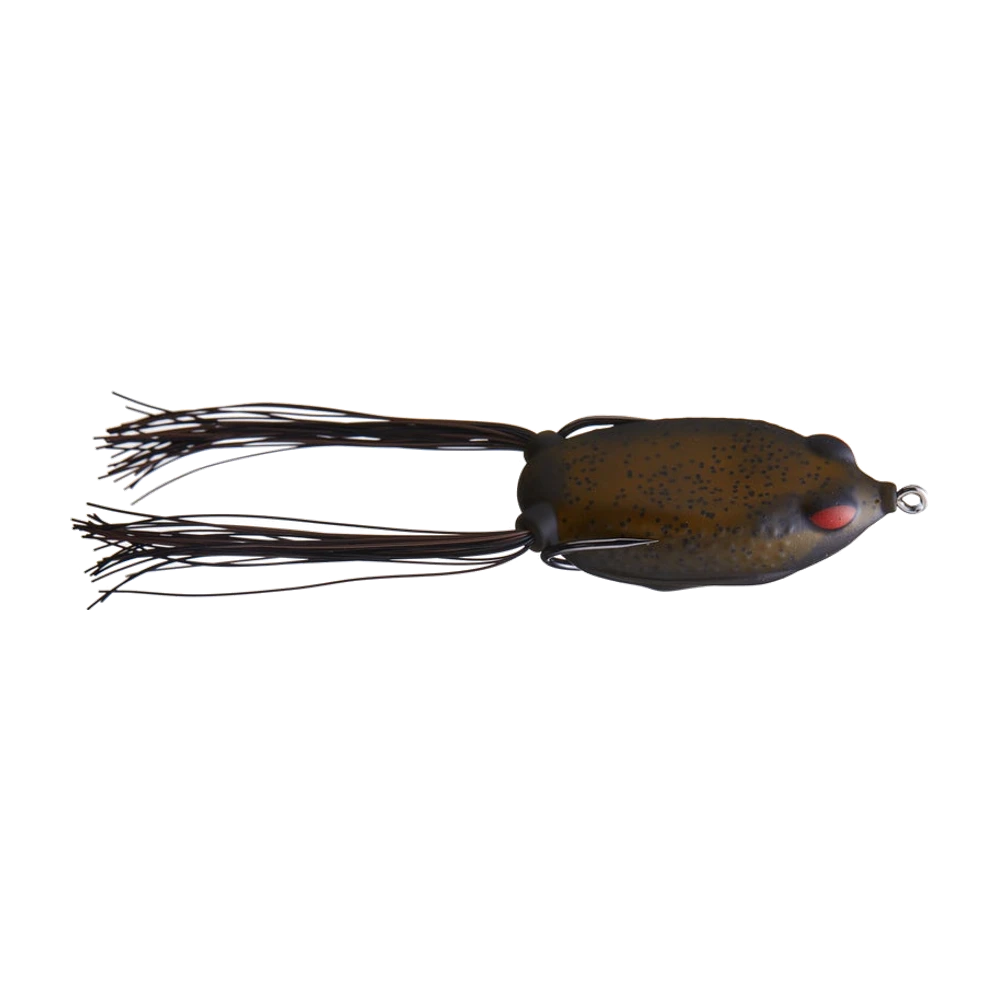
Berkley Swamp Lord Frog: the hollow body that collapses on the hookset
Not sure this lure fits YOUR spot today? CarnaFish tells you in 10 seconds, from a photo.
A mat of lily pads in August, water at twenty-five degrees, and a dull thud somewhere under the leaves. You see nothing, you feel nothing, but you know a fish is holding in the shade in thirty centimetres of water, waiting for a frog to pass overhead. That is the one situation a hollow-body frog exists for — and it is also a style of fishing where most bites end in an empty hookset.
A hollow body built to collapse fast
Berkley developed the Swamp Lord with Bobby Lane, the 2022 MLF Redcrest champion, and the stated design axis is clear: hook penetration. The body is described as ultra-soft while staying durable, so it folds the instant a fish closes on it and frees the hook points.
That is the whole problem with hollow frogs: on a body that's too stiff, the fish clamps a lump of plastic that wedges its jaws open while the points touch nothing, and you pull it straight out. A softer body compresses in a fraction of a second and puts the points in direct contact. The trade-off is well known: soft plastic deforms and punctures sooner. Plan on carrying two if you're fishing frogs all day.
The hook, the skirt, and what's sealed
The business end is a dedicated Berkley Fusion19 frog double, listed with a precisely angled point geometry and a sticky-sharp finish. In fishing where the hookset has to drive through vegetation first, that angle matters as much as the sharpness.
The skirt is made of long silicone strands, deliberately oversized. Berkley states it is meant to be trimmed to your preference. That isn't a cosmetic note: a long skirt drags on the frog and stretches out the glide, which is perfect on a thick mat where you want to work it on the spot, while a short-trimmed skirt makes the walk-the-dog action far crisper and faster over open water. Keep scissors in the box.
Finally, the hook shank and the body chamber are sealed to limit water intrusion. That's what actually wears a frog out: after twenty casts, a frog that isn't sealed fills, gains weight and loses its buoyancy. You then spend more time emptying it than fishing it.
Before every series of casts, squeeze the frog between two fingers and watch for water. If there is any, empty it completely before carrying on: a half-full frog floats crooked and refuses to walk, and you'll spend twenty minutes wondering why it stopped working.
How to work it, cover by cover
On a thick mat
On lily pads, duckweed or compact weed, you barely move the frog forward. Two sharp wrist twitches to slide it ten centimetres, then a three to five second pause in a hole of open water. The bite comes during that pause, almost every time. Fish sit beneath and come up through the leaves.
On edges and open water
As soon as the cover thins out, switch to a continuous walk-the-dog, steady rhythm, rod low. The frog then sweeps side to side and covers far more ground. This is where a short-trimmed skirt earns its keep.
The hookset
Never set on the sound. When you hear the blow-up, the fish hasn't closed its mouth yet, and an immediate hookset rips the frog straight out. Wait until you feel the weight in the rod — a full second, sometimes two — then set hard, sweeping sideways rather than upward. It's the hardest discipline to learn in this style of fishing, and it's the difference between three fish landed and three bites missed.
The listed weight deserves a comment
The maker lists 2.6 in for 2/3 oz, that is 6.6 cm for around 19 g. That is heavy for the size, clearly above most hollow frogs of the same length. If the figure is accurate it explains the casting distance and the ability to punch through wind, but it also means a frog that settles deeper into a light mat and demands a serious rod. Check the spec sheet at purchase if this point is decisive for you: it's the kind of value that sometimes varies from one color or production run to the next.
The maker's own copy also refers to this model as the Swamp Lord Popping Frog; if what you want is the cupped-mouth version, the sheet to read is the Berkley Swamp Lord Popping Frog.
Not sure what to tie on?
Photograph your spot: CarnaFish reads the scene, cross-checks the conditions and gives you the zone, the lure and the retrieve. Free on iOS and Android.
Colors by light and cover
- Heavy vegetation, clear water, full sun: a mottled olive brown, as in the photo. Seen from below, the silhouette is what counts, and a natural tone avoids alarming a fish looking up into the light.
- Dawn, dusk, overcast: a genuinely dark back, which reads better against a grey sky than a mid tone.
- Stained water or a very thick mat: a pale or chartreuse belly, to give a reference point to a fish that only sees a shadow through the leaves.
Where it sits among other frogs
In Europe, frog fishing happens mostly over the lily pads and surface weed of ponds and backwaters, for bass but also, stepping up a notch in power, for pike sitting on the edge. Against a 6th Sense Vega Hollow Body Frog, the Swamp Lord leans less on profile and more on body softness and hook quality. On small waters, or for average-sized fish, a compact format like the Gunki Micro Frog stays more relevant than a fairly chunky 6.6 cm.
Finding the right mat, the right hole of open water and the right hour counts as much as the frog choice, and that's exactly what CarnaFish makes easier: photograph the spot and the AI suggests the zone and the presentation type that fit the day. For the groundwork on tackle and reading water, our beginner's guide to bass fishing covers the rest.
The short version
- A deliberately very soft hollow body: it collapses fast and exposes the points, at the cost of a shorter service life.
- A long trimmable silicone skirt: long to work it on the spot in thick cover, short to walk it over open water.
- Body and hook shank sealed against water intrusion, but empty it between series of casts anyway.
- The listed 2/3 oz for 6.6 cm is high for the class: worth verifying if that matters to you.
FAQ
When should you set the hook on a frog bite?
Never on the sound. Wait until you feel the weight of the fish in the rod, often one to two seconds after the blow-up, then set hard and sideways. Setting on the sound is the number one cause of missed bites in this style of fishing.
What braid for frog fishing?
40 to 60 lb braid, tied direct with no leader. You need to drive the hook through vegetation and then pull the fish out of a thick mat before it has time to wrap itself up in it.
Do you really need to trim the skirt?
Not necessarily, but it's a useful adjustment. Long, it drags on the frog and favours working it on the spot; trimmed short, it frees up a crisper walk over open water. Start with it full length and shorten it if the frog feels sluggish.
Why has my frog stopped walking?
Almost always because it has filled with water. The body and shank are sealed to limit intrusion, but one hook point through the plastic is enough to open a breach. Squeeze it, empty it, and replace it if it fills straight back up.
Does the Swamp Lord Frog work for pike?
Yes, along weed edges and on shallow European ponds, provided you accept the occasional torn body and use a powerful rod. Keep in mind the hook is sized for bass first and foremost.
Can you fish a frog over open water with no vegetation?
You can, but it isn't its best ground. Over open water a popper or a treble-armed stickbait hooks far better. A frog only keeps its edge where a treble-armed lure would snag instantly.
The full bass lure guideSeason-by-season strategy: which family of lure, when, and why.Go from theory to fish
CarnaFish reads your spot from a photo and gives you the game plan: zone, lure, retrieve. Free on iOS and Android.