Westin Mike the Pike: the pike-imitating swimbait for targeting big fish
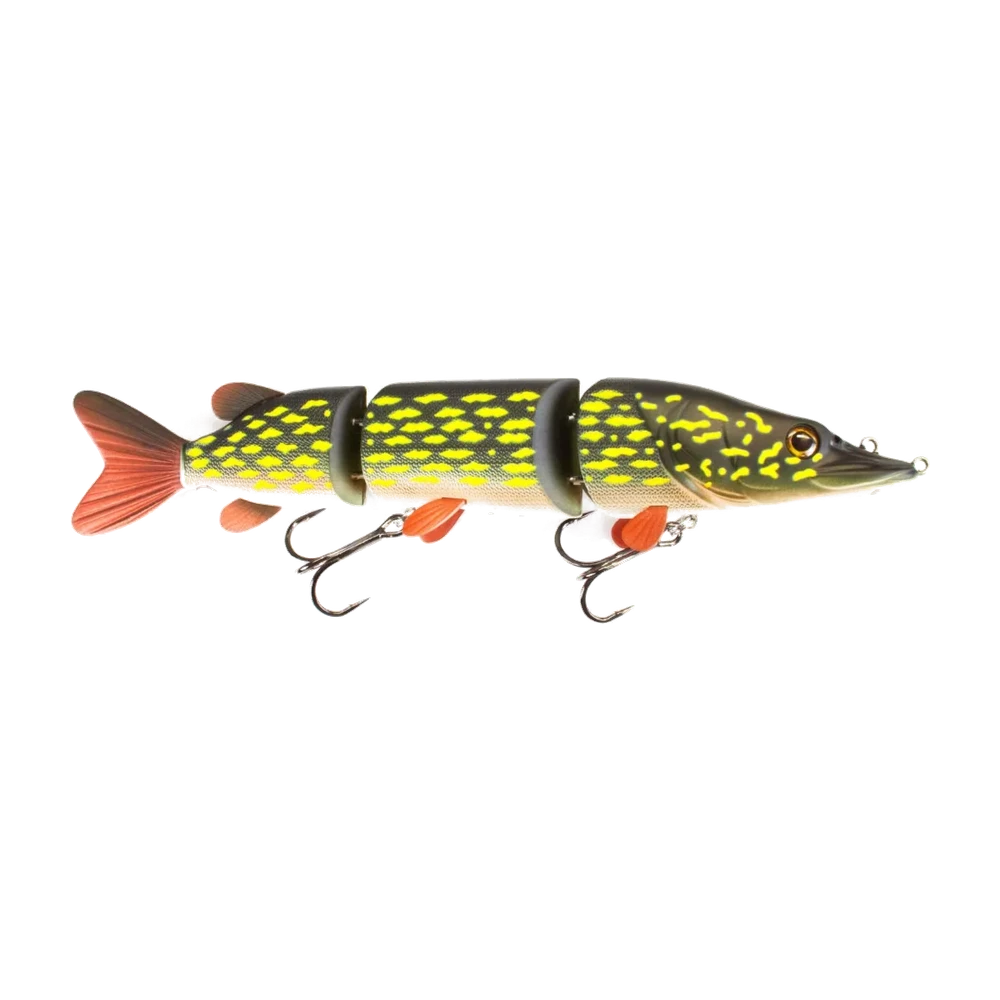
This lure shines under specific conditions. CarnaFish tells you in 10 seconds if today is one of them.
There is an uncomfortable truth for anyone chasing big pike: the largest predator in a water body often eats its own young. Cannibalism is not an accident in this species, it is a diet. From there, presenting a lure shaped like a 20 cm jack pike is not gratuitous provocation — it is simply serving the fish what it already eats. Westin's Mike the Pike is built on exactly that idea.
Why imitating a jack pike works
A good-sized pike spends a lot of energy moving. It therefore selects profitable prey: few chases, plenty of calories. A jack pike of 15 to 25 cm ticks both boxes, and it is present wherever the species spawns. A lure that reproduces that silhouette — deep body, dark marbled back, fins set well back — sends a signal the predator identifies instantly, without having to think.
That explains a pattern often observed with this type of lure: fewer bites over a day, but a markedly higher average size. You stop fishing for numbers and start fishing for the fish that counts.
The sizes and what they really imply
Mike the Pike spans a very wide range, from an entry format around 14 cm up to versions beyond 25 cm. The choice is not just a matter of ambition:
- 14 to 17 cm: the learning format. It casts with a standard big-lure rod, causes little fatigue, and takes average pike as readily as big ones. This is where to start.
- 18 to 22 cm: the most effective compromise on most European waters. Bulky enough to filter out small fish, reasonable enough to cast all day.
- 24 cm and up: for large waters known for very big fish, with dedicated tackle. On an average water, this size cuts your bite count drastically with no guarantee of compensation.
Field rule: the right size is not the biggest you can cast, it is the biggest you can cast properly for four hours. A sloppy end-of-day cast puts the lure anywhere and wrecks your wrist.
Densities: the lure's real setting
More than size, density determines where the lure works. Mike the Pike comes in floating, slow sinking and sinking versions.
The floating version
It rises during pauses. This is the option for shallow weed beds and margins: you can pause above an obstacle without snagging, and the slow rise often triggers a pike that had been following without committing.
The slow sinking version
The most versatile. It holds 1 to 2 m on a straight retrieve and drops gently on the stop, giving the fish time to attack on the pause. This is the density to pick if you only take one.
The sinking version
For deep drop-offs and hole edges, or in strong wind when you need to keep contact. It demands a clean bottom: on the pause it drops fast and finds whatever is down there.
The retrieve: the less you do, the better
A jointed swimbait works on its own. The whole difficulty lies in not preventing it from doing so.
- Slow, steady straight retrieve: the baseline. A constant retrieve is enough to set the segments moving and produce the S-glide.
- Straight retrieve with pauses: two or three metres of swimming, then a one to three second stop. On the pause the lure tips slightly onto its flank — that is where most attacks happen.
- The direction change: one firmer quarter-turn of the handle, then back to the normal rhythm. That offset mimics prey spotting danger, and is often enough to convince a follower.
What not to do: work it with the rod tip like a jerkbait. Sharp snaps desynchronise the segments and turn the swimming action into a series of incoherent jerks.
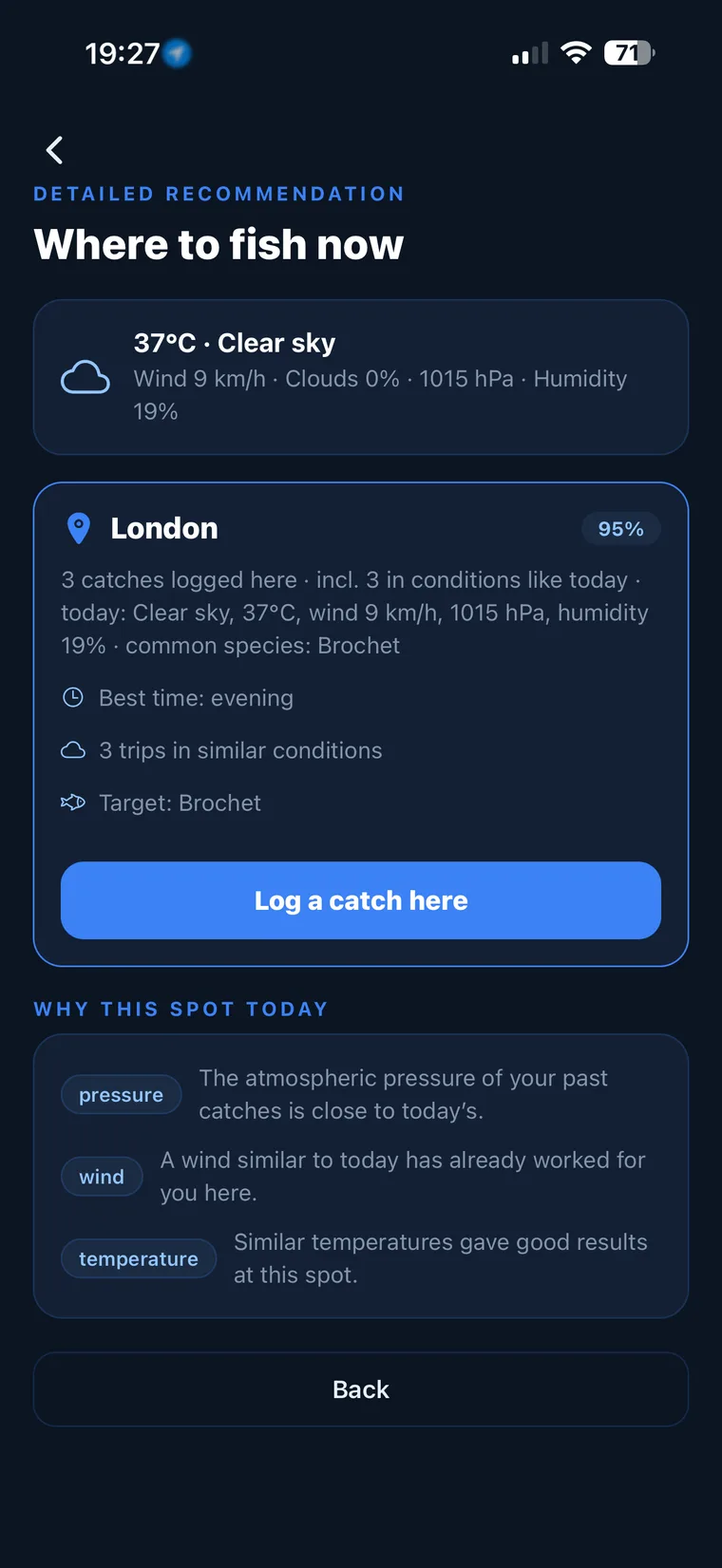
Not sure what to tie on?
Photograph your spot: CarnaFish reads the scene, cross-checks the conditions and gives you the zone, the lure and the retrieve. Free on iOS and Android.
Rigging: where you do not cut corners
A 150 g lure cast and retrieved all day applies mechanical stress unrelated to that of a 20 g lure. Three points to check:
- The leader: steel or titanium, no discussion. Even heavy fluorocarbon does not survive the teeth of a pike committing to prey this size.
- The snap: heavy-duty, and replaced as soon as it shows play. It is the cheapest part of the rig and the most frequent cause of a loss.
- The stock hooks: they are sized for the lure's load. Downsizing them for subtlety is a mistake — the weight of the body mid-attack is enough to open an undersized treble.
Where and when to use it
Mike the Pike is at its best on spots where a big pike sits in ambush: deep weed edges, submerged trees, sharp drop-offs, bay entrances. It is markedly less relevant for fast searching over large areas, where a lighter lure covers more ground for less effort.
Season matters too. Autumn and early winter, when pike feed up before the cold and the year's jacks reach a worthwhile size, are when this type of lure makes the most sense. Our complete pike lure guide covers that seasonal logic.
And to know whether the spot in front of you justifies a swimbait this size rather than a searching lure, CarnaFish analyses a photo of the place and suggests a lure family matched to the vegetation and depth it sees.
Key points
- Imitating a jack pike is not a gimmick: cannibalism is normal pike behaviour.
- Start at 14-17 cm, move to 18-22 cm once the casting stroke is grooved.
- Density matters more than size: slow sinking is the most versatile.
- Work it from the reel, never the rod tip, and use the pauses.
- Steel leader, heavy snap, stock hooks kept.
FAQ
Do I need a special rod for Mike the Pike?
For 14-17 cm formats, a big-lure rod rated 40-80 g is enough. Beyond 18 cm you need a dedicated swimbait rod (80-150 g or more) and a robust reel, otherwise casts become inaccurate and fatigue sets in fast.
Which version should I choose if I only buy one?
The slow sinking in around 18 cm: it holds depth on the retrieve, drops gently on pauses, and suits most margin and drop-off spots.
Why does my swimbait not glide in an S?
Almost always because it is worked too fast or with the rod tip. Slow down, switch to a strictly steady reel retrieve, and let the segments do the work.
Does this lure also catch average pike?
Yes, especially in 14-17 cm. It is not unusual to see a 60 cm pike attack a lure almost as long as itself — which is precisely what makes this kind of presentation credible.
Is a fluorocarbon leader enough?
No. On a frontal attack of a lure this size the pike engages deeply and its teeth cut fluorocarbon, whatever the diameter. Steel or titanium only.
What is the best period for this type of lure?
Autumn and early winter, when pike build reserves and the year's jacks have reached a size that makes them profitable prey.
The full pike lure guideSeason-by-season strategy: which family of lure, when, and why.Go from theory to fish
CarnaFish reads your spot from a photo and gives you the game plan: zone, lure, retrieve. Free on iOS and Android.