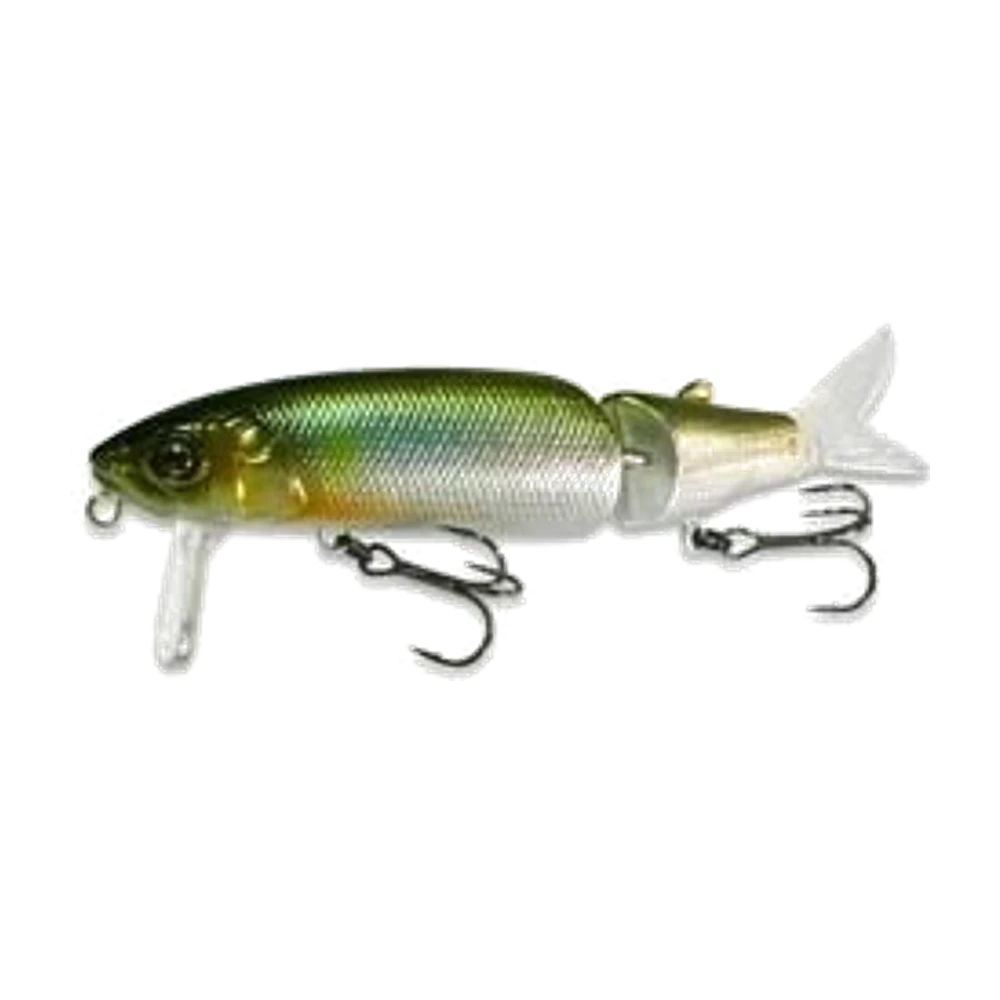
Illex Magallon: the jointed swimmer you fish on the handle alone
The right lure in the wrong spot still catches nothing. CarnaFish spots the zone that works, from a single photo.
There are days when anything moving fast gets refused. The pike follows, settles a metre behind the lure, and turns away. You slow down, but your soft plastic loses its action at low speed and your hardbait starts swimming off-kilter. The problem is not speed in itself: it is that most lures stop living when you slow them down.
A jointed body changes that equation. Because the swim comes from the oscillation between two segments rather than from pressure on a lip, the action still exists at a speed where a one-piece lure is dead. The Magallon exploits that fully: this is a lure you wind in on the handle, slowly, doing nothing else, and it undulates along its whole length the entire way.
If you already know the small model in the range, the heart of this page comes down to one question: what does the bigger size actually bring?
What moving up to the full size changes
The Tiny Magallon runs around 8.8 cm for roughly 7 g. The Magallon goes up to 11.3 cm for close to 14 g. It is not just a bigger lure: three things shift.
Swim amplitude. On a jointed body, the sideways travel of the tail depends on segment length. The bigger size traces a wider, slower S. The Tiny shimmies; the Magallon undulates. To the eye the difference is obvious in the last two metres before the bank.
The target. The Tiny is a lure for perch, chub and small bass, used on clear water and wary fish. The Magallon crosses a threshold: at 11 cm it becomes credible prey for a decent pike, and a lure for adult bass rather than for fish of the year.
Workable conditions. Seven grams is a lure that becomes unusable the moment there is wind, and that caps casting distance at fifteen metres or so. Fourteen grams gives you twenty-five to thirty metres and real tolerance to a crosswind. On a big water that is not a detail, it is the difference between fishing and watching.
What the Tiny keeps for itself, though, is delicacy. On very clear water, on pressured venues or on small fish, the little size stays ahead. The two complement each other, they do not replace each other.
The slow straight retrieve: why doing nothing works
On this lure, the most productive retrieve is also the dullest to describe.
- Cast along a structure: a weed edge, a fallen tree, a line of jetties. The Magallon fishes parallel to a margin, not across it.
- Start winding immediately, before the lure sinks.
- Turn the handle very slowly and very steadily. About one turn per second on a standard reel, sometimes less. You should feel a continuous, muted, regular vibration.
- Give no twitches. None. The jointed body already supplies all the action the lure needs.
- Stop dead every five or six metres, for one to two seconds. The lure tips onto its flank and rolls slightly: a powerful trigger on a follower.
- Slow down further over the last three metres and work a figure of eight with the rod if you see a fish behind it.
Rod position sets the depth: rod high and the lure works in the top forty centimetres; rod low, tip at water level, and it drops towards a metre. You do not need to change model to change layer.
On the water: if a pike follows without taking, change neither speed nor lure. Stop the retrieve completely and let the Magallon tip onto its flank for two seconds. Nine followers out of ten are waiting for exactly that signal — prey that seems to give up. Speeding up only confirms to the pike that it will never catch it.
Settings and rigging
| Parameter | Effect on the fishing |
|---|---|
| Rod held high during the retrieve | Swims at 30-40 cm, above the weed |
| Tip at water level | Swims at 1 m, along drop-offs |
| 0.30 mm fluorocarbon | Standard compromise, good transmission |
| 30 cm supple wire leader | Compulsory for pike, limited impact on the action |
| Heavy snap at the nose | Avoid: it restrains the front segment's oscillation |
| Stock trebles swapped for heavier ones | The lure sinks and loses its high swim |
One point deserves attention: the central joint is the lure's sensitive part. After several seasons, or after a few pike, play develops and the swim turns uneven. Check the pin regularly, and avoid storing the lure bent in a box that is too small.
Not sure what to tie on?
Photograph your spot: CarnaFish reads the scene, cross-checks the conditions and gives you the zone, the lure and the retrieve. Free on iOS and Android.
Its best ground
The Magallon is a margin lure, in shallow water, in clear to slightly stained conditions.
- Weed beds and lily pads, running the edge, from spring to autumn.
- Sunken timber and fallen trees, passing fifty centimetres off the obstacle.
- Cold early-season water, where slowness is a decisive advantage.
- Educated fish on heavily fished venues that refuse aggressive actions.
It is poorly suited elsewhere: beyond a metre fifty of depth it will not go down; in very murky water its signal stays too discreet and a high-vibration lure takes over; and for covering a big volume quickly, its compulsory rhythm rules it out. Finally, its two exposed trebles make it unusable in dense vegetation.
Magallon, Tiny Magallon or glidebait
Three choices for three different problems.
The Tiny Magallon remains the right call on perch, on very clear water, and anywhere an 11 cm lure scares more than it attracts. Its tighter swim also suits smaller fish better.
The Magallon takes over as soon as you are after pike, need to cast further, or want a wider undulation that reads from a distance.
A glidebait such as the Gan Craft Jointed Claw works in an entirely different register: it does not swim on its own, it glides left and right on twitches you give it, with far wider tracks and a much bulkier profile. It is a provocation lure for big pike, where the Magallon stays an imitative swimming lure.
Our guide to choosing a pike lure places these families relative to each other through the season. And if you are unsure which layer to target when you arrive at a weed edge, CarnaFish analyses a photo of the spot and answers.
Key takeaways
- The jointed body keeps swimming at speeds where a one-piece lure is inert.
- The bigger size brings a wider undulation, real casting distance and access to pike.
- Fish it on the handle alone, no twitches, with one to two second stops.
- On a follower, stop everything: the tip onto the flank triggers better than acceleration.
- A margin lure between 0.4 and 1.2 m; unsuited to depth, murk and dense vegetation.
FAQ
Should you twitch the Magallon?
No. Its joint already produces the whole action. Twitches break the regularity of the undulation and make the swim erratic with no benefit. Turn the handle slowly and steadily, that is all.
What is the difference with the Tiny Magallon?
The Tiny is around 8.8 cm for 7 g, with a tighter swim: a lure for perch and very clear water. The Magallon, at 11.3 cm and 14 g, undulates far more widely, casts considerably further and becomes credible on pike.
How deep does it swim?
Between 40 cm and 1.2 m depending on rod position. Rod high and it stays near the surface; tip at water level and it drops towards a metre. You adjust the layer without changing lure.
Do you need a wire leader?
For pike, yes, a supple model around thirty centimetres. Its impact on the undulation stays limited, unlike a heavy snap at the nose, which clearly restrains the head segment.
Why does the swim turn uneven over time?
Most often because the central joint has developed play, after several seasons or a few pike. Check the pin by hand and avoid storing the lure under strain in a box that is too short.
Does it work in murky water?
Less well. Its signal is visual and its undulation stays discreet. As soon as visibility drops below a metre, a high-vibration lure or a soft plastic with a big paddle covers the ground better.
The full pike lure guideSeason-by-season strategy: which family of lure, when, and why.Go from theory to fish
CarnaFish reads your spot from a photo and gives you the game plan: zone, lure, retrieve. Free on iOS and Android.