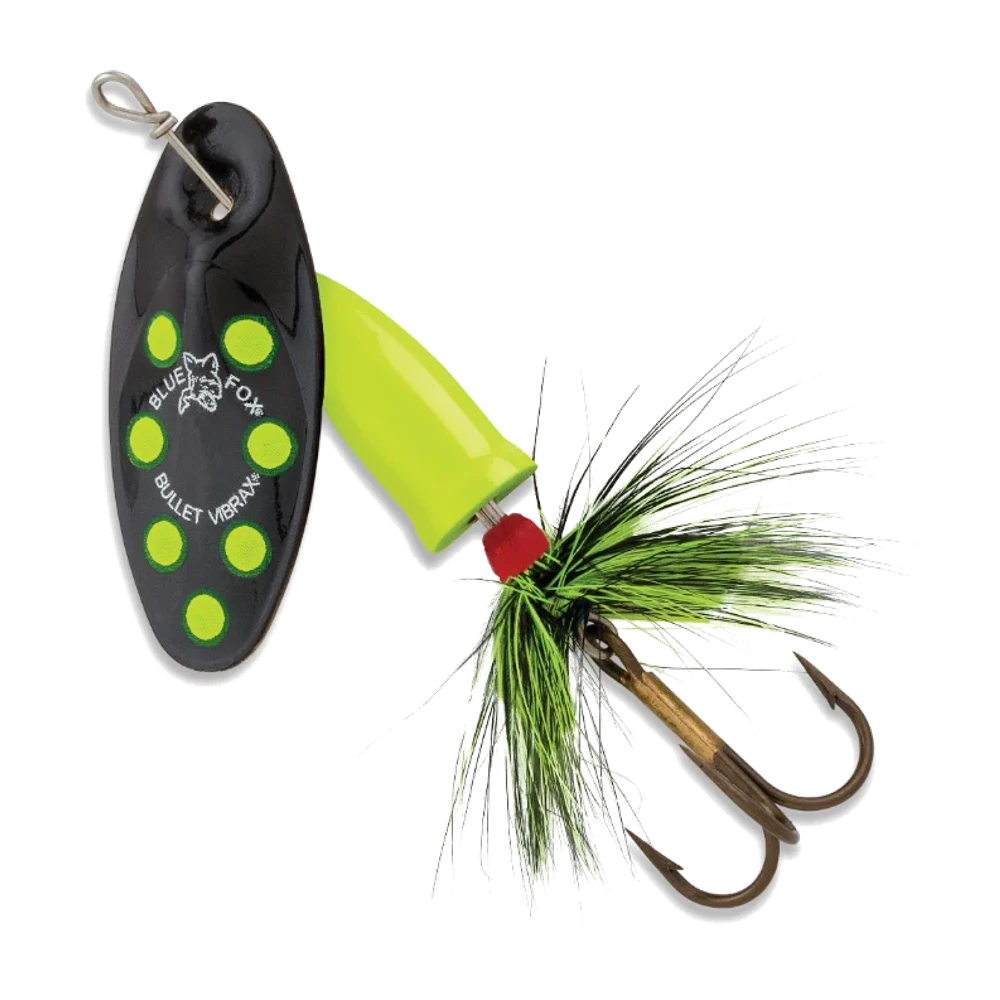
Blue Fox Super Vibrax Bullet: the bullet body that cuts through fast current
Rather not fish it blind? Photograph your spot — CarnaFish cross-checks the conditions and points you the right way.
A deep spring riffle, fifty centimetres of visible water but a current that pushes hard, and a two-metre pool right behind it. You cast your usual spinner: it lifts out halfway across, climbs in the current, and you wind back a lure that spent two thirds of its run near the surface. The fish, meanwhile, stayed on the bottom.
The Vibrax Bullet is Blue Fox's answer to exactly that problem. It keeps the two-part sound body the range is known for, but swaps the wide bell for a machined brass bullet — a narrow, heavy body shaped to cut through a current seam instead of floating on top of it. For the same blade size, it weighs around 30 % more than the standard Vibrax.
This is not a "heavier" version of the same spinner. It is a different trade-off: you gain penetration and distance, and you change the sound signature.
What the bullet body actually changes
Three effects stack up, and it is the combination that makes the model worth having.
- The frontal section is smaller. A bullet body offers far less surface to the current than a bell body. At the same retrieve speed, it is pushed towards the surface much less.
- The mass sits low on the shaft. The lure recovers its balance immediately after knocking into a rock, instead of spinning out for the next two metres.
- The blade turns directly on the shaft, through a wider arc than a spinner with a clevis-mounted blade. That extended arc keeps a strong signal at low speed and out away from the body.
The two-part body stays: the two halves turn against each other and strongly limit how much twist reaches the line. You do not eliminate line twist, but you bring it back to a manageable level for a spinner of this weight.
In return, the bullet offers a smaller sound chamber than the standard Vibrax bell. The sound it puts out is sharper and less deep. In clear moving water that is neutral or even an advantage; in very stained, still water the standard version keeps the edge.
Fishing the riffle and the fast seam
This is the water the model exists for.
- Find the main seam and stand upstream of it, off to the side.
- Cast downstream at about 30 degrees to the bank, into the seam, not past it.
- Let it sink one to three seconds depending on the depth, line slightly tight.
- Start with one firm pull to get the blade turning, then settle into a steady retrieve, just fast enough to feel the vibration continuously in the rod tip.
- Work up the seam in bands, moving your cast a metre towards the centre each pass.
- On the pool below the riffle, stretch the sink to five seconds and slow down: the lure will work at a metre fifty instead of fifty centimetres.
On the water: on a spinner, the right speed is not the one that makes the blade turn — it is the slowest speed at which you still feel it beating clearly in the rod tip. Half a handle turn slower and you lose rotation; half a turn faster and you lose fifty centimetres of depth. Look for that point at every spot, because it moves with the current.
The sizes and where they belong
| Size | Rough weight | Water |
|---|---|---|
| 0 to 1 | 3 to 5 g | Small fast river, small trout, clear water |
| 2 to 3 | 6 to 9 g | Medium river, deep riffle, canal perch |
| 4 | 11 to 13 g | Big river, heavy current, long casts from the bank |
| 5 | 14 to 16 g | Deep pool, high water, settled wind |
A common mistake is to pick the size based on the size of the fish you are after. On this spinner, pick it on current strength and depth: a thirty-centimetre trout takes a size 4 without hesitation in strong flow, and refuses a badly presented size 2.
Where it wins, and where the standard takes over
It dominates in moving, deep water: riffles over a metre, big-river seams, the foot of a weir, and windswept canal margins where you need to cast far. It is also the right call for perch sitting on a drop-off, on a counted drop down the slope.
It loses its point in calm, stained water, where the more generous sound chamber of the standard version carries better. It is also too heavy for a stream under fifty centimetres deep, where it hits bottom before it has swum. And on educated fish in slow gin-clear water, its heavy signal can put them off more than it draws them in.
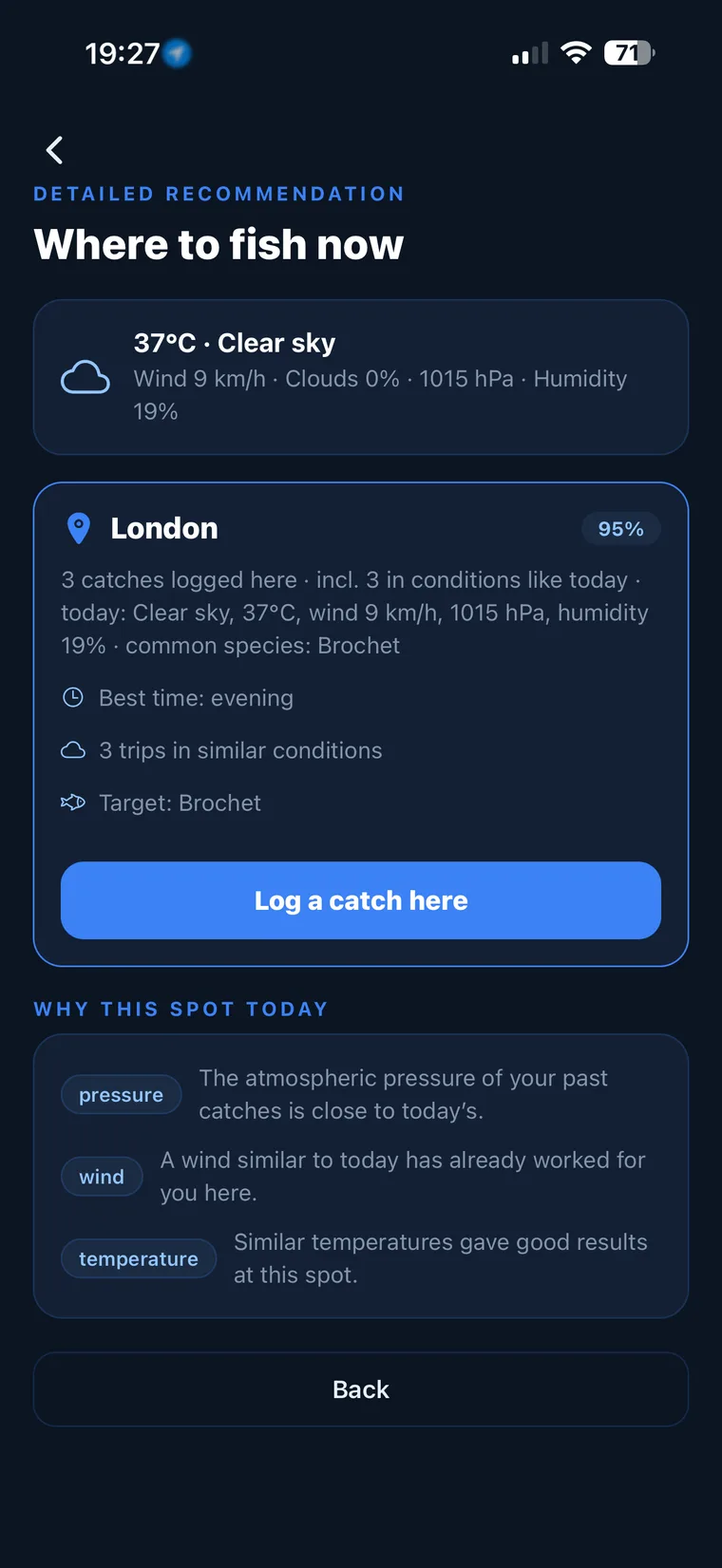
Not sure what to tie on?
Photograph your spot: CarnaFish reads the scene, cross-checks the conditions and gives you the zone, the lure and the retrieve. Free on iOS and Android.
Rigging: the swivel, again
A heavy spinner in strong current generates twist, two-part body or not. Fit a rolling swivel fifty centimetres above the lure, and get into the habit of letting your rig drift without the lure for ten seconds in the current at the end of a session: you will see immediately whether the line has stored twist.
Line of 0.18 to 0.22 mm for sizes 0 to 3, 0.24 to 0.26 mm above that. A small snap is acceptable and makes size changes easy, as long as it stays light.
Bullet or standard Vibrax
This is the only comparison in the range really worth settling.
The Blue Fox Vibrax relies on its bell-shaped sound body: a low-frequency vibration that carries far, particularly effective in stained water and on a slow retrieve across still water. It is the spinner for canals, ponds and slow rivers.
The Bullet trades part of that signature for useful weight and a penetrating profile. It takes over as soon as there is current, depth, wind, or ground to cover.
Against a Mepps Aglia Long, the logic shifts again: the Aglia Long holds current through its narrow blade and reduced rotation angle, while the Bullet holds it through mass and body shape. In very heavy flow the Aglia Long stays better behaved, the Bullet runs deeper. Our guide to river trout fishing covers how to read a riffle. And if you are unsure which size to tie on when you reach the bank, CarnaFish analyses a photo of the spot and answers.
Key takeaways
- Machined brass bullet body: around 30 % heavier than a standard Vibrax of the same size.
- The reduced frontal section stops the lure climbing in the current.
- The blade turns directly on the shaft through a wide arc, which keeps the signal alive at low speed.
- Choose the size on current strength and depth, not on the size of the fish.
- Less relevant than a standard Vibrax in calm, stained water.
FAQ
What is the difference between the Vibrax Bullet and the standard Vibrax?
The Bullet replaces the bell body with a machined brass bullet, around 30 % heavier for the same size. It cuts into current better and casts further, but its smaller sound chamber puts out a sharper sound that carries less well in calm, stained water.
How deep does it run?
Between 0.6 and 2 m on the retrieve, depending on size, speed and current strength. With a three to five second sink before you start, you work it considerably deeper, which is the right method over a pool.
How do I set the retrieve speed?
Find the slowest speed at which you still feel the blade beating clearly in the rod tip. That is the balance point between rotation and depth, and it has to be reset at every spot according to the current.
Does it twist the line?
The two-part body strongly limits how much twist is transmitted, but does not eliminate it, especially in the bigger sizes and in heavy current. A rolling swivel fifty centimetres above the lure remains essential.
Which size for river trout?
Sizes 2 and 3 cover most medium rivers. Drop to a 0 or 1 in clear shallow water, move up to a 4 when the flow gets strong or you need to cast far, even if the fish you are after are no bigger.
Is it any good for perch?
Yes, particularly on gravel-pit drop-offs and canal margins, on a counted drop down the slope followed by a steady retrieve. Sizes 2 and 3 are the most versatile for that job.
The full trout lure guideSeason-by-season strategy: which family of lure, when, and why.Go from theory to fish
CarnaFish reads your spot from a photo and gives you the game plan: zone, lure, retrieve. Free on iOS and Android.