Rublex Ondex: the inline spinner you fish on a countdown
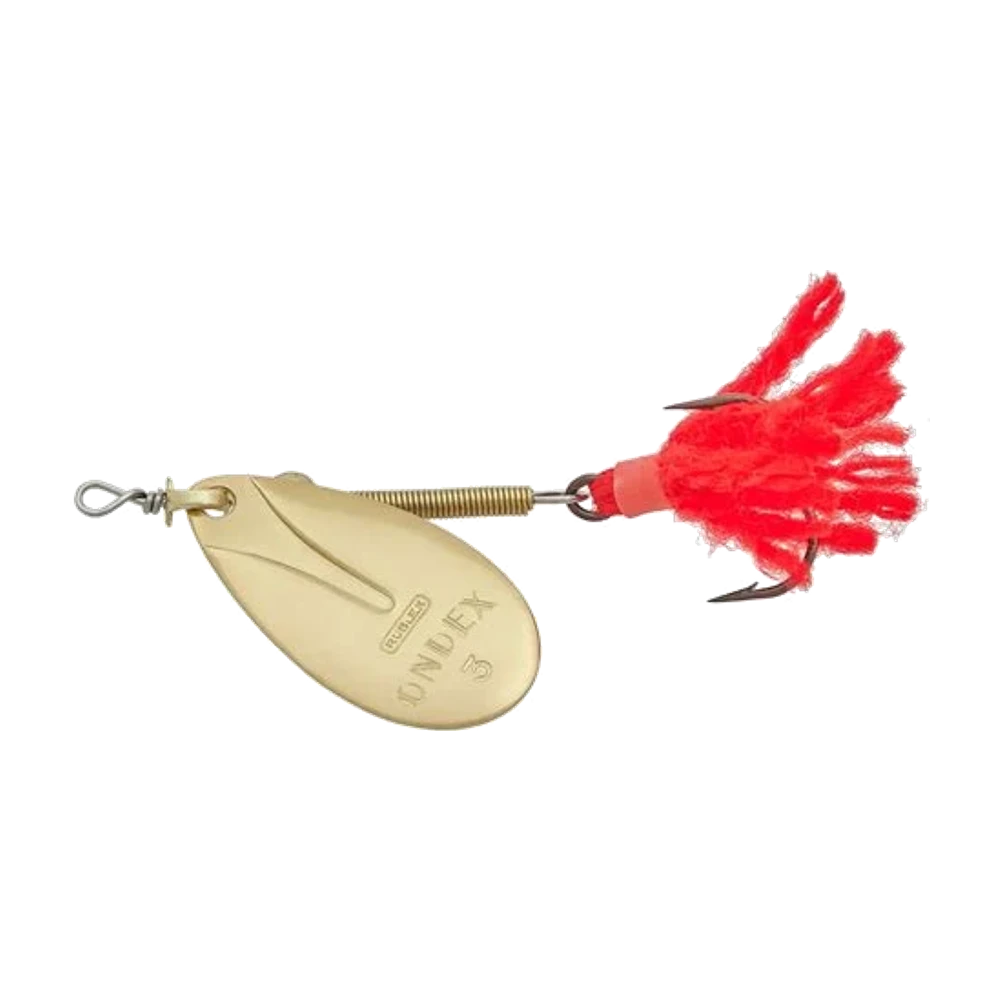
This lure shines under specific conditions. CarnaFish tells you in 10 seconds if today is one of them.
A gravel pit in September, a rocky margin dropping to four metres. The perch are there — you see them scatter when you walk too close. You cast a standard spinner and wind it back: the lure swims forty centimetres under the surface and passes politely above a shoal that has no reason to come up.
A light inline spinner is designed for one specific problem — fishing shallow, often against the current. It cannot go down: its blade generates lift that holds it in the top of the column the moment it moves forward. To reach a perch sitting three metres down in still water, you need a weighted spinner and a different way of fishing it.
That is the Ondex's niche: a spinner whose metal body concentrates enough mass to sink properly, and whose blade stays engaged through the fall if you guide it correctly.
A spinner that agrees to go down
On a spinner, the body does two jobs: providing casting weight, and acting as a shaft for the blade. The Ondex pushes the first role much further than average.
- Mass concentrated in the body, not in the blade. The lure sinks nose down, steadily, without gliding sideways the way a casting spoon does.
- A blade that starts over a very short distance. One or two turns of the handle are enough to get it going. That matters: fishing on the drop, you do not have the distance to "kick-start" a reluctant lure.
- A tight, continuous vibration, very different from the slow thump of a wide blade. It transmits clearly up the line, letting you know at all times whether the lure is working — essential when it is three metres beneath you and invisible.
The trade-off: on a slow, high straight retrieve it is less alive than a light spinner. That is not its ground.
The helicopter drop, step by step
This is the presentation that makes the lure different. The aim is to keep the blade turning through the fall, producing a continuous signal where most lures go silent on the way down.
- Cast parallel to the margin, not perpendicular to it. You want to run along the drop-off, not cross it in one second.
- As soon as the lure lands, close the bail and lift the rod to forty-five degrees to put a slight tension on the line.
- Let it sink with the line semi-tight and count the seconds. The weight of the body drives the fall while the blade turns slowly on the shaft. You should feel a faint tremble in the rod tip: that is it.
- Cut the descent at your chosen number and give two quick turns to engage the blade fully.
- Retrieve slowly and steadily over five to ten metres, then add a two-second stop.
- Repeat the cycle all the way in, changing the count on every cast until you find the right layer.
On the water: when you find the depth that produces, do not record it in metres, record it in seconds of sink and turns of the handle. That is the only reproducible setting from a bank where you cannot see the bottom. Two anglers side by side with the same lure can end up three to one apart simply because one counts and the other does not.
Which size for which layer
| Size | Approximate weight | Target layer | Fish |
|---|---|---|---|
| Small | 3 to 5 g | 0.5 to 1.5 m | small perch, small-lake trout |
| Medium | 6 to 9 g | 1.5 to 3 m | decent perch, reservoir trout |
| Large | 10 to 14 g | 3 to 4 m and beyond | big perch, long-range searching |
A rolling swivel is not optional on this lure. A blade turning continuously on the drop and on the retrieve twists line very fast. Put it around forty centimetres from the spinner, and check your line every half hour: as soon as it starts looping when slack, the swivel is tiring.
Not sure what to tie on?
Photograph your spot: CarnaFish reads the scene, cross-checks the conditions and gives you the zone, the lure and the retrieve. Free on iOS and Android.
Its good spots, and the ones where it has no business
Its ground:
- Rocky margins and gravel pit banks, where depth goes from one to four metres over two metres of distance.
- Ponds and currentless lakes, in late summer and autumn, when perch gather in shoals on a specific point.
- Harbours and river basins, along the quays and under jetties.
- Trout reservoirs, to reach fish that are no longer near the surface.
Its blind spots:
- Small trout streams: too heavy, it ploughs the bottom and snags on every cast.
- Strong current: the mass of the body and the drag of the blade fight each other, the action turns unstable and the line bellies out.
- Fast surface fishing: at speed it rises and turns poorly.
- Dense weed: the blade collects everything.
Ondex or Celta: two Rublex, two jobs
The Rublex Celta is the narrow-stream spinner: light, it starts in thirty centimetres of water and is fished almost always upstream, in current, on spots you cover in three casts before moving on. Its strength is instant response in very little water.
The Ondex takes on exactly the opposite problem: still water, depth, distance. It does not replace the Celta on a river — it would be too heavy and would snag — but it opens up a layer the Celta will never reach. If you mostly fish ponds and gravel pits, this is the one you want; if you mostly fish streams, stick with the Celta.
In the same box, the Rublex Veltic fills a third niche, that of big-river trout and fan-casting at constant speed. Our guide to lure fishing for perch covers how to locate a shoal before choosing your depth. And if you are unsure which layer to target from a margin, CarnaFish analyses a photo of the spot and answers.
Key takeaways
- Heavy body, blade that starts fast: this is the spinner that agrees to go down.
- Fish it on a counted drop, line semi-tight, blade trembling through the fall.
- Record your settings in seconds of sink and turns of the handle, not in metres.
- Its niche: still water, rocky margins, autumn perch shoals, reservoirs.
- A poor choice in streams, in strong current and over dense weed.
FAQ
How deep can you fish an Ondex?
Down to three or four metres with the larger sizes, provided you count the drop and keep the line semi-tight. In the small size you stay within the first metre and a half, which is plenty for perch along a margin.
How do I stop the line twisting?
A quality rolling swivel forty centimetres from the lure, and a regular check on the line. A spinner with a continuously turning blade twists line more than a casting spoon: if your line loops when slack, change the swivel rather than the line.
What size Ondex for perch?
The medium size, around 6 to 9 g, is the best compromise: heavy enough to reach two or three metres, discreet enough not to spook a shoal. Go bigger only if you need to cast much further.
Is the Ondex suitable for trout streams?
No, it is the wrong tool. Its weight makes it dive and snag in very little water, where a light spinner such as the Celta starts instantly and stays high. Keep the Ondex for calm, deep water.
Should I retrieve fast or slow?
Slowly and steadily, just fast enough to feel the blade vibrating in the rod tip. Speeding up brings nothing with this lure: what makes the difference is the depth you reach before you start the retrieve.
Can it be fished vertically from a boat?
Yes, alternating guided drops and lifts of two or three metres along a steep bank. The blade turns on the way up and trembles on the way down, giving you two different signals within one cycle.
The full trout lure guideSeason-by-season strategy: which family of lure, when, and why.Go from theory to fish
CarnaFish reads your spot from a photo and gives you the game plan: zone, lure, retrieve. Free on iOS and Android.