Mepps Aglia Long: the inline spinner that holds in current
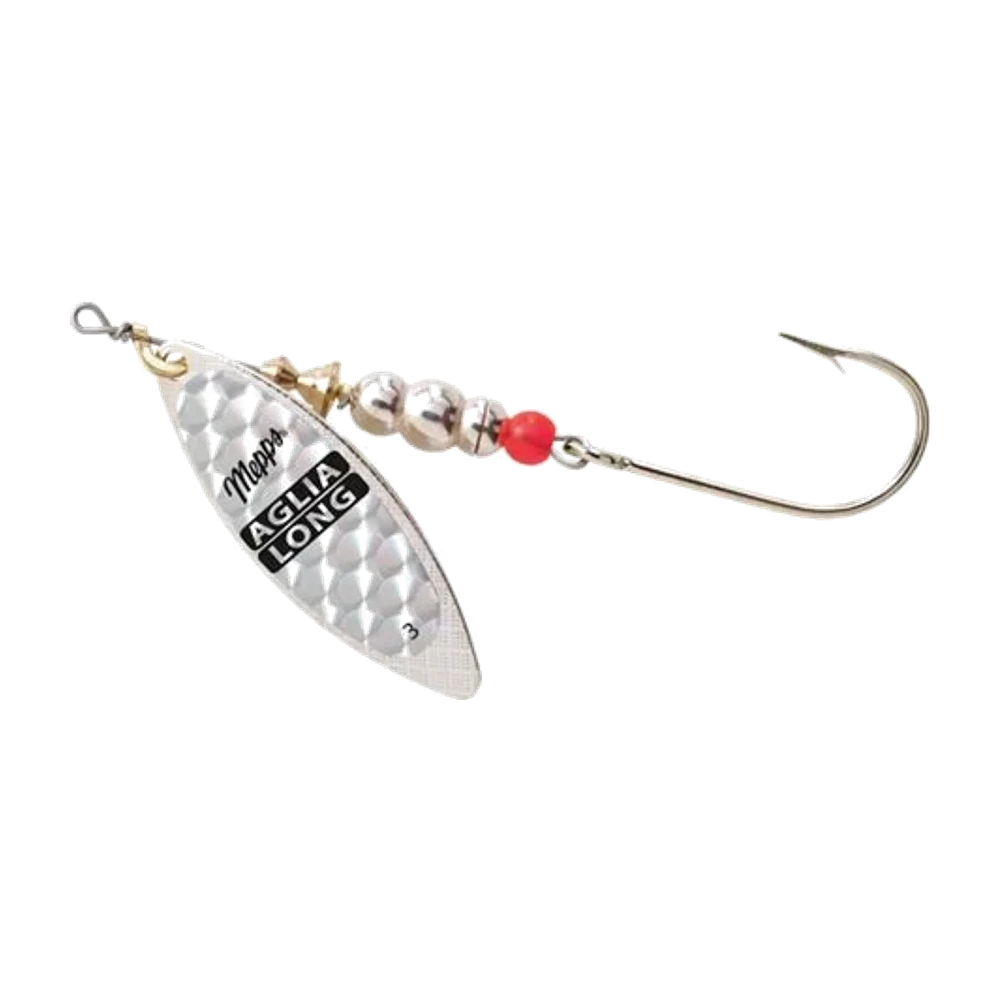
One lure, endless conditions. CarnaFish reads your spot from a photo so you are not just guessing.
A river at medium level after a storm, a current pushing hard, and an inline spinner that rides irresistibly up towards the surface the moment you slow down. You watch it skipping in the seam, rolling onto its side, coming back scratching the surface — and you catch absolutely nothing, because the trout is sitting on the bottom, a metre fifty below all that circus.
That is the fundamental problem with a round-bladed spinner: it generates an enormous amount of lift. That is precisely what makes it effective in slow water, and it is what makes it unusable as soon as current adds itself to your retrieve speed.
The elongated blade exists for that. It is not a cosmetic variation on the classic Aglia, it is a different mechanical setting that shifts the lure's entire operating window.
Thirty degrees instead of sixty
A round blade swings out from the shaft to an angle close to 60°. It pushes a lot of water, produces a heavy, low-frequency vibration, and above all it behaves like a wing: it pulls the whole rig upwards.
The Aglia Long's elongated blade rotates much closer to the shaft, around 30°. The consequences are direct:
- Less lift. The spinner drops and stays in the layer you are targeting, even on a fast retrieve.
- Less felt resistance. You feel the lure less in the rod, which is disconcerting at first, but you can speed up without it stalling.
- A different signal: flash takes over from vibration. Where the round Aglia makes itself heard, the Aglia Long makes itself seen.
- A slimmer silhouette, closer to a minnow or an elongated fry than to an insect or a stocky fish.
The window: current, depth, fast water
The Aglia Long's natural ground is everything that gives the round Aglia trouble.
Fast current seams, where the spinner has to stay inside them rather than above. Holes of two metres and more, where you want to reach the bottom before the lure is already halfway home. Big riffles in high spring water, where the trout holds behind the boulders and will not come up for a lure near the surface.
It is also the spinner for fast searching in lakes: on perch, a Long retrieved quickly and without pauses provokes decisive chases where a round blade with a heavy vibration ends up boring the fish of a school that has already been worked over.
The retrieve: three passes per spot
- Find the spot and cast upstream, never downstream. The spinner has to reach the fish drifting, not swimming up at it.
- Count the sink. About one second per thirty to fifty centimetres, depending on size. On a spot a metre fifty deep, count three to four seconds before starting.
- Start the blade with one sharp turn of the handle, then go immediately to a steady retrieve, slightly faster than the current.
- Make a first pass high, a second at mid-depth by letting it sink longer, then a third right along the bottom, retrieving at the rotation threshold.
- At the end of the drift, let the spinner make its natural arc in the current without touching the speed. Plenty of bites come as it swings round and shows its flank.
On the water: with an elongated blade, you barely feel the lure turning at all. Do not conclude that it is not turning and do not speed up to "feel it". The reliable reference is visual: over the first few metres, watch it under the surface once per spot to calibrate the minimum speed, then fish blind at that speed.
Which size for which spot
| Size | Indicative weight | Ground |
|---|---|---|
| No. 0 to No. 1 | 2.5 to 4.5 g | Small streams, low clear water, small trout and small perch |
| No. 2 | 5 to 6 g | Medium rivers, riffles, the most versatile size |
| No. 3 | 7 to 8 g | Strong current, 2 m holes, high water |
| No. 4 and up | 10 g and up | Big rivers, real depth, schooling perch in lakes |
The most useful reflex: do not change colour when it is not working, change size. Going from a No. 3 to a No. 2 while keeping the same finish changes the depth, the rotation speed and the silhouette all at once.
Not sure what to tie on?
Photograph your spot: CarnaFish reads the scene, cross-checks the conditions and gives you the zone, the lure and the retrieve. Free on iOS and Android.
What it does less well
Let us be clear: the Aglia Long is not a better Aglia, it is a different spinner.
- In slow, cold water, it is too discreet. A round blade churning water stays superior when you have to wake up an apathetic fish.
- In very murky water, its signal is essentially visual. Without visibility, it goes unnoticed.
- In very short spots, it needs slightly more distance to start cleanly than a spinner designed to fire up instantly.
- On pike, the absence of a strong leader rules it out: the fine line that goes with these sizes does not forgive.
Aglia Long or round Aglia
The Mepps Aglia No. 3 remains the better choice in calm water, early in the season on inactive fish, and whenever the vibration has to carry through dirty water. Its round blade calls from a distance in a way the Long does not.
The Aglia Long takes over as soon as the current pushes, as soon as you need to get down, and as soon as you want to retrieve fast. Over a single day on a river, it makes sense to carry both: the round one for slow pools and margins, the Long for the seams and the holes.
In a very tight stream, neither beats the Smith AR-S Spinner, whose blade fires up within a few centimetres. Our guide to river trout fishing explains how to work through these spots one after another. And if you are unsure what size to tie on when you reach a current seam, CarnaFish analyses a photo of the spot and answers.
Key takeaways
- An elongated blade turning at around 30°: less lift, more depth, more flash.
- This is the spinner for strong current and deep holes, not for slow water.
- You barely feel it in the rod: set the speed by eye once per spot, then fish blind.
- Change size before you change colour: it is the most effective adjustment.
- A rolling swivel is compulsory, even though it twists less than a round blade.
FAQ
What is the difference between the Aglia and the Aglia Long?
The blade shape. The round Aglia turns at a wide angle of around 60° and produces plenty of vibration and lift; the Aglia Long turns at around 30°, runs deeper, handles current better and plays on flash rather than vibration.
Does the Aglia Long suit beginners?
Yes, with one caveat: you feel it far less in the rod. A beginner tends to speed up to sense the rotation, which makes it run too high. Check by eye once how fast it turns, then hold that rhythm.
What size should you choose for river trout?
No. 2 covers most medium-sized rivers. Drop to No. 1 or No. 0 in low clear water, go up to No. 3 in high water, in strong current, or when fishing holes of two metres and more.
Do you need a swivel with an inline spinner?
Yes, always. Even though the Aglia Long twists less than the round one thanks to its reduced rotation angle, the torque exists and eventually twists the line. A small rolling swivel is enough, set thirty or forty centimetres up.
Can you retrieve it fast?
That is precisely its advantage. Where a round blade comes out of the water when you speed up, the Long keeps its rotation and its running depth. That is what makes it usable for fast searching on perch.
Does it work in stained water?
Less well. Its main signal is flash, so visibility. In dirty water, a round blade vibrating hard, or a lure with a wide vibration, will cover the ground better.
The full trout lure guideSeason-by-season strategy: which family of lure, when, and why.Go from theory to fish
CarnaFish reads your spot from a photo and gives you the game plan: zone, lure, retrieve. Free on iOS and Android.