Booyah Buzz: the clacker buzzbait that planes from the first turn
This lure shines under specific conditions. CarnaFish tells you in 10 seconds if today is one of them.
First light, the back of a pond dotted with scattered lily pads, and that little outboard-motor sound moving away through the calm. Then nothing: a hole in the water, the line coming tight, and a bass heading for the weeds. A buzzbait doesn't touch many fish in a day, but it touches the right ones, and it does it inside a very short window. The Booyah Buzz is built to exploit that window.
Planing right away is 80% of the problem
A buzzbait only fishes while it stays on top. The classic flaw in this family is a bait that needs two metres of fast retrieve before the blade spins up and lifts the body: during those two metres, the lure is under water and does nothing. Multiply by a hundred casts and you've lost two hundred metres of water, usually in the best stretch — the one against the bank or the edge of the grass.
Booyah makes two specific points: the blade planes quickly and the bait runs true out of the package. The second matters as much as the first. A buzzbait with a slightly tweaked arm runs off to one side, lies down on a flank and loses half its noise. Out of the pack, the Booyah Buzz holds its line, which saves you the pliers session before the first cast.
The practical upshot: you can start reeling the instant it lands, or even start the handle half a second before impact, and the lure fishes from the first centimetre. On a cluttered bank, that is exactly where you want it working.
The clacker, a second sound signal
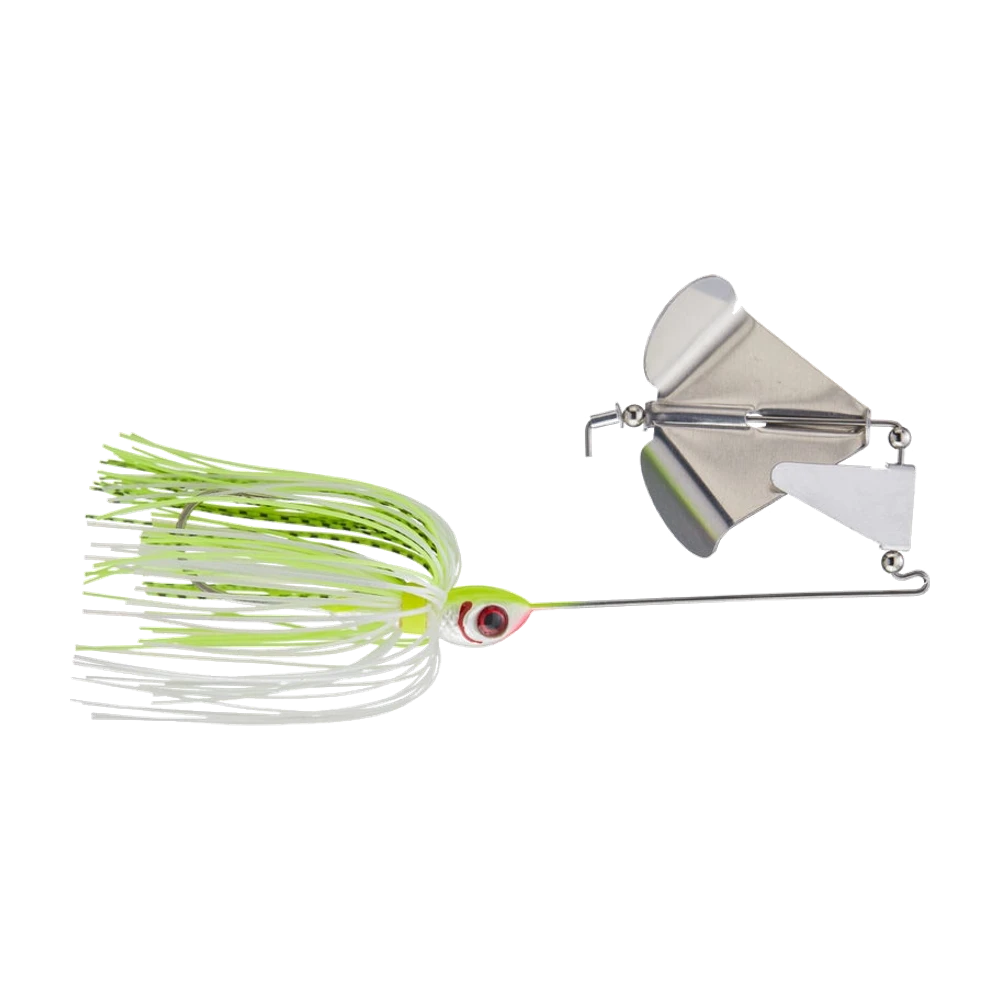
Most buzzbaits make one sound: the blades churning the surface. The Booyah Buzz makes two. A small metal plate is fitted on the wire just behind the blade, and every vane strikes it as it passes. The result isn't a louder noise, it's a different one: a sharp, rhythmic clack layered over the sizzle of churned water.
That detail matters on two kinds of water. In stained water or in grass that deadens everything, the clack carries further than the sizzle and pulls in fish that would never have located the bait. On heavily fished water, it's a sound signature bass haven't yet learned to associate with danger, unlike the standard buzz of a plain model.
The clacker wears in. A brand-new buzzbait clacks less than one with ten trips on it: the friction cuts a slight groove in the plate and the contact gets crisper. Don't bin a tired Booyah Buzz — it has often become the best one in the box.
Speed is the only real adjustment
There's nothing to work on a buzzbait, and that's the trap. The only parameter you control is retrieve speed, and the right answer isn't "fast". The right answer is the slowest speed that keeps the blade on top. Slow down until the lure starts to sink, then come back up one notch. At that speed the bait spends longer in the strike zone, the sound is deeper, and the fish has time to catch up with it.
Two variations are worth trying. The first is running the lure into something hard — a stake, a branch breaking the surface, the edge of a dock — and letting it hit squarely. The stumble it causes often triggers a strike within the second. The second is a quarter-second stop with the handle locked: the bait falters, barely sinks, and takes off again. That's brutal on a fish that was following without committing.
The mistake that costs the most fish
Setting on the sound. A buzzbait strike is spectacular, and the reflex is to set the moment you see or hear it. Half the time the fish has missed the lure or doesn't have it in its mouth yet: you pull the buzz away from its nose. The right method is mechanical — keep reeling at the same speed until you feel the fish's weight in the rod, and only then set. It takes discipline, but the gain over a season is huge.
Not sure what to tie on?
Photograph your spot: CarnaFish reads the scene, cross-checks the conditions and gives you the zone, the lure and the retrieve. Free on iOS and Android.
Rigging, line and hook
The Booyah Buzz comes on a 5/0 Mustad Ultra Point: heavy wire and a wide gap. That fits the fishing involved — you set through a 55-strand skirt, often in vegetation, with a line already loaded by the blade's drag.
For line, 20-30/100 braid is the default. It doesn't stretch, which compensates for the fish being a long way off at the set, and it floats, which helps the lure stay up. Avoid fluorocarbon here: it sinks and pulls the nose down. The rod needs backbone, medium-heavy to heavy, with a tip that isn't too stiff so the hook doesn't tear out during the fight.
And if pike are around
A buzzbait over shallow grass pulls pike too, especially in late summer on shoreline flats. The problem is obvious: a thin steel arm offers no protection against those teeth, and a pike strike on this kind of bait very often ends in a clean cut above the hook. If you're fishing a spot known to hold them, add a supple 20-30 cm wire leader. You lose a little finesse, but you don't leave a lure in a fish's mouth.
Plenty of anglers also add a trailer treble on the shank. It does raise the hook-up rate on short strikes, but it turns the lure into a weed magnet: keep it for genuinely open flats, and check what the local rules allow before changing the hardware.
Colour by light and water
- Stained water or grey dawn: white and chartreuse, the combination in the photo. Chartreuse stays readable in loaded water and white gives the silhouette volume seen from below.
- Clear water, overcast sky: plain white, imitating a small baitfish without visual overload on a wary fish.
- Dusk and nightfall: black. Seen from underneath against a still-bright sky, a black silhouette reads far better than a bright colour, and that outline is all the fish really perceives.
A buzzbait doesn't forgive a misread spot: too deep, too open, too late in the morning, and nothing happens. That's exactly what CarnaFish helps settle — a photo of the spot, and the app suggests the zone and the lure family that fit the hour and the conditions. To build the basics, our beginner's guide to bass fishing covers spots and tackle. And when fish refuse loud topwater, a switch to a Booyah Pad Crasher over thick vegetation, or back under the surface with a Booyah Covert Spinnerbait, often takes over.
Key takeaways
- The blade planes on impact: the lure fishes from the first centimetre, which changes everything near the bank.
- The clacker plate adds a sharp knock to the usual sizzle, useful in stained water and on pressured fish.
- The right speed is the slowest that keeps the blade on top, not the fastest.
- Never set on the sound — set on the weight you feel in the rod.
FAQ
What Booyah Buzz weight should I pick?
The maker doesn't publish a detailed weight chart in its copy. Work from wind and distance: a lighter model planes more easily and suits calm pockets, a heavier one casts better into wind but needs a little more speed to stay on top.
When does a buzzbait work best?
In the first hour after daybreak and the last before dark, when light is low and bass move up onto the flats. Under cloud and a light ripple, the window can hold through much of the day.
Why does my buzzbait sink instead of staying on top?
Either you're reeling too slowly, or you're fishing fluorocarbon, which sinks and drags the nose down. Switch to floating braid and go up a notch in speed until the blade churns continuously.
What exactly does the clacker do?
It's a metal plate the blade vanes strike on every rotation. It adds a sharp knock to the sizzle of churned water, helping fish locate the bait in stained water or in grass that absorbs sound.
Do I need a wire leader with a buzzbait?
Only if the spot holds pike. The lure's thin arm protects nothing, and a strike usually ends in a clean cut. On a pure bass pond, braid alone is enough and stays more discreet.
Can I add a trailer treble?
Yes, and it lifts the hook-up rate on short strikes, but the lure loses its weedless character and collects everything floating. Keep that option for open flats, and first check what the local regulations allow.
The full bass lure guideSeason-by-season strategy: which family of lure, when, and why.Go from theory to fish
CarnaFish reads your spot from a photo and gives you the game plan: zone, lure, retrieve. Free on iOS and Android.