Booyah One Knocker: the lipless that thuds instead of rattling
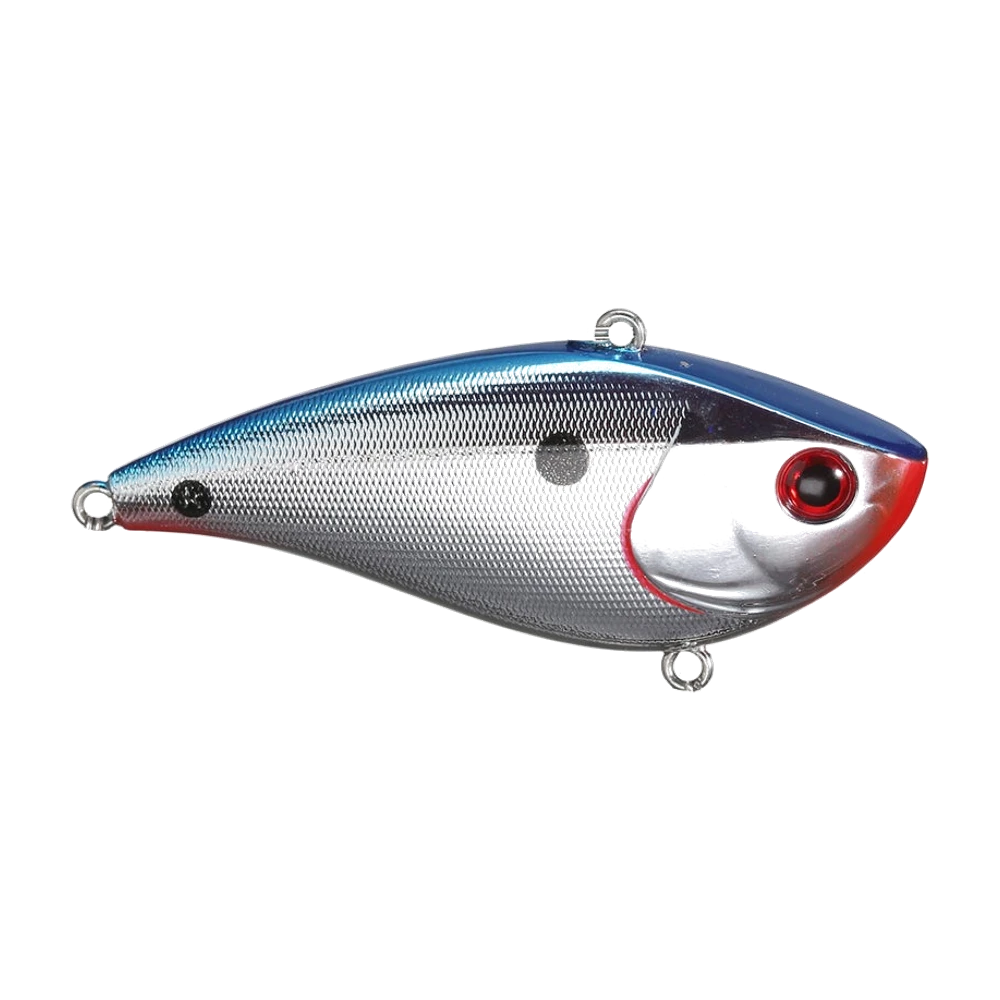
This lure shines under specific conditions. CarnaFish tells you in 10 seconds if today is one of them.
There are late-winter days when you know the fish are there, pinned to the bottom of a gravel flat, and no lipless gets a single response. You've tried everything: faster, slower, closer to the bottom. Sometimes the problem isn't speed or depth at all — it's noise. On a lake where everyone has been dragging multi-rattle lipless baits for three weeks, a lure that puts out a completely different sound becomes a novelty again.
One knocker, a signal nobody else is sending
Almost every lipless on the market works off the same acoustic recipe: a chamber packed with small steel BBs that clatter against each other and produce a high-pitched, broadband rattle that carries a long way. The One Knocker goes the other way. Booyah fitted it with a single oversized tungsten knocker running free in one chamber. Every time the body rolls, that knocker slams one wall and then the other, and what comes out isn't a rattle at all: it's a low, steady thud sitting far lower in the frequency range.
That detail isn't cosmetic. Low frequencies travel further and get absorbed less by weed and bottom structure, while cluttering the immediate sound field much less. In practice you get a bait that announces itself from a distance without hammering fish that are already under pressure. That's exactly the argument for pulling this one out when a classic multi-rattle Bill Lewis Rat-L-Trap has been working all morning without a touch.
Tungsten also matters for mass: denser than steel, it hits harder for a given size and drops the center of gravity, which keeps the bait tracking true at speed.
If you're fishing two to a boat, don't both tie on the same style of lipless. One Knocker on one rod, multi-rattle on the other, and inside half an hour you'll know which sound register the fish will take today. It's a ten-minute test that can rescue a whole day.
Three sizes that don't do the same job
The manufacturer lists three versions, and all three are sinking: 2-1/4 in at roughly 7 g / 1/4 oz, 2-1/2 in at roughly 14 g / 1/2 oz, and 3 in at roughly 21 g / 3/4 oz. This isn't a range where you pick a size at random.
The 7 g version is the subtle one: it sinks slowly, forgives a sloppy retrieve and casts fine on a medium rod. It's the one that interests perch most on shallow flats in Europe, where a 3 in lipless often overshoots the size of forage actually present.
The 14 g version is the all-rounder. It casts a long way into a crosswind, sinks at a usable rate — figure about a second per 30 to 40 cm / 12 to 16 in in calm water — and keeps a firm vibration even when you slow down. If you only buy one, buy this one.
The 21 g version does two specific jobs: covering breaklines between 4 and 7 m / 13 and 23 ft on a long count-down, and fishing through hard wind when a smaller bait no longer finds bottom. It wears out your wrist over a full day, and it filters for bigger fish more than the other two.
The two retrieves that actually pay
The straight retrieve that ticks cover
This is the basic presentation, and there is nothing passive about it. Cast, count the bait down to just above the grass line or the gravel, then wind at a steady medium pace. The moment the bait catches a stem or clips a rock, snap the rod tip up to tear it free. That sudden release, followed by a split second of flutter, is the real trigger: more than half the bites come in the second after a deflection, not during the steady part of the retrieve.
The yo-yo over fish sitting deep
When fish are low and lethargic — cold water, heavy pressure, the middle of a summer day — a straight retrieve stops producing. Let the bait hit bottom, lift the rod 60 cm to 1 m / 2 to 3 ft in one long sweep, then follow it back down keeping light contact with the line. The One Knocker falls flat, vibrating and thudding, and the bite happens during that fall. It rarely registers as a thump: usually the line simply shifts sideways or goes slack. Set the hook on anything that feels odd.
Over hard bottom, let the bait deliberately slam the substrate before you lift it — the puff of sediment and the impact add another layer of signal.
Not sure what to tie on?
Photograph your spot: CarnaFish reads the scene, cross-checks the conditions and gives you the zone, the lure and the retrieve. Free on iOS and Android.
Rigging, hardware and lost baits
In the catalog photograph the bait appears bare, with its three hangers empty: the dorsal line tie, the belly hanger and the tail hanger. Out of the package the manufacturer supplies it rigged with two trebles on split rings. That's worth checking on arrival, and worth watching in use: a lipless spends its life colliding with hard objects and the points dull fast.
Tie straight to the dorsal eye or use a small quick-snap — both work here, because unlike a billed crankbait there is no lip to choke. That said, the tie point sits well forward on the back, so an oversized snap changes the attitude and makes the nose dig. Keep the hardware light.
The mistake that costs baits
Fishing a lipless inside dense vegetation and hoping it will come through. It won't: two exposed trebles on an unprotected body is the worst possible profile in thick grass. The One Knocker is built to shave the top of a weedbed, not to cross it. If you need to fish inside the salad, that's the moment to switch to a hollow-body frog like the Booyah Pad Crasher or to a Texas rig. For line, 15 to 20 lb braid with a 60 cm / 2 ft leader of 30 to 35/100 fluorocarbon strikes the right balance between pulling power and stealth.
Colors by water and season
- Clear water, silver forage: Chrome Blue Back, exactly the finish in the photo. Chrome throws short flashes as the body rolls, which reads like a fleeing shad without adding artificial color.
- Cold water, hard bottom, early season: Red Craw. Brick red matches crawfish, and it's the historic late-winter lipless color on gravel flats.
- Stained water or low cloud: Chartreuse Black Back. The dark-back, bright-flank contrast stays readable once visibility drops under a metre, where a chrome finish simply disappears.
Picking the right sound register and the right countdown assumes you read the spot before casting. That's exactly what CarnaFish does: photograph the water and the AI suggests the zone, the depth and the lure family that match the day's conditions. To place the lipless inside a full season, our season-by-season predator fishing guide explains when this family takes the lead over soft plastics.
The short version
- A single tungsten knocker instead of a swarm of steel BBs: a low, even thud that matters once fish have heard every standard lipless on the lake.
- All three listed sizes (roughly 7, 14 and 21 g) sink, so depth is managed by counting down, not by retrieve speed.
- Bites come on the release after a deflection or during the yo-yo fall, rarely on a pure straight retrieve.
- Two exposed trebles: perfect for shaving a weedbed, useless inside one.
FAQ
What's the real difference against a multi-rattle lipless?
Sound. One oversized tungsten knocker produces a low, spaced thud, where a chamber of steel BBs produces a high, continuous rattle. On heavily fished water, that change of register is often enough to restart bites without altering anything else about the presentation.
Which size should I start with?
The 2-1/2 in, roughly 14 g / 1/2 oz. It casts well, sinks at a rate that's easy to count and holds its vibration even on a slow retrieve. The 7 g and 21 g versions cover narrower cases: small forage in skinny water for the first, deep breaklines or strong wind for the second.
Does this bait float at rest?
No. The manufacturer classes all three versions as sinking. The second you stop winding, it drops while still vibrating, which is what makes the yo-yo retrieve work but also means you have to stay alert over snaggy bottom.
Can you fish it in weed?
Not well. Two exposed trebles grab everything. It's designed to pass just above vegetation and to be ripped free with a snap of the rod when it ticks a stem. To fish inside a dense weedbed, switch to a hollow-body frog or a Texas rig.
Does it suit perch and pike in Europe?
Perch, yes, especially in the smallest size over shallow flats in spring and autumn. Pike will take it, but it demands a strong leader, and two exposed trebles in a pike's jaw make unhooking awkward. On a known pike spot, a bait that's easier to handle is the better call.
Should I replace the stock trebles?
Not necessarily straight out of the package, but check the points often. A lipless works in contact with gravel and rock, and dulled points turn a bite into a simple pull-off. A pass with a hook file, or a mid-season replacement, is usually enough.
The full bass lure guideSeason-by-season strategy: which family of lure, when, and why.Go from theory to fish
CarnaFish reads your spot from a photo and gives you the game plan: zone, lure, retrieve. Free on iOS and Android.