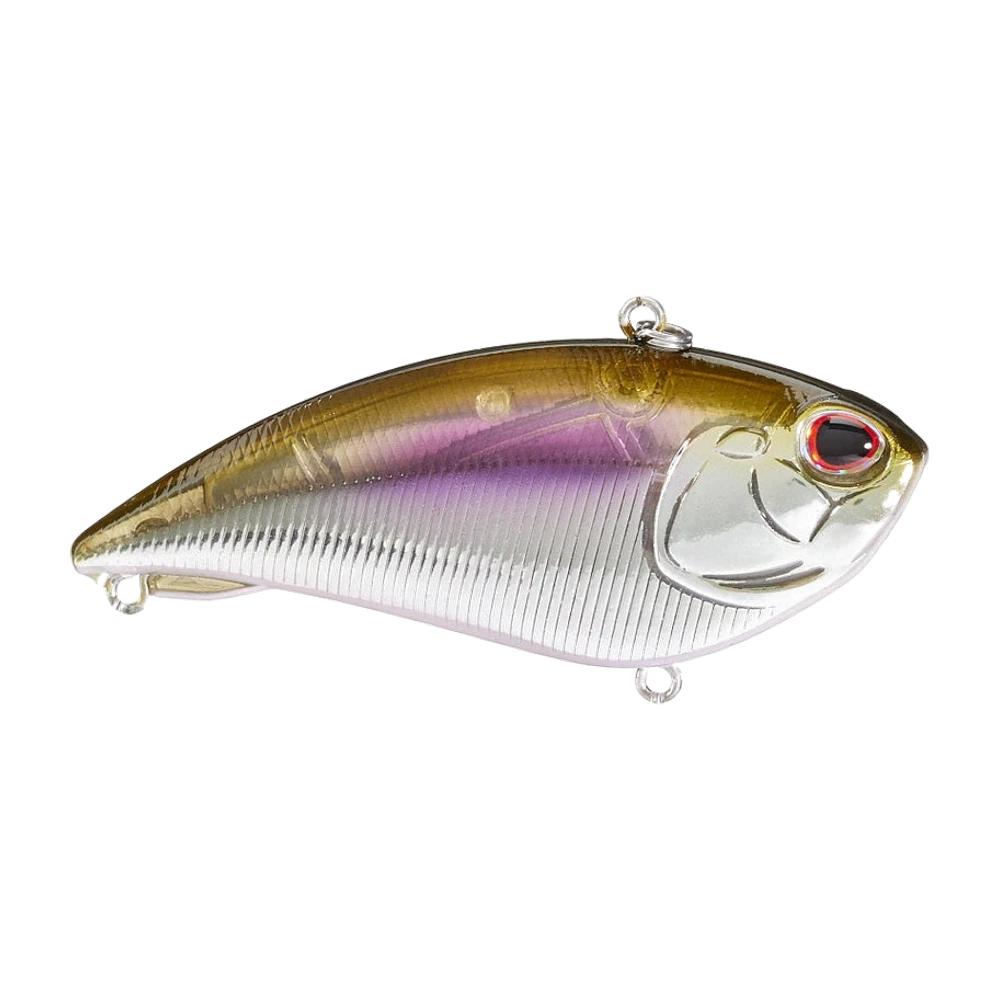
Berkley Jack 8: the tungsten lipless built for a fast fall
Rather not fish it blind? Photograph your spot — CarnaFish cross-checks the conditions and points you the right way.
The sonar shows three clean returns at seven metres, over a fifteen-metre hole. The fish are there, suspended in the middle of the column, and they are not going to move for a bait that needs twenty seconds to reach them. That is exactly the problem the Jack 8 was built to solve: get down fast, flash hard on the way down, and come back up fast enough to do it again.
Tungsten, and what it really does to the fall
Berkley weights this lipless with tungsten, and that is not a catalogue line. Tungsten is roughly 1.7 times denser than lead: for the same weight the ballast takes far less volume, so it sits lower and further forward in the body without bulking out the silhouette. The practical result is 28 g in a bait only 7.6 cm long — a density that puts the Jack 8 in a class of its own among lipless baits.
That concentrated mass produces a very fast fall and, more importantly, a fall that stays decisive. Plenty of lead-weighted lipless baits flutter down like a dead leaf the moment you give slack, which looks pretty and takes forever. This one noses down, rolls onto its side and drops in one run, showing each flank in turn. Berkley calls it dual flash-point: two light-returning zones on the sides that throw a distinct flash on every roll. That signal, more than the vibration, is what works during the descent.
A knife-blade back and fins — what for
The Jack 8 has a very flat profile and a ridged back that Berkley describes as a knife blade design. Two consequences. First, the ridge cuts the water instead of pushing it, which limits drag on the way down and partly explains the drop rate. Second, the flat body generates a tight, crisp vibration on the retrieve rather than the wide roll of a lipped crankbait.
The small fins on the body do a job that rarely gets mentioned: they stabilise the track and right the bait after it hits something. A lipless that deflects off a stump or a rock usually spins out and comes back crooked, hooks up, ready to snag. This one flattens itself out again faster on its own. On a contact presentation through rock or sunken wood, that is a few baits saved per season.
Two retrieves, two different fish
Berkley gives two ways to work it, and they address different moods.
Sharp rip and fall on a slack line
You snap the rod tip up, the bait climbs while vibrating, then you give the line back. On slack line the Jack 8 noses over and drops fast, flank to the light, with no input from you. It is the most aggressive version, the one that triggers an active or annoyed fish. The bite almost always comes on the fall: you see it on the line, rarely feel it in the rod.
Gliding descent under tension
Same rip, but you keep light contact with the line through the descent. The bait then glides back towards you, markedly less erratic, and you feel everything. This is the cold-water version, the one for fish that follow without committing, and it is also the one that works best when you are watching the whole thing on forward-facing sonar — Berkley states the bait is built with that use in mind.
The detail that decides how many fish you actually hook: keep the line tight between rips, but not the rod. If you follow the fall with the rod held high, you move into the dead zone where you can no longer set. Tip low, line just taut enough to see it jump: that is where you convert.
The classic mistake
Reeling it straight back like a light lipless. At 28 g you can — it vibrates, it swims, nothing is wrong — but you are then using a very dense bait for a job any 14 g lipless would do just as well, and you lose the one argument that sets it apart. The Jack 8 earns its place when drop rate matters: deep fish, suspended fish, hard wind, or current that would sweep a lighter bait away.
Where it works, and how deep
Berkley gives it for suspended fish anywhere from two to forty feet, roughly 0.6 to 12 m. That wide band mainly tells you one thing: since it sinks, the depth of this bait is whatever your count-down makes it. Count the seconds after the splash, note the count that produced the bite, repeat it.
In practice the three situations where it beats an ordinary lipless are vertical work over a school marked on the sonar, casting over a deep flat, and bank fishing into a head wind, where its density buys you metres of cast you would not otherwise have. In a more conventional, less dense register a Rapala Rippin' Rap covers shallow water better, and a Westin Swim Lipless offers a bulkier profile for pike.
Not sure what to tie on?
Photograph your spot: CarnaFish reads the scene, cross-checks the conditions and gives you the zone, the lure and the retrieve. Free on iOS and Android.
Colours by water
- Clear water: the tone in the photo — olive-gold back, purple flank, chrome belly — which plays on reflection rather than colour and imitates a baitfish in good light.
- Cold early-season water: a red or brown craw tone, matching the period when crayfish are the dominant forage over hard bottom.
- Stained water or overcast skies: chartreuse with a black back, so the fish keeps a visual reference once the flash no longer carries past a metre.
A situational bait, not a box staple
The Jack 8 is not the lipless you tie on by default: it is the one you reach for when fish are deep or suspended and you need to get there fast. It is a poor substitute for a light shallow-water lipless such as a 6th Sense Quake Lipless Crankbait over a cluttered flat, but it reaches fish none of those models can get to in a sensible amount of time.
Of course you still have to know where that suspended fish is. That is what CarnaFish does: a photo of the spot, and the AI suggests a zone, a depth and a family of lures consistent with the day's conditions. For the reasoning behind reading a zander lie, our beginner's guide to zander on lures spells out the whole method.
What to remember
- 7.6 cm for 28 g: tungsten ballast gives a rare density and a decisive fall, not a dead-leaf flutter.
- Two distinct retrieves — slack-line free fall for active fish, tension glide for wary ones.
- The fins right the bait after a deflection, which clearly cuts snags when fishing rock.
- Reeling it straight back means paying for a density you never use.
FAQ
Does the Jack 8 sink or float?
It sinks — Berkley classes it explicitly as a sinking model. That is its whole point: the drop rate produced by the tungsten ballast is what separates it from lighter lipless baits.
What exactly is the size of this model?
7.6 cm, or 3 in, for 28 g — the largest size in the Berkley lipless line-up it belongs to. A short but very dense format, which explains the unusual feel on the cast.
How deep should I fish it?
The manufacturer gives it for suspended fish between two and forty feet, roughly 0.6 to 12 m. Since it sinks, your count-down sets the depth: count the seconds, remember the count that produced the bite.
Should I change the stock hooks?
Not necessarily — the stock Fusion 19 trebles are sharp and correctly sized. If you are fishing a pike water, put the effort into the leader instead: the line is what fails, not the hook.
Can it be fished with forward-facing sonar?
Yes, that is one of the stated uses. Its density makes it easy to track on screen and to drop quickly to the level of a marked fish, then lift and drop in front of it until the fish decides.
How does it differ from a lighter classic lipless?
A 14 to 18 g lipless falls more slowly and planes more, which is an advantage over cluttered shallow flats. The Jack 8 does the opposite: down fast and up fast, which only matters if you are fishing deep, suspended, in hard wind or in current.
The full bass lure guideSeason-by-season strategy: which family of lure, when, and why.Go from theory to fish
CarnaFish reads your spot from a photo and gives you the game plan: zone, lure, retrieve. Free on iOS and Android.