Buckeye G-Buzz: the buzzbait whose argument is its wire
The right lure in the wrong spot still catches nothing. CarnaFish spots the zone that works, from a single photo.
You blow up eight fish in a morning and put three in the net. Every buzzbait angler knows that ratio, and the usual response is to change colour or speed. In most cases the problem lies elsewhere: it is in the steel wire joining the blade to the hook. The Buckeye Lures G-Buzz, developed by Gerald Swindle, starts from exactly that observation.
The wire frame, the part nobody talks about
A buzzbait is a lead head carrying a single hook, a blade, and between the two a steel wire bent into a V. That wire does three things at once: it holds the blade at the right angle, it serves as the point of pull, and it folds against the hook when the fish closes its mouth. Those three jobs call for different stiffnesses, and that is where most models settle for a compromise.
A soft wire feels good in the shop: the blade starts turning earlier, the lure seems alive at a reduced speed. On the hookset, though, the upper arm collapses without resistance and absorbs part of the energy that should have reached the point. The fish has a mouthful of lure, you feel the weight, you set — and it swims off. Too stiff a wire does the opposite: it transmits well, but it props the jaws apart and levers against the set.
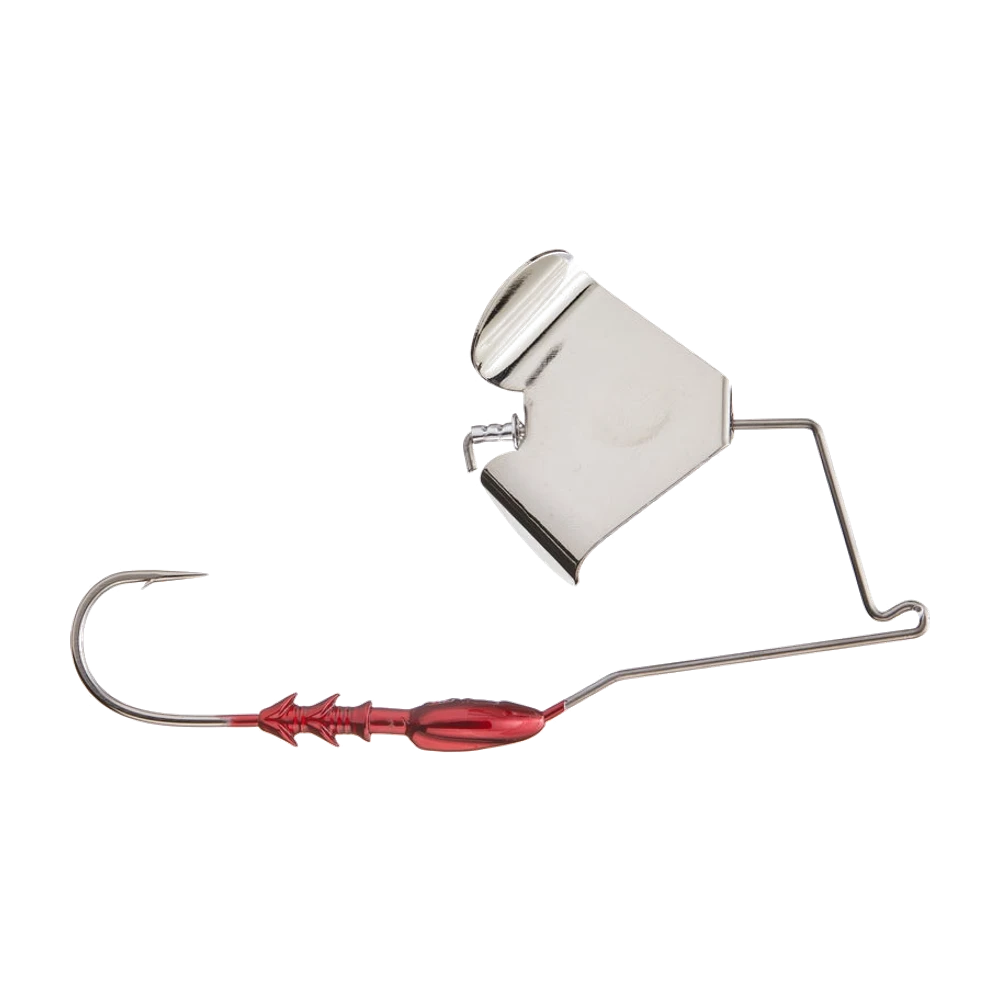
The maker presents the G-Buzz as a direct answer to that problem: a wire gauge chosen so as not to be over-limber, and a frame bent in a specific way to maximise hookups. In the photograph the bend is obvious, noticeably sharper than on a generic buzzbait. In the water that translates into two things: the lure holds a straight line instead of crabbing sideways, and the hook's angle of penetration stays as designed even when the pull comes from the side.
Lay your buzzbait flat on a table and look at it from above, line tie towards you. The hook point, the line tie and the centre of the blade should sit in one plane. After three or four fish and as many pulls out of the wood, they no longer do — the lure rolls on the retrieve and you blame the speed. Ten seconds of visual check between casts beats a lure change.
A buzzbait shown bare, and what that reveals
The G-Buzz is photographed here naked, with no skirt and no trailer. So you see what you never see on the shelf: the barbed keeper collar on the lead head that locks the silicone skirt in place, and the heavy single hook sitting in line with the pull. That is useful, because it is a reminder that the skirt is a wear part. When the strands break or pack down, the lure loses bulk, its apparent buoyancy drops and you have to retrieve faster to stay on top — precisely the adjustment you are trying to avoid. A fresh skirt fixes a tired buzzbait more reliably than a new model does.
The maker stresses the tuning of every part, from the blade to the rivet, without announcing a clacker as such. That is the difference in approach between the two models in the range: the Buzzerk is built around a metal piece that cracks, while the G-Buzz bets on geometry and stiffness. On heavily pressured water, the second is often the better call.
The retrieve, and what happens on contact
Cast beyond the zone, rod tip up, and start reeling before the lure even touches down. That is the reflex that separates a buzzbait angler from everyone else: if you wait for the splash to put a turn on the handle, the lure sinks a metre and you lose the first three metres of the retrieve, usually the ones closest to the cover.
After that, the slowest speed at which the blade stays up and, above all: run the lure into contact with an obstacle rather than past it. A lily stem, a branch breaking the surface, a piling — the slight knock, the hesitation and the resumption of churning often trigger a strike that would never have happened in open water. The same holds over weed: letting the lure scrape the top of the vegetation beats running it ten centimetres above.
The hookset
The same rule as on any buzzbait: do not set on the noise, set on the weight. Wait until you feel tension, then sweep sideways. With a frame as stiff as the G-Buzz's you have less margin for error than with a soft one — the lure is less forgiving of an early set, but rewards a correct one far better. Moderate-action rod, 30 to 50 lb braid, drag tight enough to pull a fish out of cover without slipping.
The limits, and there are some
The G-Buzz has no weed guard: it crosses sparse vegetation but fouls in a dense mat, where a hollow body frog remains the only viable choice. It fishes on the surface only, so over water less than two metres deep and above roughly 15 °C (59 °F). And like every topwater, it becomes close to useless under a midday sun on clear water.
Where to use it, and on which species
Weed edges, shallow flats, dock frontages, fallen trunks, backwaters: the G-Buzz is fished by covering the bank, not by working one spot. The best windows are the two hours after first light, dusk and the night, from late spring to early autumn.
In Europe it also takes pike over late-summer weed. In that case a wire or titanium leader is mandatory: the strike lands on the body of the lure and the line ends up in the fish's mouth. And if you want the same fast search fishing but beneath the surface instead of on it, a spinnerbait covers the same banks through the whole water column. For a slimmer profile on wary fish, the Berkley Toad Riveter is a sound option.
Not sure what to tie on?
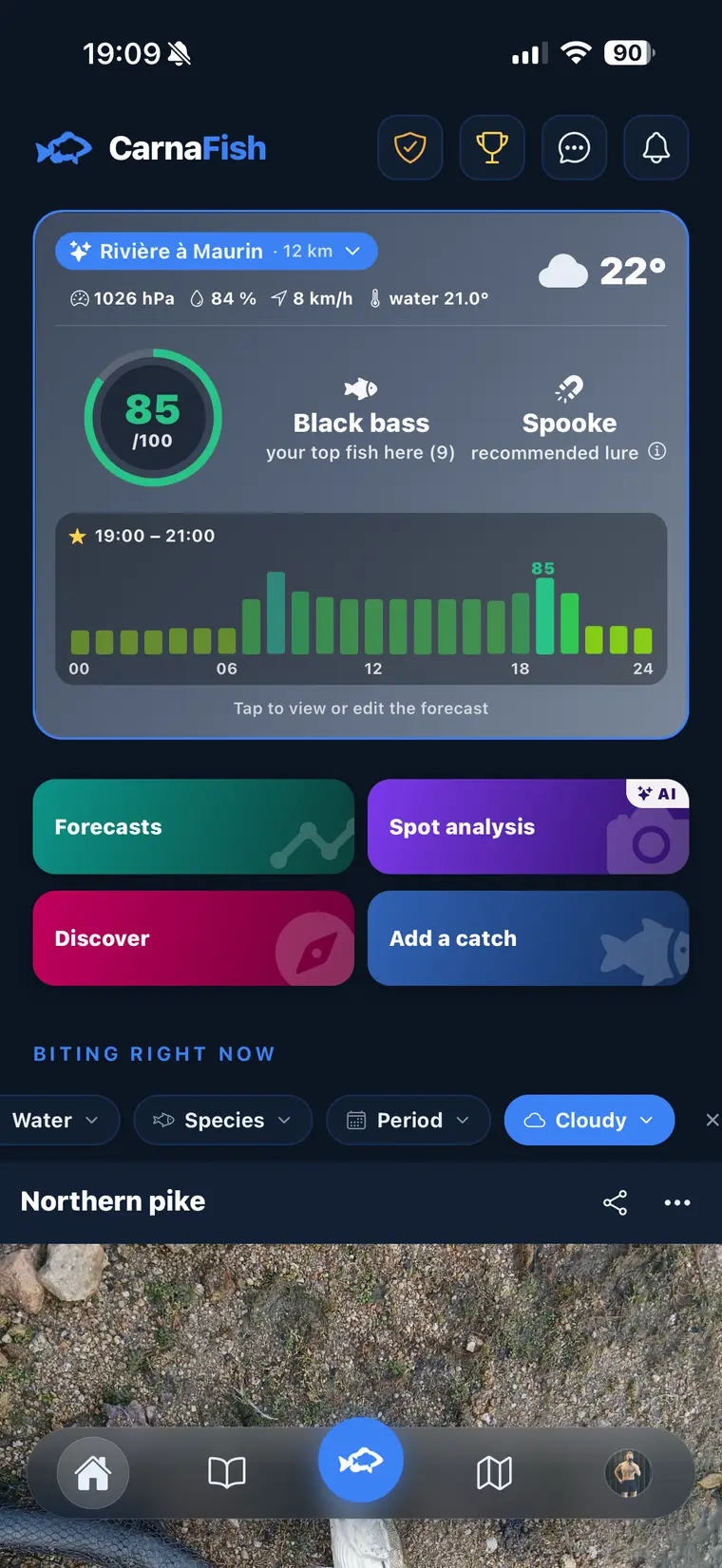
Photograph your spot: CarnaFish reads the scene, cross-checks the conditions and gives you the zone, the lure and the retrieve. Free on iOS and Android.
Colours by light level
- Fry at the surface, clear water: white or pearl white, with a silver blade like the one shown to throw flash.
- Low light, dawn, dusk, after dark: solid black. Against the sky a fish sees a silhouette, not a colour, and black gives the cleanest one.
- Stained water, overcast daylight: chartreuse and white, which stays visible without excess once clarity drops under a metre.
A lure you judge over a season, not over one session
The G-Buzz does not promise more strikes than the next bait — it promises to convert more of them, and that is a promise you can only verify after twenty-odd sessions. Even so, the best buzzbait is worth nothing cast at the wrong bank at the wrong hour. That is what CarnaFish is for: from a photo of the swim, the AI suggests a zone and a presentation consistent with the day's conditions. And for the groundwork on tackle and bass holding spots, our guide to getting started in bass fishing covers the essentials.
Key points
- The G-Buzz's argument is its frame: a wire stiff enough, and a specific bend, so that the energy of the set reaches the point.
- Start reeling before the lure lands, or you lose the first metres, the ones nearest the cover.
- Run the lure into the obstacle, not past it: that is where strikes are triggered.
- No weed guard, surface only, water above 15 °C: a specialist lure to alternate with others.
FAQ
Which G-Buzz size should I choose?
The maker lists several sizes without publishing the corresponding weights. The reasoning is standard for buzzbaits: the lightest that stays on top at slow speed over a calm flat, something heavier as soon as there is wind or you need distance.
Why does a stiff wire frame improve hookups?
Because a soft wire collapses on the set and absorbs part of the energy meant for the hook point. With a stiffer, correctly bent frame, the pull arrives straight at the point along the intended axis.
Does the G-Buzz get through weed?
Through sparse vegetation or over weed that just breaks the surface, yes. Through a dense mat of pads or filamentous algae, no: it has no weed guard and a hollow body frog is the only sensible choice there.
Should I add a trailer?
It is not essential. A soft trailer lengthens the profile and slows the lure a little, which helps you stay on top at a reduced pace. If you are missing fish, a stinger hook does more than a bulky trailer.
What is the difference from the Buzzerk in the same range?
The Buzzerk is built around a clacker and bets on noise, which pays in coloured water and after dark. The G-Buzz bets on frame geometry and a steady track, which often makes it the better choice on clear, pressured water.
Does the G-Buzz catch pike?
Yes, in Europe, over late-summer weed. Fit a wire or titanium leader, because a pike attacks the body of the lure and the line ends up straight between its teeth.
The full bass lure guideSeason-by-season strategy: which family of lure, when, and why.Go from theory to fish
CarnaFish reads your spot from a photo and gives you the game plan: zone, lure, retrieve. Free on iOS and Android.