Strike King Tour Grade Spinnerbait: choose your blades before anything else
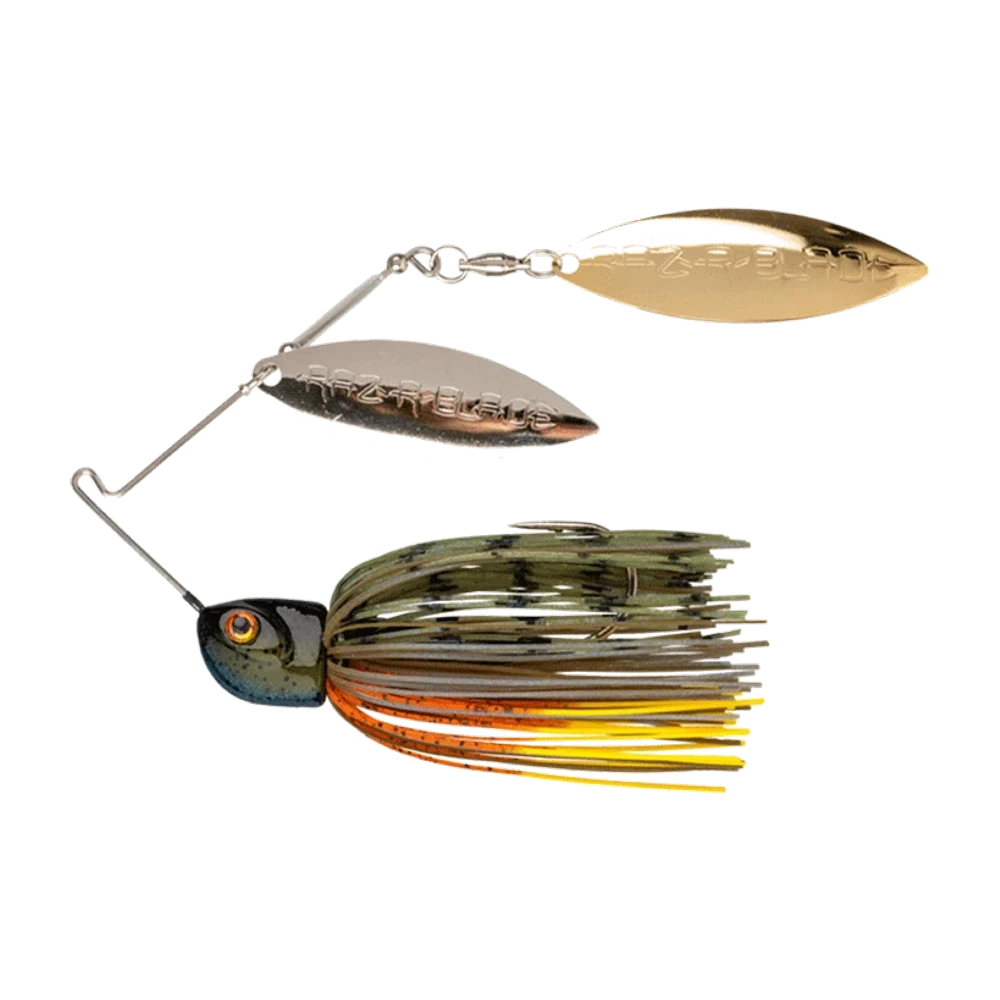
One lure, endless conditions. CarnaFish reads your spot from a photo so you are not just guessing.
You buy a spinnerbait, you cast it, it swims. It works more or less everywhere, so you stop there and never ask another question. That is exactly why most anglers plateau with this lure: they swap skirt colours when the bites dry up, when the only variable that really counts is out on the ends of the arms.
A spinnerbait is not a lure, it is a platform. The lead head, the wire and the skirt form a near-neutral chassis; it is the blades that decide the vibration, the speed you can hold and the depth you reach. The Strike King Tour Grade is interesting precisely because it comes in several blade combinations on an identical frame, which lets you reason cleanly without changing everything else.
So this page starts with the blades, not with the lure.
What each blade type does
Three shapes cover the essentials, and they do not do the same job.
- Colorado: wide and heavily rounded. It turns far off the axis, pushes hard against the water and sends out low, slow waves. It lifts the lure, slows the retrieve and is clearly felt in the rod.
- Willow: long and tapered. It turns close to the axis, offers little resistance, and produces mostly flash with little vibration. It lets the lure run deeper and takes a fast retrieve without blowing out.
- Indiana: the in-between, oval. An honest compromise, most useful as the front blade in a tandem.
The Tour Grade comes in the classic double willow, colorado-willow tandem and double colorado. Those three versions fish at different speeds and different depths on the same weight.
| Combination | Vibration | Workable speed | Window |
|---|---|---|---|
| Double willow | low | fast | clear water, weed, active fish |
| Colorado-willow tandem | medium | moderate | all-round, lightly stained water |
| Double colorado | high | slow | coloured water, cold water, night |
The rest of the Tour Grade's build serves that logic: a hard wire frame that does not bend out of shape on the first pike, a ball-bearing swivel on the rear blade so it starts turning at very low speed, and a strong-wire single hook, essential the moment pike are around.
The retrieve: five sequences to know
A badly fished spinnerbait is one wound in at a constant speed from start to finish. Here is the progression to run through on a spot.
- Cast and let it drop under tension. Keep the line tight, rod at ten o'clock. Most early-retrieve bites come during that pendulum drop, and you never feel them on a slack line.
- Start slowly and check that you can feel the blades turning. If you cannot feel them, you do not know where your lure is.
- Wind straight while holding the depth you want: the slower you go the deeper it runs, the faster you go the higher it climbs.
- Force a contact. Bump a piling, a sunken branch, a rock. The lure loses balance for a fraction of a second, the blades skip a beat, the skirt flares. That is when the bite lands.
- Give it a dead stop of one to two seconds after the contact, letting the lure nose down, then pull it away sharply.
On the water: when fish follow without committing, do not change colour, change speed within the same retrieve. Wind hard for two turns then cut dead. A follower that sees its prey change gear attacks; a follower that sees the same speed for ten yards drops off.
Setting the depth without changing lures
The spinnerbait is one of the rare lures whose depth is entirely under your hand. Three levers, in this order.
The weight. The 10.5 g covers the 30 cm to 1.5 m band on a normal retrieve. The 14 g runs comfortably at 2-3 m and handles wind. Below 7 g you lose casting distance and the ability to hold in current.
The speed. At the same weight, slowing by a third buys you close to a metre of depth. That is quicker and more reliable than switching lures.
The rod angle. Rod tip high and the lure stays in the top 50 cm, so you can skim it over a weed bed. Rod tip low and it dives and follows the slope.
For line, 0.15 to 0.20 mm braid gives the sensitivity you need to feel the blades turning; a 0.35 to 0.40 mm fluorocarbon leader protects against abrasion, and a 20 to 30 cm wire or titanium leader becomes mandatory as soon as pike are present. Fish the Tour Grade tied straight to the open loop on the arm, never with a snap that would close the angle and choke the wire's flex.
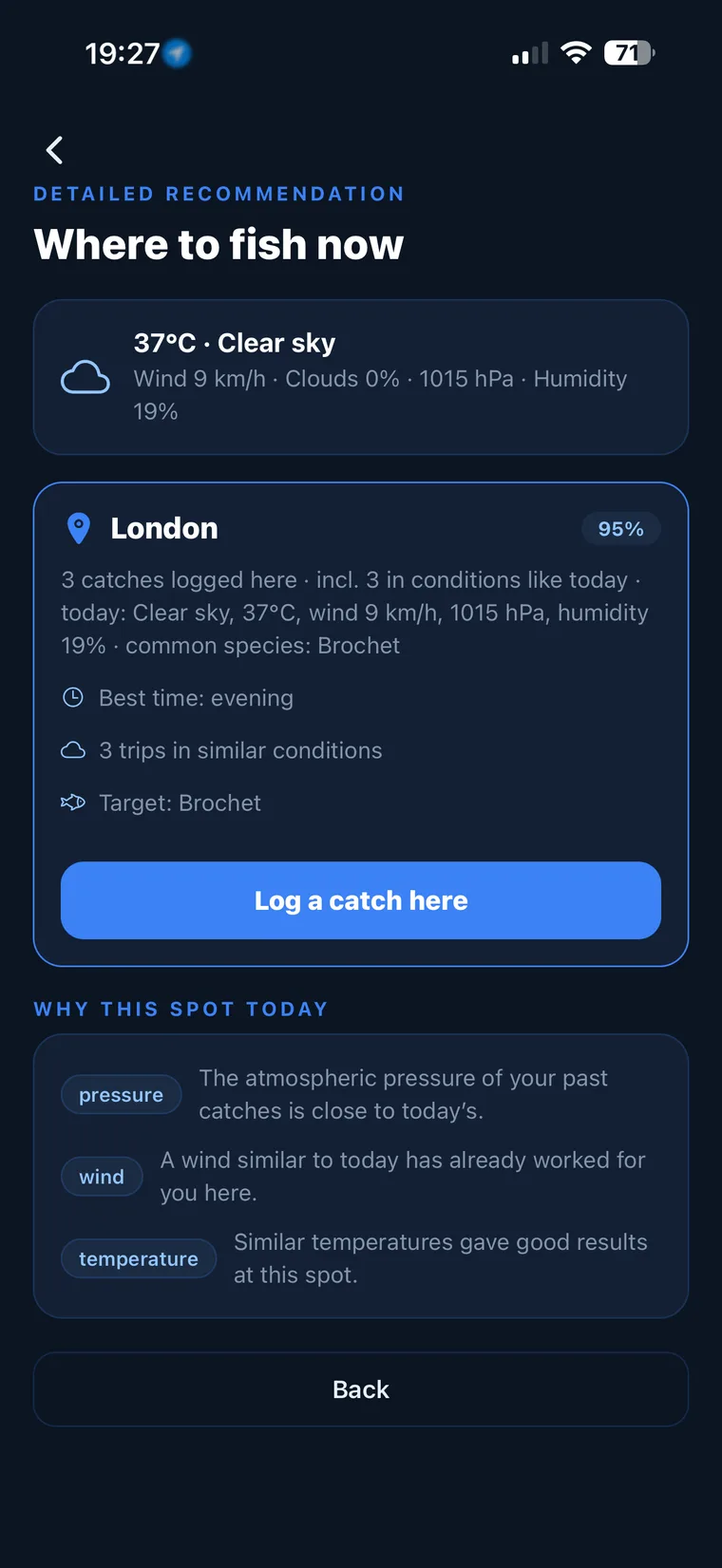
Not sure what to tie on?
Photograph your spot: CarnaFish reads the scene, cross-checks the conditions and gives you the zone, the lure and the retrieve. Free on iOS and Android.
Where it excels, where it is useless
The spinnerbait is a lure for cover and coloured water. That is where it has no serious rival.
- Sunken timber, low branches, stumps: the V frame walks the lure through places where a treble-hooked crankbait snags on first contact.
- Stained or churned water after rain: colorado blades send out a signal the fish finds without seeing it.
- Weed bed and lily pad edges, where you run it along shallow.
- Wind and chop: its compact mass casts far and stays controllable.
Conversely, it is frankly poor in three situations. In very clear, calm water on educated fish, its artificial outline shows too much; a subtle soft plastic will do better. In open water with no structure, you are covering emptiness with a lure built to brush against things. And fishing vertically or on fish pinned to the bottom in winter, it does not sink cleanly and loses all interest the moment you cannot wind it back.
Against the other spinnerbaits on the site
The Booyah Covert Spinnerbait plays on a more discreet frame and a compact profile: it is a finesse choice, one to favour when the water clears and the fish have already seen a crowd go through. The Tour Grade is approached as an interchangeable blade system in which you choose the signal first.
The War Eagle Double Colorado is a deliberately specialised case: two wide blades, maximum vibration, minimum speed. It takes the lead in genuinely dirty water, at night, or in early spring on cold water. The Tour Grade's colorado-willow tandem covers the middle ground, which is to say the vast majority of sessions.
For pike, our guide to choosing a pike lure places the spinnerbait against the other families. And if you are unsure which blade combination to tie on when you reach the bank, CarnaFish analyses a photo of the spot and answers.
Key takeaways
- The blade decides everything: vibration, workable speed, depth. Skirt colour comes a long way behind.
- Double willow in clear water and fast, double colorado in dirty water and slow, tandem for everything else.
- Depth is set with weight, speed and rod angle, without changing lures.
- Force a contact with structure, then a dead stop: that is where the bite lands.
- Pointless in open water with no structure and in very clear water on wary fish.
FAQ
Colorado or willow, how do I choose when I get to the bank?
Look at the water clarity. If you can see your lure more than a metre down, go willow for the flash and the speed. If you lose sight of it at 30 cm, switch to colorado: the fish will find the lure by vibration, not by eye.
Which weight should I buy first?
The 10.5 g covers the most situations, from the surface down to about a metre and a half. Take the 14 g second, for wind, current and deeper spots. The extreme weights can wait.
Should I add a trailer hook?
Yes as soon as you start logging several missed takes at the end of the retrieve, typically on unaggressive fish. On the other hand, leave it off in dense sunken timber: it doubles your snags and throws away the spinnerbait's main advantage.
Do I need a wire leader for pike?
Yes. A spinnerbait attacked from the side often puts the line straight into the teeth. Twenty to thirty centimetres of titanium or coated wire is enough, and it costs nothing in action on a lure that is hardly subtle to begin with.
Can you fish a spinnerbait in winter?
Yes, but slowly and with colorado blades, letting it sink longer and winding it just fast enough to keep the blades turning. On fish that are genuinely pinned to the bottom and inactive, a soft plastic on a slow straight retrieve stays more effective.
Why is my spinnerbait swimming crooked?
The wire frame has bent, almost always after a fish or a forced pull-free. Line the blade arm up by eye with the hook shank and bend it gently back by hand until the lure runs true on a fast retrieve.
The full bass lure guideSeason-by-season strategy: which family of lure, when, and why.Go from theory to fish
CarnaFish reads your spot from a photo and gives you the game plan: zone, lure, retrieve. Free on iOS and Android.