Berkley Toad Riveter: the finesse buzzbait that squeaks out of the pack
One lure, endless conditions. CarnaFish reads your spot from a photo so you are not just guessing.
A launch ramp in late August, three boats already through ahead of you, and bass rising to your buzzbait without ever taking it. Two follows, three refusals twenty centimetres short. The fish are there, they are on the surface, but something in what you are showing them is one notch too much. That is precisely the moment a finesse buzzbait stops being a catalogue curiosity.
Downsize, but downsize the right thing
A standard buzzbait is an aggression lure: big blade, broad wake, hoarse clatter. When it stops producing, the reflex is to slow down or change colour. The right answer is usually elsewhere: shrink the blade and the disturbed surface without giving up any of the sound.
That is the bet the Toad Riveter makes. Berkley fits a smaller than average anodized blade, paired with a purpose-made ring rivet. The metal-on-metal contact of that assembly produces a sharp, high squeak, and the sound is there straight out of the pack — no need for the twenty-cast break-in most buzzbaits demand before they start singing. That is a concrete detail rather than a sales line: on a short session, a buzz that has not started squeaking yet is a buzz that is not fishing.
The difference from a full-size buzz can be heard and seen. The wake is narrower, the spray less spectacular, and the noise climbs an octave. Against a fish that has already turned down two big topwaters that morning, this reduced profile often tips the balance.
A frame built for skipping under docks
The recurring failure of a buzzbait is mechanical: skip it under a dock often enough and the wire opens up. The angle between the upper arm and the shank shifts by a few degrees, and the lure starts tracking sideways without you understanding why.
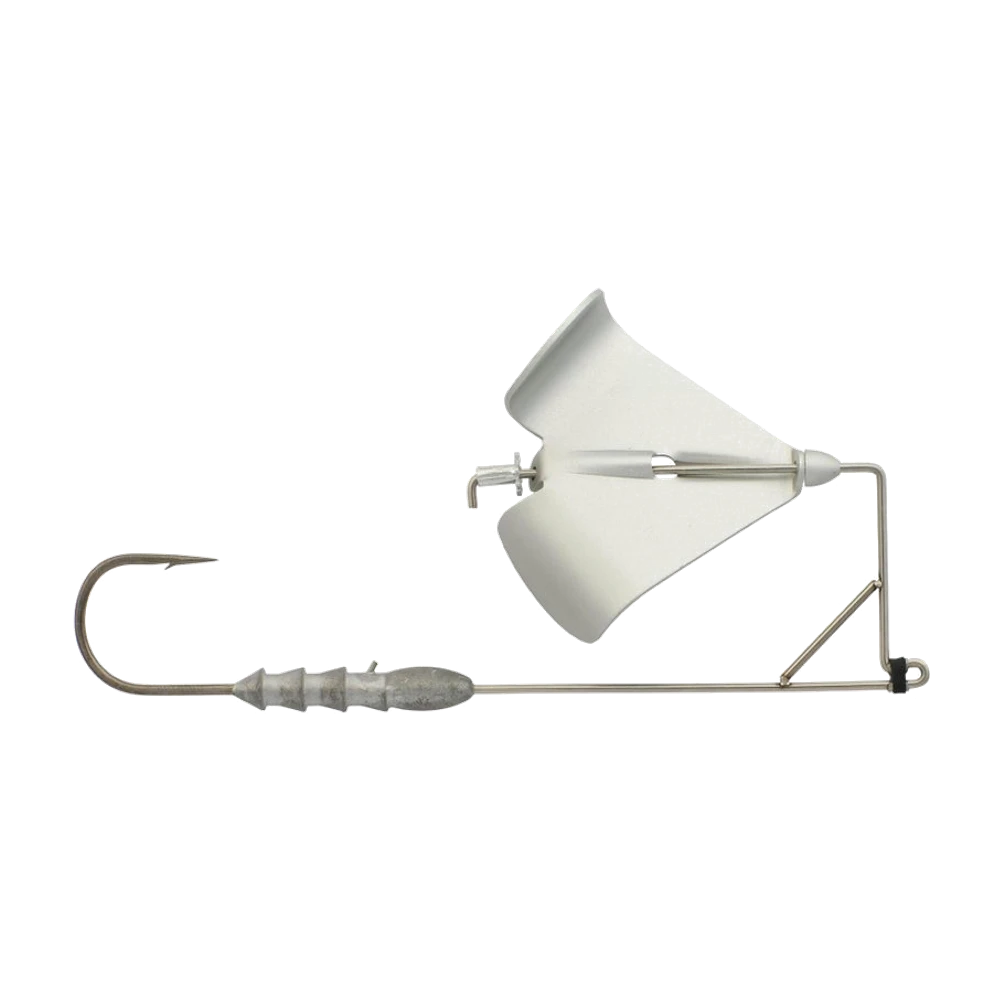
Berkley has welded a 45-degree brace at the junction of the two arms — you can see it clearly in the photo, set diagonally behind the blade. It is an unremarkable thing to look at, but it is the difference between a frame that survives a season of fishing under cover and one you straighten with pliers every fifteen casts.
Two other technical points deserve a mention. The tie point is banded, closed off by a small collar that stops the knot sliding into the bend of the wire — a very real problem on open-loop buzzbaits, where the knot migrates and unbalances the presentation. And the overall shape is a streamlined cone, stretched forward, to deflect floating weed instead of collecting it.
The hook is a custom long-shank Fusion 19 with an O'Shaughnessy bend. That open geometry is a coherent choice on a topwater lure, where the fish attacks from below and often only half connects.
The trailer is half the lure
The Toad Riveter is supplied bare, exactly as photographed: a frame, a blade, a hook, and nothing else. No skirt, no body. It is explicitly built to carry a small soft toad, and that choice is entirely yours.
How to rig it
The keeper barbs on the shank are large and numerous, meant to lock a soft plastic in place so it does not slide back on the first cast. Thread the toad on dead straight, body centred on the shank, dangling legs in line. A trailer rigged crooked makes the whole buzzbait spiral, and you will spend the day fighting a lure that tracks off to one side.
A Zoom Horny Toad is the obvious starting point: its two flapping legs add a paddling disturbance that completes the squeak of the blade. If you want a quieter signature, a small single-tail soft bait cuts the disturbance back further.
The classic mistake
Rigging a trailer that is too big. The reflex is understandable — you want a visible profile — but an oversized toad drags, forces you to speed up to keep the blade on the surface, and cancels every benefit of the finesse format. If you have to reel fast to keep the blade spinning, your trailer is too big or your rod tip is too low.
Keep the rod high, tip towards the sky, from the moment the lure lands. That is what lets the blade spin at the slowest speed possible, and on a finesse buzzbait the minimum speed is always the right speed.
When it beats a full-size buzz
The Toad Riveter is not a first-choice lure. A big buzzbait or a Deps Buzzjet covers more water, makes more noise and works better on active fish early in the day. The finesse format takes over in three specific situations: pressured water, very clear water, or late in the season when bass turn selective about size.
It also has an advantage the big buzz does not: it travels under docks, low branches and jetties, where a bulky lure slaps and skips badly. The narrow profile and the welded brace exist for that.
In exchange, accept its limits. It casts shorter than a heavy buzzbait, it does not punch through wind, and it is wrong for thick vegetation, where a frog like the Berkley Swamp Lord Popping Frog remains the only workable tool.
Not sure what to tie on?
Photograph your spot: CarnaFish reads the scene, cross-checks the conditions and gives you the zone, the lure and the retrieve. Free on iOS and Android.
Colors for the light
- Clear water, open sky: white or pearl, like the frame photographed here, imitating a small baitfish panicking on top.
- Against the light and at sundown: all black, blade included. The fish sees a silhouette against the sky, and black is the only colour that truly cuts out in those conditions.
- Stained water: chartreuse and white, a contrast that stays readable when visibility drops below a metre.
On a buzzbait, colour matters less than on almost any other lure: the fish comes up to the noise and the wake, not to the shade. Work on your speed and your tracking line first.
Signal first, silhouette second
A finesse buzzbait is not a discreet lure. It is a loud lure with a reduced profile, which is a very different thing. It still announces itself from a distance while showing less bulk once the fish is close — exactly what you need when the refusals come in the last metre.
You still have to be working the right bank at the right time, and that is what CarnaFish is for: one photo of the spot, and the AI suggests the zone, the depth and the family of lure that suit the day. To build the rest, our beginner's guide to bass fishing covers the lies to read and the tackle to gather.
Key points
- Small anodized blade and ring rivet: the squeak is there on the first cast, with no break-in.
- A welded 45-degree brace and a banded tie point, two answers to the two classic buzzbait failures.
- Supplied bare: the soft trailer is half the lure, and an oversized trailer cancels the whole point of the format.
- Berkley publishes neither a length nor a weight for this model, worth knowing if you are ordering unseen.
FAQ
How much does the Toad Riveter Finesse Buzzbait weigh?
Berkley does not publish it, and no official figure accompanies this model. Ballast is limited to a ribbed collar on the shank, which makes it a light buzzbait — but if the exact weight matters to you, check with the retailer before ordering.
Which trailer should I rig on it?
A small soft toad with flapping legs, such as the Zoom Horny Toad, remains the reference choice: it completes the squeak with a paddling disturbance. Avoid anything bulky, which would force you to speed up to keep the blade on top.
Why does my buzzbait track sideways?
Nine times out of ten, the trailer is rigged crooked on the shank. Pull it off and reseat it perfectly straight, body centred. If the problem persists, check the wire has not taken an angle after a skip into a dock.
Does a new buzzbait need breaking in?
On most models, yes: the blade has to wear its axle slightly before it produces a real squeal. The Toad Riveter is designed to squeak out of the pack thanks to its ring rivet, which is a genuine gain on a short session.
How fast should it be retrieved?
At the minimum speed that keeps the blade breaking the surface, and no faster. Lift the rod right after the splashdown to get the blade started early, then lower it progressively as the lure comes back to you.
Finesse buzzbait or standard buzzbait?
The standard version covers more water and suits active fish. The finesse version takes over in clear water, on pressured fisheries, or when bass follow without striking. If your first three casts with a big buzz draw follows and no bites, that is your signal to switch.
The full bass lure guideSeason-by-season strategy: which family of lure, when, and why.Go from theory to fish
CarnaFish reads your spot from a photo and gives you the game plan: zone, lure, retrieve. Free on iOS and Android.