Deps Cover Scat: the ultra-dense stickbait built to drop into cover
The right lure in the wrong spot still catches nothing. CarnaFish spots the zone that works, from a single photo.
There is a category of spot everyone stares at and nobody actually fishes: the tangle of drowned branches under a leaning tree, the tight row of dock pilings, the base of a dam where weed clings to the stone. The fish are there, no question. The problem is that a standard soft plastic hangs up on the second cast, and you end up fishing two metres off the cover instead of inside it. Deps built the Cover Scat for exactly that ground, and the way it solves the problem has nothing to do with shape and everything to do with density.
Heavy because it is salted, not because it is weighted
The headline figure Deps gives is 40% salt content in the plastic. That is not a token amount added for taste, it is what turns a small stickbait into something genuinely castable with no lead at all. The maker describes an ultra-high specific gravity material, and the catalogue weights back it up: roughly 7 g / 0.25 oz for the 2.5 in (6.4 cm) version, 12.5 g / 0.44 oz in 3 in (7.6 cm), 16 g / 0.56 oz in 3.5 in (8.9 cm) and up to 26.5 g / 0.94 oz in 4 in (10.2 cm). Those are bait-only figures, with no weight and no hook. For scale, a benchmark stickbait like the Yamamoto Senko 5 sits around 10 g / 0.35 oz for 12.5 cm / 5 in: the Cover Scat packs twice the mass into a body half the length.
That density changes the whole approach. A conventional weightless stickbait sinks slowly and glides, which is precisely its appeal in open water. Deps goes the other way on purpose: the bait is designed to be fished with no added weight and to fall quickly. In a mess of branches, that drop speed is a direct advantage — the bait punches through the first layer of obstruction and reaches the level where the fish is holding before the line has had time to lay itself over a limb.
The second piece is attitude. Deps advertises a horizontal fall, held by two stabilisation fins moulded along the flanks. A heavy soft plastic naturally wants to nose down or spiral; the fins work like small tail planes and keep the body flat all the way down. That detail is what makes the bait readable to a fish: prey falling flat stays visible along its full length, whereas prey falling nose-first shows nothing but a thin silhouette.
The dimples, the bulb and the belly slot
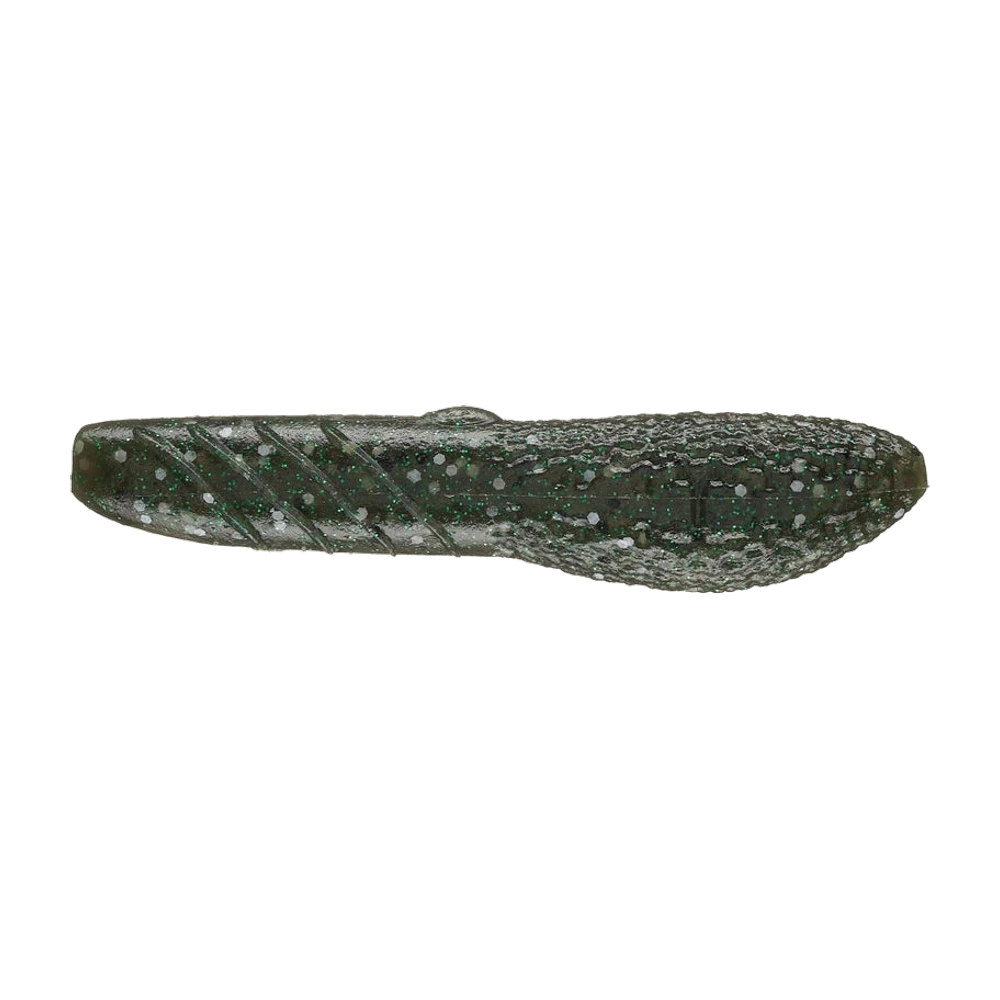
The rear of the bait is swollen and covered in a recessed texture, clearly visible in the photo. Deps explains that this dimpled surface gives the body the same texture and vibration as a crawfish underwater. In practice that is not a swimming action: the Cover Scat has no appendages and kicks nothing. It is a contact and micro-turbulence signature, working on the lateral line at close range rather than pulling fish from a distance. Worth knowing before you buy: this bait does not cover water, it gets dropped onto a fish you have already located.
The complete absence of appendages — no claws, no tail, no skirting — is the second pillar of the concept. An elaborate creature bait like the O.S.P Dolive Craw hangs up far more readily in a fork of branches, simply because it offers more to catch on. The Cover Scat comes back out of a brush pile the same way it went in.
Rigging, designed into the mould
Deps moulded three features purely to serve weedless rigging: a hook guard cup, a belly slot to seat the hook shank, and a bulb on top of the back that caps the point. The belly slot has a concrete mechanical effect — with less plastic to shift down the hook shank on the hookset, the point clears faster and your hook-up rate goes up. That is the classic complaint about very thick baits, and it is exactly where Deps put the engineering.
On hooks, the maker gives recommendations by size: offset 1/0 or 2/0 for the 2.5 in, 3/0 for the 3 and 3.5 in, 6/0 or 7/0 for the 4 in. The jump from 3/0 to 6/0 looks odd until you handle the biggest size: a short hook no longer offers enough gap to clear that much plastic.
With a bait this heavy the instinct is to follow the drop on a tight line. Don't. Leave slack through the whole fall: slack is what delivers the horizontal attitude those fins promise, and a tight line swings the bait back towards you on an arc exactly when it should be dropping down the face of the piling.
Pitch it, let it go, do nothing
The retrieve has three beats, and the third is the hard one. Pitch or skip the bait tight to the obstruction, leave the line slack while it reaches bottom or the depth of the spot, then do nothing for three to five seconds. The bite very often comes on that pause, or shows up when you re-establish contact and the line has simply gone heavy.
If nothing happens, two or three small lifts of the rod tip are enough before you reel in and place the bait a metre further along. The Cover Scat is a precision tool: you do not drag it twenty metres, you work a dock piling by piling and a laydown branch by branch. On a ten-metre stretch of cover, fifteen casts is not excessive.
The mistake that costs bites
Adding a bullet weight out of habit. The bait was designed to be fished bare, and a standard Texas weight kills two of its qualities at once: it pulls the nose down, cancelling the horizontal attitude, and it speeds up a fall that was already deliberately fast. If wind or current stop you feeling the drop, change size rather than adding lead — stepping from the 3 in to the 4 in already adds 14 g / 0.5 oz.
Not sure what to tie on?
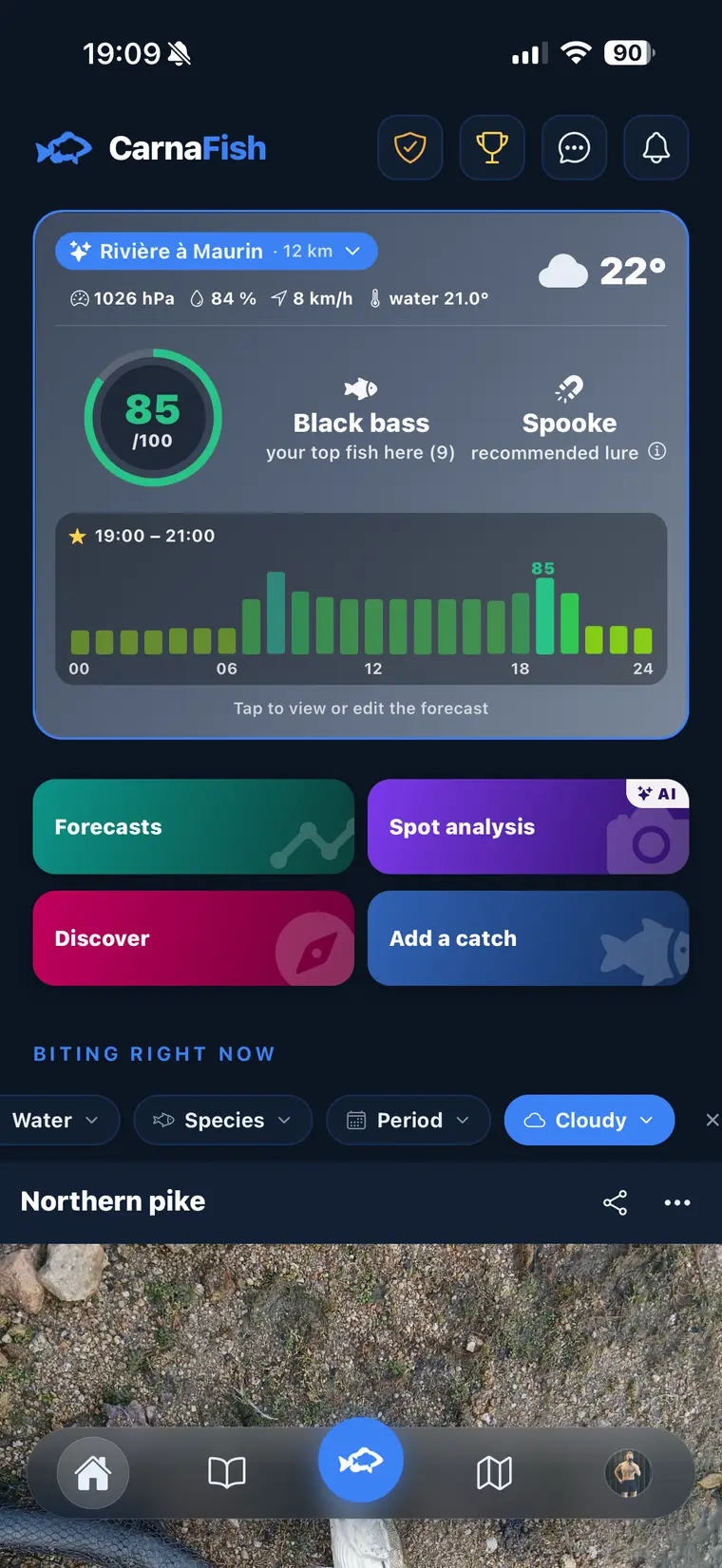
Photograph your spot: CarnaFish reads the scene, cross-checks the conditions and gives you the zone, the lure and the retrieve. Free on iOS and Android.
Where and when to use it
This is a vertical-structure bait first and foremost: leaning trees, dock pilings, bridge pillars, dam riprap, submerged bushes along the bank. It genuinely comes into its own when bass bury themselves in cover — peak summer heat, bright light, heavy fishing pressure — and far less when fish are chasing in open water. In Europe, waters holding bass with that kind of flooded timber are fairly uncommon, which mechanically limits the number of days this is the right tool. Worth knowing before you order all four sizes.
Colour by water clarity
- Clear to lightly stained water: flaked green pumpkin tones, like the one in the photo with its green flake and white dots, remain the baseline. Against dark branches the bait stands out just enough.
- Hard bottom, flooded wood, crawfish present: a crawfish brown plays to the consistency of what the dimpled texture already imitates.
- Dark water, heavy colour or low light: black and blue, for a clean silhouette seen from below.
A bait built for cover is useless if you fish the wrong tree. That is exactly what CarnaFish sets out to simplify: a photo of the spot, and the app suggests a zone and a presentation suited to the day's conditions. To build the tackle and spot-reading fundamentals before you take on flooded timber, our beginner's guide to bass fishing is a good place to start.
Key takeaways
- 40% salt and a very dense plastic: the bait casts and fishes with no weight, from 7 g / 0.25 oz in 2.5 in to 26.5 g / 0.94 oz in 4 in.
- Two side fins hold the body flat through a deliberately fast fall — provided you leave the line slack.
- No appendages, a dorsal bulb guarding the point and a belly slot: it goes into cover and comes back out without snagging, and it hooks better than a typical thick bait.
- It is a precision bait for vertical structure, not a search bait.
FAQ
Do I need to add weight to the Cover Scat?
No, it is built to be fished bare. The mass comes from the salt in the plastic, and a bullet weight would wreck the horizontal fall those side fins exist to maintain. If you need more weight, step up a size instead.
Which size should I start with?
The 3.5 in (8.9 cm, around 16 g / 0.56 oz) is the best compromise: heavy enough to cast and skip easily, compact enough not to put off a sluggish fish. The 2.5 in becomes interesting under heavy fishing pressure.
What hook should I rig it on?
Deps recommends an offset 1/0 or 2/0 in 2.5 in, 3/0 in 3 and 3.5 in, and 6/0 or 7/0 in 4 in. The belly slot seats the shank and the dorsal bulb takes the point for a fully weedless rig.
Does the Cover Scat sink or float?
It sinks, and fast. The maker does not publish a buoyancy class for this model, but it describes an ultra-high specific gravity material and a fast fall: there is no floating version.
Can I use it to cover water on long casts?
That is not its ground. With no appendages and no kicking tail it puts out no long-range signal: its crawfish-type vibration works at close quarters. To cover water, a bait with an active tail like the O.S.P Dolive Shad does a far better job.
How is it different from a standard stickbait?
A standard stickbait trades on a slow gliding descent in open water. The Cover Scat does the opposite: far denser, shorter, appendage-free, and built to punch quickly through a layer of obstruction and settle under the cover.
The full bass lure guideSeason-by-season strategy: which family of lure, when, and why.Go from theory to fish
CarnaFish reads your spot from a photo and gives you the game plan: zone, lure, retrieve. Free on iOS and Android.