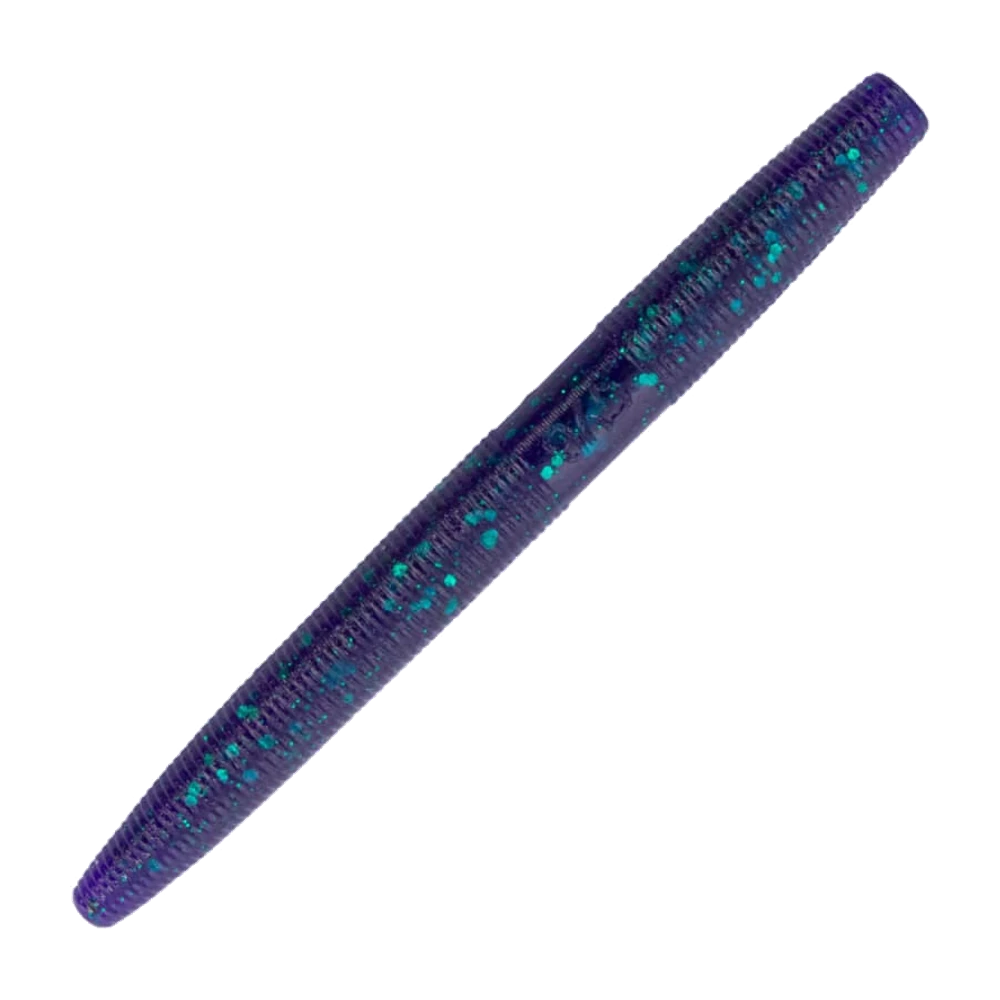
Yamamoto Senko 5-inch: the stick worm that invented the modern wacky rig
Not sure this lure fits YOUR spot today? CarnaFish tells you in 10 seconds, from a photo.
Back in the 1990s, Gary Yamamoto released a plastic stick with no tail, no legs, no appendage of any kind. On paper, it looks like nothing. In the water, it changed bass fishing in the US, then everywhere else. The Senko became so central that "wacky rig" — the technique that made it famous — is now used for any worm rigged the same way, even from brands that have nothing to do with Yamamoto.
Why a plain fall is enough
What makes the Senko work isn't a complex shape — it's density. The plastic is salt-impregnated and compressed, making it heavier than water without any added weight. Rigged weightless, it sinks on its own, slowly, wobbling through a hypnotic spiral. No hardbait replicates that motion, because no hardbait has this combination of softness and density.
That fall, and that fall alone, triggers most of the strikes. There's almost nothing to do: cast, let it sink, set the hook if the line moves.
The wacky rig, step by step
Push a thin-wire hook — an Owner Wacky Hook or Gamakatsu Skip Gap style — straight through the middle of the body, perpendicular to it. The bait then folds into a V on the fall and kicks on both sides at once — that's the famous shimmy.
- Pure wacky, weightless: best in clear, shallow water (under 3 m/10 ft) where you can watch the fall.
- Wacky with a nail weight: a small tungsten nail inserted in one end speeds the fall to reach fish holding deeper, without killing the shimmy.
- Texas nose-hooked: for covering more water or slipping through light cover, at the cost of a straighter, less dramatic fall.
A rule that holds for every finesse worm: the clearer the water and the more spooky the fish, the less you should move it. The Senko fishes best when you do nothing.
The mistake that kills the action
The classic trap: rigging too thick or too large a hook. Heavy wire stiffens the plastic and turns the shimmy into a faint tremor. Stick to a thin-wire hook sized for a 12.7 cm body — action beats apparent toughness every time.
Colour and visibility
- Clear to lightly stained water: Green Pumpkin, the do-everything shade that reads as pretty much anything crawling on the bottom.
- Dark water or low light: Black/Blue, a clean silhouette that shows up well.
- Heavily pressured water: Watermelon Red Flake, more subtle and less associated with the "obvious" colours that pressured bass learn to avoid.

Not sure what to tie on?
Photograph your spot: CarnaFish reads the scene, cross-checks the conditions and gives you the zone, the lure and the retrieve. Free on iOS and Android.
Senko, Fluke, or finesse worm: how to choose
The Senko isn't the right tool for everything. On a spot where fish are actively feeding up top, a horizontally-worked Zoom Super Fluke will do better. And when fishing pressure is so high even the Senko stops working, it's worth downsizing to a Yamamoto Kut Tail Worm on a ned rig — an even more subtle presentation.
Where and when it shines
The Senko does its best work on clearly identified vertical targets: docks, laydowns, pier edges, weed lines. The approach is always the same: cast tight to the structure, let it sink at least to mid-depth before working it back, and repeat on the other side of the cover if nothing happens.
Before knowing where to cast, you need to spot the right targets. That's where CarnaFish comes in: the app reads a photo of your water and hands you a zone and a presentation suited to the day's conditions — a useful companion to our beginner's guide to bass fishing, which covers tackle and typical spots.
Key takeaways on the Senko 5"
- Dense, salt-impregnated body that sinks on its own — the fall does the fishing, not the retrieve.
- Wacky rig for the most dramatic fall, Texas rig for covering more ground.
- Thin-wire hook is non-negotiable to keep the shimmy alive.
- Pairs well with a Fluke (active topwater) and a Kut Tail worm (extreme finesse on pressured fish).
FAQ
Do you need to add weight to the Senko?
Not necessarily. In shallow, clear water, pure weightless is enough. Past 3-4 m, or to speed up the fall to reach fish holding deeper, a small tungsten nail weight inserted in the body works without killing the action.
What hook for a wacky rig?
A thin-wire, wide-gap hook, pushed through perpendicular to the middle of the body. Heavy wire stiffens the plastic and reduces the Senko's signature shimmy.
Does the Senko work in murky water?
Less well than in clear to lightly stained water, since its strength relies on a subtle visual presentation that fish need to spot from a distance. In very murky water, a vibrating bait like a chatterbait usually outperforms it.
What size Senko should I use?
The 5-inch is the most versatile size, suited to most bass. On heavily pressured water, downsizing can restart the bite when the standard size stops working.
Can you fish the Senko with a standard cast-and-retrieve?
Yes, Texas nose-hooked, it fishes like a regular worm on a cast-and-retrieve. But the presentation that built its reputation remains the wacky rig, fished almost sight-fishing style near vertical cover.
Why isn't my Senko falling straight?
Check that the hook is centred and perpendicular to the body. An off-centre rig unbalances the fall and kills the symmetrical shimmy that makes the bait work.
The full bass lure guideSeason-by-season strategy: which family of lure, when, and why.Go from theory to fish
CarnaFish reads your spot from a photo and gives you the game plan: zone, lure, retrieve. Free on iOS and Android.