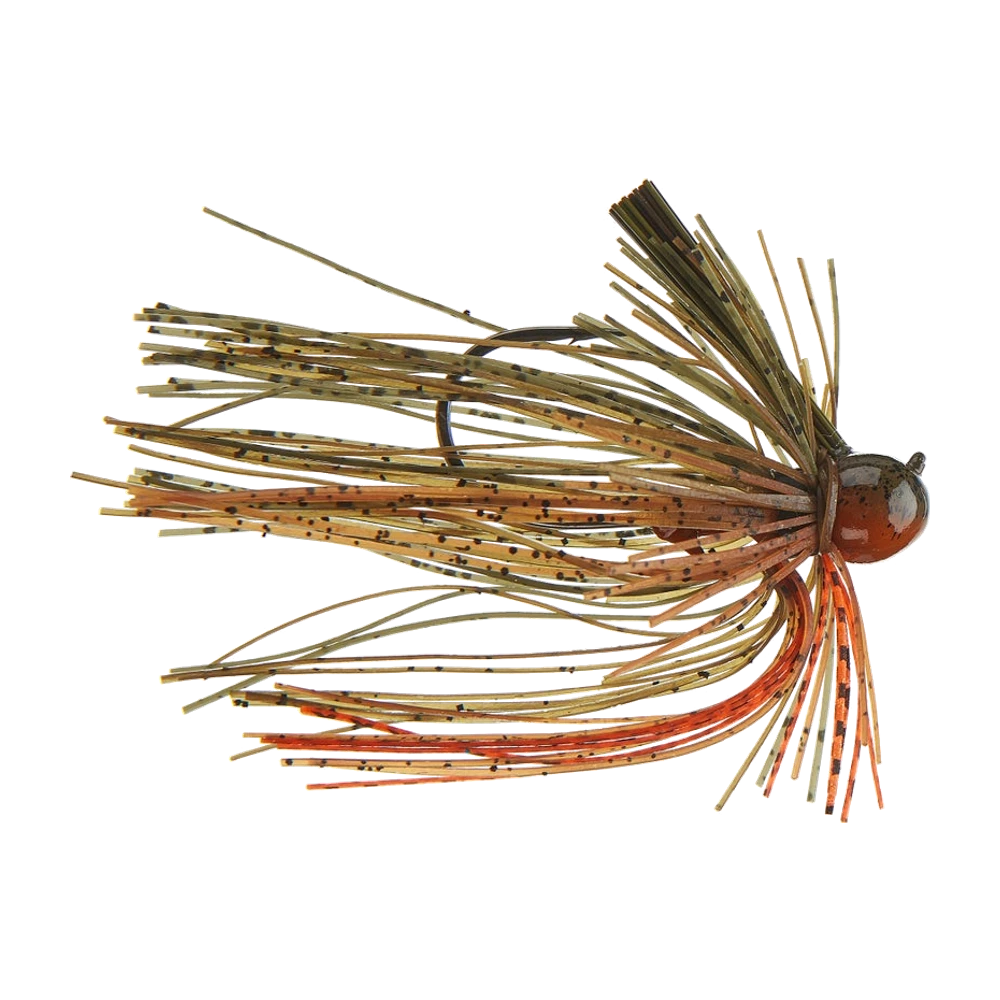
Dirty Jigs Luke Clausen Finesse Jig: small profile, serious hooking power
Before tying this one on, it helps to know if the spot actually calls for it. CarnaFish reads the scene from a photo.
November, water at twelve degrees, a lake that saw three boats go through the weekend before. The big black and blue jig that worked wonders in May brings nothing back, and the temptation is to switch to a drop shot to save the day. There is an intermediate step most people skip: keep the jig, but scale everything down — head, skirt, trailer, line diameter. That is exactly where the Luke Clausen Finesse Jig lives, designed by an angler who has won both a Bassmaster Classic and a Forrest Wood Cup, so hardly someone you would accuse of fishing small out of timidity.
A finesse jig is not just a smaller jig
The difference from a flipping jig is not only bulk. A finesse jig is fished slowly, often on a visible target or an identified break, with thin line and a forgiving rod: the whole setup exists so the fish holds the bait one second longer. That means a head that does not wedge in rock, a short but thick hook, and a skirt detailed enough to survive inspection from a fish that comes to look before it eats.
Dirty Jigs describes the head here as all-terrain, built to go into and back out of cover without sticking. That is a concrete point: over rock, half of your snags come from a head that drops into a crack instead of riding around it. Next to the Luke Clausen Compact Pitchin' Jig from the same designer, this one targets a different moment of the season — not the fish buried in thick cover, but the wary fish hanging around it.
What the description spells out, and what it leaves unsaid
Three hardware details deserve attention. The hook first: a compact 4/0 Gamakatsu, so a short wide-gap wire rather than a long flipping hook, with a flat line tie angled at 60 degrees. That angle changes the pull axis on the hookset and helps the point drive upward into the roof of the mouth instead of sliding along the jaw.
Then the line tie recessed into the head. On a finesse jig you fish thin fluorocarbon and rub rock all day; a protruding eye exposes the knot on every contact. Recessing it protects the weak point of the whole setup, and you can check it at the end of the day by running the knot between your fingers — it is noticeably less chewed up than with a standard head.
Finally the finish: a three-tone airbrushed paint job under a thick epoxy clear coat. The practical benefit is not the shelf photo, it is that a jig dragged over gravel does not turn lead grey after two outings.
What the description does not give is the head weight, the length, or any mention of a weedguard. So I will not invent one: if you plan to fish wood or dense grass, check that point on the packaging before buying, because a jig with no guard behaves very differently in cover. For weight, apply the usual finesse rule — the lightest head that still lets you feel bottom.
Two retrieves that cover 90% of situations
The slow drag on hard bottom
This is the finesse jig's core use. Cast, let it sink on a tight line, then move the bait with the rod alone, very slowly, taking the tip from nine o'clock to eleven over five or six seconds. Pick the slack back up with the reel, reset the rod, repeat. The jig must stay in permanent contact with the bottom: you should feel the difference between gravel, rock and silt without ever lifting it clear.
The bite on this retrieve feels like nothing you would recognise. No knock at all: just weight that gets added, as if you had picked up a dead leaf. When in doubt, drop the rod, take up the slack and set. You will set on nothing ten times, and the eleventh will be the fish of the day.
Skipping under cover
The compact profile and the soft skirt suit skip-casting well, which lets you slide the jig deep under a dock or a leaning tree where a normal cast will not reach. Rod low, whipped sideways, the jig skims the surface and bounces two or three times before sinking. It takes practice and costs a few backlashes, but it is the only way to reach fish that never see a lure.
Not sure what to tie on?
Photograph your spot: CarnaFish reads the scene, cross-checks the conditions and gives you the zone, the lure and the retrieve. Free on iOS and Android.
Trailer, line and rod
In finesse fishing, the trailer mainly sets fall speed. A small craw with slim claws, say a Berkley PowerBait Chigger Craw trimmed short, slows the drop and adds a flutter at rest. A compact trailer with no appendages does the opposite, letting the jig fall straight and fast, which is what you want deep or in wind.
For line, 10-14 lb fluorocarbon is the obvious call: discreet, abrasion resistant, and it sinks, which helps keep contact. A medium-heavy rod of 1.95 to 2.05 m with a moderate-fast action cushions head shakes, because thin line does not let you win an arm wrestle.
The classic mistake
Fishing a finesse jig at a normal jig's pace. Plenty of anglers make three hops, two turns of the handle, and recast after fifteen seconds. A proper finesse jig pass along a fifteen-metre break takes two to three minutes. If it feels painfully slow, you are probably going at the right speed.
Colours by water clarity
- Clear water, gravel or grass bottom: Green Pumpkin, the default choice, neutral enough never to give the bait away.
- Rocky bottom with crawfish present: Brown Craw, which matches a real crawfish and justifies the dragging retrieve on its own.
- Stained water or low light: Black and Blue, a clean silhouette that still reads when visibility drops under a metre.
A finesse jig punishes a bad read of the bottom: drag it over soft silt while the rock break sits ten metres further out and you get nothing. That is where CarnaFish saves you time — a photo of the spot, and the app suggests the zone, the depth and the kind of presentation that suits the day. For tackle and spot-reading fundamentals, our beginner's guide to bass fishing is a good companion.
Key takeaways
- The 60-degree flat line tie recessed in the head protects the knot from abrasion, which matters on thin fluorocarbon over rock.
- The head is described as all-terrain, meaning it avoids wedging in cracks rather than clearing weed.
- The description states no weight, no length and no weedguard — check the packaging if you fish dense cover.
- The slow bottom-contact drag is the reference retrieve, and it takes two to three times longer than you think.
FAQ
How does it differ from the Compact Pitchin' Jig by the same designer?
The Compact Pitchin' Jig is stated to have a fiber weedguard and is made to place the bait inside thick cover. The Finesse Jig leans on an all-terrain head and a recessed line tie, for slow dragging around cover rather than through it.
Will this jig come through weed?
The description mentions no weedguard, so nothing supports that claim. Treat it as a hard-bottom jig: rock, gravel, dock edges, scattered wood. For thick grass, look for a model with explicit protection.
What line diameter should I use?
10-14 lb fluorocarbon covers most situations. Go thinner and you gain stealth but lose the margin needed to pull a fish away from an obstacle; go heavier and you cancel part of the point of fishing finesse.
Does a finesse jig work in summer?
Yes, especially on busy waters and in the hot hours, when fish refuse big profiles. It remains most decisive in cold and clear water, the two situations where slowing down pays best.
What is the 60-degree line tie for?
It changes the pull angle on the hookset. With a pronounced angle the point travels upward and lodges more often in the roof of the mouth, which gives more secure hookups on thin line where you cannot set hard.
Should the trailer be loud or subtle?
Subtle in the large majority of cases, since the whole approach is about reducing the signal. A trailer with big flapping claws has its place in stained water, but in clear water it cancels the advantage you were after by going finesse.
The full bass lure guideSeason-by-season strategy: which family of lure, when, and why.Go from theory to fish
CarnaFish reads your spot from a photo and gives you the game plan: zone, lure, retrieve. Free on iOS and Android.