Dirty Jigs Compact Double Willow: the spinnerbait for educated fish
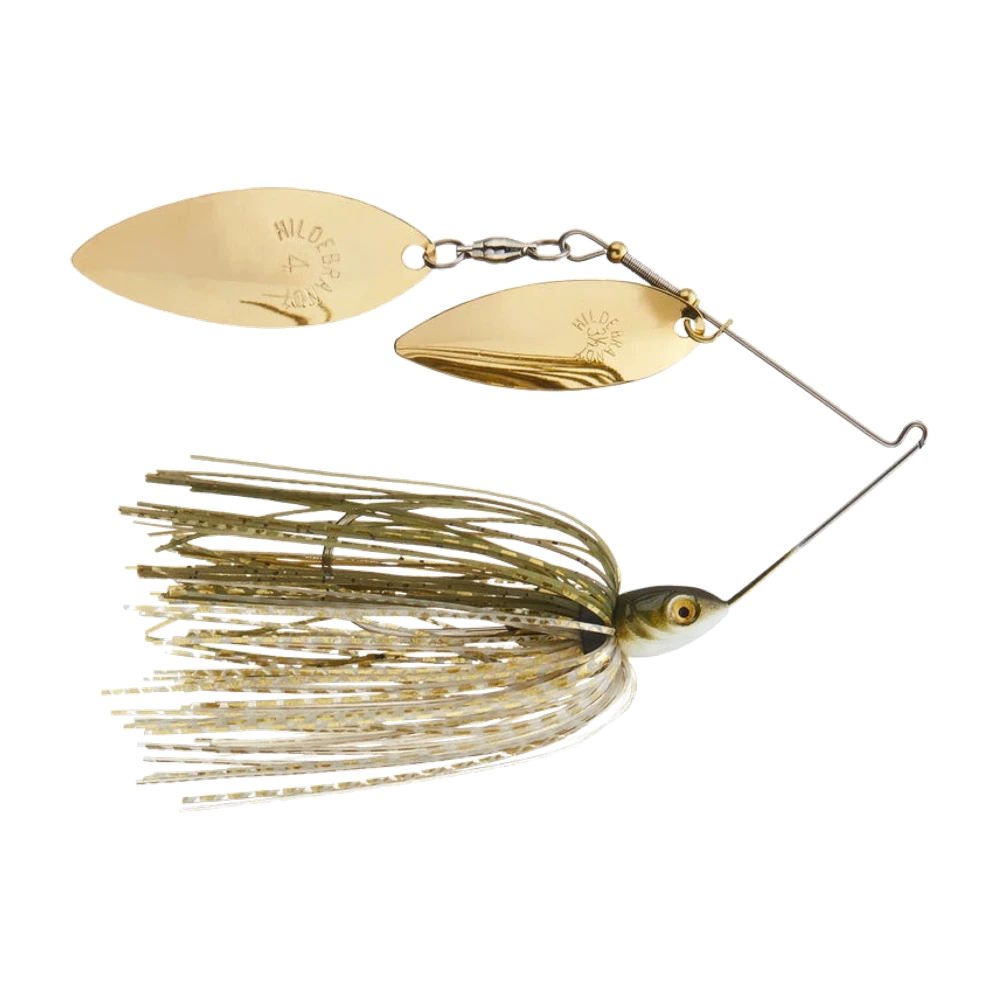
This lure shines under specific conditions. CarnaFish tells you in 10 seconds if today is one of them.
There is a moment on any heavily fished water when the standard spinnerbait simply stops producing. Not because the fish have left, but because they have watched the same bulk of skirt and the same Colorado thump go past every weekend since May. The Dirty Jigs Compact Double Willow is built for exactly that moment: same family of lure, same working principle, but everything dialled down a notch.
Small profile: what it actually changes
A standard spinnerbait is thrown to be seen from a distance. It moves water, it thumps, it makes noise, and in water nobody has fished for three weeks that works beautifully. The problem starts once the fish have learned to associate that signature with something that is not food.
Dirty Jigs attacks the problem from two directions. First the skirt, cut short and in fine strands — a finesse cut that reduces the apparent bulk of the lure and lets it flare faster with less inertia. Then the head, hand-painted with sculpted gill plates and realistic eyes, shaped like a small baitfish rather than a generic bulb. The result is not "a prettier spinnerbait", it is a lure whose silhouette holds up when the fish inspects it up close instead of eating it on faith from a distance.
That reduced profile comes with a cost you have to accept: the lure sinks more slowly and casts shorter than a heavy model. You gain credibility, you lose range. Into a headwind you feel it on the very first cast.
Twin willows, and why not a Colorado
The blade choice is not cosmetic, it is most of the lure's behaviour. Dirty Jigs hangs two Hildebrandt willow leaf blades here, and that choice shapes everything else.
A willow leaf spins tight, close to the shaft, and returns a lot of flash for very little vibration. A Colorado does the opposite: it swings wide, thumps heavily, and announces itself to the fish through pressure on its lateral line more than through light. By doubling up on willows, Dirty Jigs deliberately picks the flash-and-subtlety camp — exactly what you want when fish are keyed on small schools of bait in relatively clear water and refuse anything that pounds too hard.
The trade-off is worth knowing before you buy: in genuinely dirty water, or at night, two willows do not put out enough signal. That is where a Colorado-bladed spinnerbait like a Booyah Covert Spinnerbait keeps the advantage, and there is no reason to force the Compact Double Willow into a job that is not its own.
Count the handle turns between the splashdown and the first bite, over two or three fish. With willows the productive speed window is narrow: too slow and the blades stall, too fast and the lure climbs out of the water. Once you find the tempo, hold it for the whole session.
The trailer is not optional
The wire bait keeper welded to the hook is not decoration: Dirty Jigs designs this spinnerbait around a small finesse swimbait on the back. That is not a regional habit, it is part of the design.
A paddle-tail swimbait adds a tail kick that layers on top of the blade flash, and it lengthens the silhouette without thickening it. A Keitech Swing Impact Fat 3.8 or a Zman Slim SwimZ fills that role without upsetting the balance.
Three rigging details that matter
The first: thread the trailer dead straight on the shank. A swimbait rigged crooked makes the whole spinnerbait helicopter, and the fault is invisible from the bank — you will only catch it by watching the lure over the last few metres.
The second: do not push the trailer too far down the bend. It has to stop short, otherwise it shrouds the point and you will pay for that on the soft bites.
The third: line. Fluorocarbon in the 10 to 14 lb range is plenty on a lure this size, and it transmits blade vibration into the rod better than braid with a long leader. If you are fishing water that holds pike, accept a thin wire trace — but know you will give up some of the finesse that makes this model worth owning.
The classic mistake: fishing it like a big spinnerbait
The temptation is to cast long and burn it back, the search-bait reflex. With this model that is the surest way to blank: too fast and the two willows flatten against the shaft while the lure rides up to the surface producing nothing.
The right approach is the opposite. Cast short, pick precise targets — a weed edge, a laydown, a rock line — and bring it back at a steady medium speed, letting the lure graze the cover. Half a turn of acceleration as it touches the structure stalls a blade for a fraction of a second, and that is very often when the bite comes.
Not sure what to tie on?
Photograph your spot: CarnaFish reads the scene, cross-checks the conditions and gives you the zone, the lure and the retrieve. Free on iOS and Android.
Where and when it takes over
The Compact Double Willow is at its best in clear to lightly stained water, with decent light, when fish are hunting small forage. Late spring, then late summer and early autumn when the year's fry bunch up into tight schools: that is its window.
On heavily pressured waters it becomes interesting even in peak season, simply because it does not look like what the fish sees every day. For perch, the compact format works in its favour too: a standard spinnerbait is often too big a mouthful for an average perch, while this one stays inside what she can actually eat.
One point of honesty: Dirty Jigs publishes neither length, nor weight, nor blade sizes in its description. The lure exists in several weights, but the exact value of each reference has to be read off the packaging at the point of sale. If you are building a precise setup around a given weight, do not trust an estimate found online.
Colors by water clarity
- Clear water, bright sun: a natural silver and gold scheme, like the finish in the photo. The gold blades already produce plenty of flash, there is no need to add more on the skirt.
- Overcast, lightly stained water: a dark back over a pale belly. That vertical contrast stays readable even when low light stops the blades from doing their job.
- Stained water with heavy forage: a louder tone, chartreuse or solid white, so the lure does not vanish inside the real bait school.
Recognising the day a fishery demands the small profile is worth more than any fully stocked box, and that is exactly what CarnaFish helps with: one photo of the spot, and the AI suggests the zone, the depth and the lure family that suit the day. To go further on structure and tackle, our beginner's guide to bass fishing lays out the full framework.
Key takeaways
- Finesse-cut skirt and a hand-painted baitfish head: a spinnerbait designed to be inspected up close, not spotted from far away.
- Two Hildebrandt willow blades mean lots of flash and little vibration: this is a clear-water, educated-fish lure.
- The wire bait keeper is part of the design: the model expects a small finesse swimbait on the back.
- Neither length nor weight is published by Dirty Jigs: check the packaging if your setup depends on an exact weight.
FAQ
What is the difference between willow and Colorado blades?
A willow leaf spins tight and mostly produces visual flash. A Colorado swings wide and sends out strong vibration the fish picks up on its lateral line. Two willows is a clear-water, wary-fish choice; a Colorado earns its place in dirty water.
Do I have to run a trailer on this spinnerbait?
It is not mandatory, but the wire bait keeper shows the lure was built for one. A small finesse swimbait adds a tail kick and lengthens the silhouette without bulking it up.
Which weight should I pick in the range?
Dirty Jigs does not publish weights in its description, so the only reliable answer is to read the packaging. In practice the lightest weight that still reaches your target depth is always the right call on a finesse lure.
Does this spinnerbait work for perch?
Yes, and that is one of its strengths in Europe: the compact format stays inside what an average perch can swallow, where a standard spinnerbait is usually too much of a mouthful for her.
Can it be fished in dirty water?
It can, but that is not its ground. Two willow blades put out very little vibration, so in heavily coloured water or at night a Colorado-bladed model or a bladed jig will announce itself far better.
Why does my spinnerbait roll over on the retrieve?
In the vast majority of cases it is a trailer threaded crooked on the shank. Check it sits perfectly in line. If the fault persists, make sure the wire arm has not been bent out of true by a fish or a snag.
The full bass lure guideSeason-by-season strategy: which family of lure, when, and why.Go from theory to fish
CarnaFish reads your spot from a photo and gives you the game plan: zone, lure, retrieve. Free on iOS and Android.