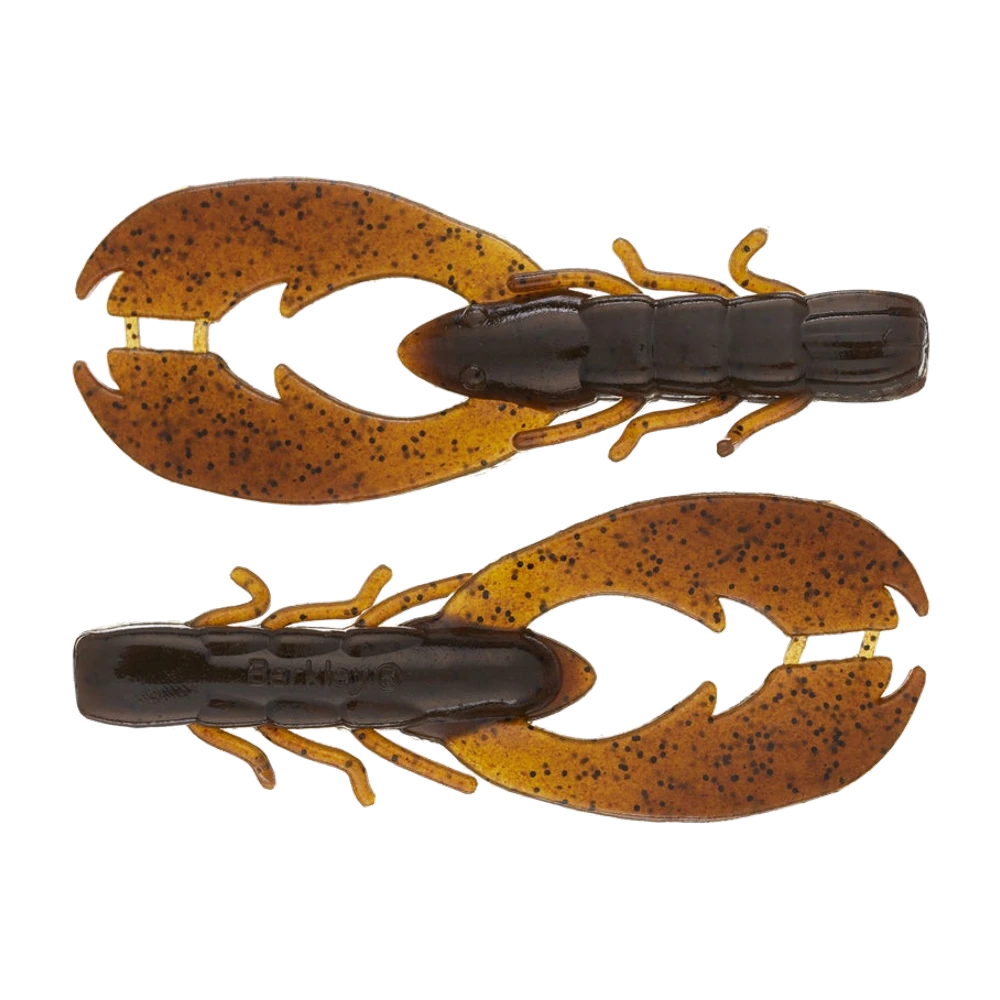
Berkley Chigger Craw: the soft craw for Texas rigs and jig trailers
Rather not fish it blind? Photograph your spot — CarnaFish cross-checks the conditions and points you the right way.
A crayfish sitting on the bottom is never perfectly still. Even in its defensive posture, claws up, it keeps working its legs and antennae - and it is that micro-movement, not travel, that gives it away to a bass holding two metres off. Most soft imitations forget this: they only live during the pull and go back to being a lump of plastic the moment the lure settles. The Chigger Craw is built around the other half of the problem.
What moves while you do nothing
Berkley moulded small appendages along both sides of the body, in addition to the two claws. The detail looks trivial on the rack; in the water it changes the nature of the bait. The flat claws work on the drop and on the pull, like any soft craw, but those much finer side appendages keep undulating under the slightest current or the slightest tremor passed down the line, with the lure at rest.
That is exactly what late-summer and early-spring fishing asks for, when fish refuse to chase anything but will eventually inhale a meal that stays within reach and keeps on living. You drop it, you wait ten seconds doing nothing, you re-establish contact. The lure, meanwhile, never stopped working.
When in doubt, don't pull: shake. Keep the bait in contact with the bottom and vibrate the rod tip on the spot without moving the line more than a couple of centimetres. The appendages go wild, the craw never leaves its defensive posture, and that is often the precise moment the line swims off sideways.
Two sizes, two distinct jobs
The manufacturer lists two lengths, and they do not do the same work.
- 7.6 cm / 3 in, ten to a pack. The versatile size, equally at home on a light Texas rig over hard bottom or as a trailer on a compact jig. Its reduced profile makes it a credible option for a big perch along a rocky margin - a use American anglers never bother with but which makes complete sense in Europe.
- 10.2 cm / 4 in, nine to a pack. The flipping size, the one you pitch into sunken timber with a 10 to 18 g bullet weight to look for a single better fish. More volume, so more water displaced, but fewer bites.
Berkley does not publish the weight of the bare bait, and it hardly matters: on a Texas rig as on a trailer, the sinker or the jig head sets the fall rate. Work on the basis that you pick the depth and the cover density first, then the weight, and only then the size of the bait.
The two reference rigs
Weighted Texas rig for flipping
Tungsten bullet, pegged or free, a 3/0 wide-gap hook on the 7.6 cm and a 4/0 on the 10.2 cm, point tucked back into the body. You pitch the bait against a piece of cover - a tree base, a dock piling, a reed edge - and let it drop on a controlled line without holding it back. Half the bites come on that first fall, often with nothing more than a line that stops going down. That is why you keep an index finger on the braid during the descent.
For that job the Chigger Craw plays in the same register as a Zoom Brush Hog, with a more pronounced craw profile and fewer swimming appendages.
Jig trailer
This is the historical use of the bait and where it adds the most. Threaded behind a tungsten football jig it bulks up the silhouette, slows the fall and adds a source of movement behind the silicone skirt. Push the body onto the hook until the claws just clear the skirt: too far on and you choke the appendages, not far enough and the bait slides out of line at the first rock.
One rigging tip that saves grief: open the body with a needle before pushing the hook through. On a craw of this volume the plastic tends to tear if you force the point.
The scent, and why it genuinely matters here
The body is impregnated with Berkley's PowerBait formula. On a fast presentation a scent changes very little: the fish decides in a fraction of a second. On a slow bottom presentation like this one it has a measurable effect, because the fish takes the time to chew before making up its mind. Every second gained in that phase is another second to set the hook before the bait gets spat out. That is also why the outer texture of this model is worked in relief: a rough surface holds scent better than a smooth one.
The mistake to avoid: setting on the first contact
Fishing a Texas rig on the bottom, you constantly feel contacts that are not bites: a branch, a rock, a change of substrate. Setting the hook on every sensation loses you baits, drags the rig out of the zone and, above all, makes you miss the real bites, which are usually far subtler than a knock. Learn the difference: a rock resists then releases, a fish pulls and keeps going. When in doubt, drop the rod, take up contact gently, and only set if the weight is still there.
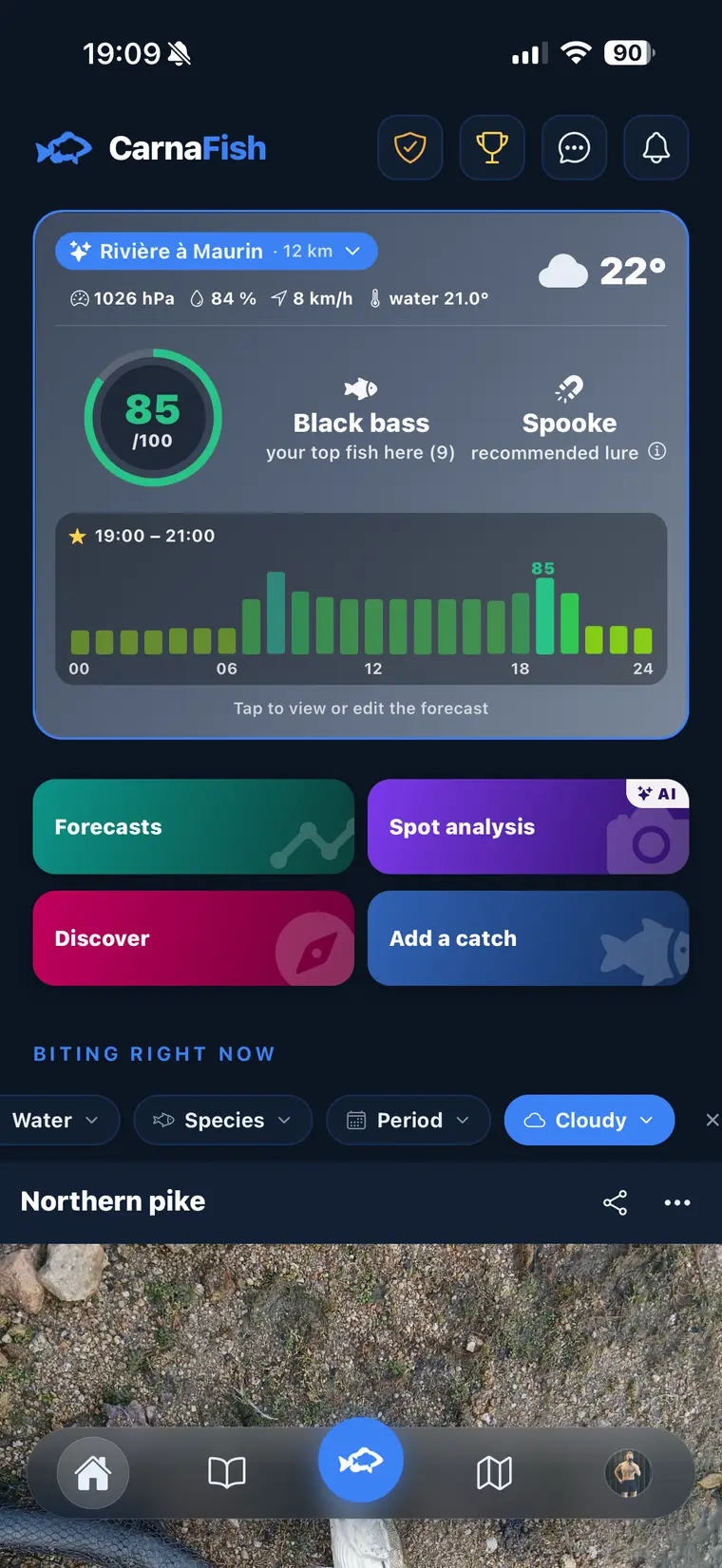
Not sure what to tie on?
Photograph your spot: CarnaFish reads the scene, cross-checks the conditions and gives you the zone, the lure and the retrieve. Free on iOS and Android.
Colours by water clarity
- Clear water, gravel or rock bottom: green pumpkin, the tone that best matches a European crayfish in late summer.
- Lightly stained water: a brown-orange tone with black flake. The orange of the claws imitates a moulting crayfish, a vulnerability signal fish read easily.
- Dirty water, silt bottom, low light: black and blue, the great classic of the jig trailer, which keeps a clean silhouette when no natural tone registers any more.
Where it sits among other craws
The Chigger Craw is not after spectacular action. Against a Strike King Rage Craw, whose claws thrash at the slightest pull, it offers a quieter and more continuous movement. One is for stained water and an active fish you need to alert from a distance, the other for clear water and a wary fish you only convince with finesse. If you want to stay with Berkley but with a more compact profile and sharper claw action, the Powerbait The Champ Craw covers that ground.
Lure choice always comes after reading the water, and that is exactly what CarnaFish makes easier: one photo of the spot, and the AI suggests the zone, the depth and the lure family that suit the day's conditions. To build the method around it, our guide to getting started with bass fishing covers the water worth working first.
Key points
- The side appendages keep working with the bait at rest, which makes it a slow-fishing craw rather than a search bait.
- 7.6 cm / 3 in for versatility and perch, 10.2 cm / 4 in for flipping into sunken timber.
- As a jig trailer, the claws should just clear the skirt rather than be buried in it.
- Half the bites come on the first fall: stay in contact with the line during the descent.
FAQ
Which Chigger Craw size should I pick?
The 7.6 cm / 3 in for versatility, on a light Texas rig or as a compact jig trailer. The 10.2 cm / 4 in when you are pitching into timber and hunting a better fish, accepting fewer bites.
How much does a Chigger Craw weigh?
Berkley does not publish the weight of the bare bait. In practice it makes no difference: the fall rate depends on the tungsten bullet or the jig head you rig it with.
Does the Chigger Craw work for perch?
Yes, in 7.6 cm / 3 in on a light rig along a rocky margin or a rip-rap bank. Big perch feed on crayfish, and the compact profile of that size stays within their reach.
Does it need much animation?
As little as possible. Short pulls separated by long pauses, and above all shaking on the spot without moving the bait: the side appendages do the work, not your arm.
How do I stop the bait tearing when I rig it?
Open the body with a needle before pushing the hook point through, and on a jig slide the bait all the way up to the collar rather than forcing it. A cleanly pierced body survives several fish.
Texas rig or jig trailer - which should I favour?
The Texas rig when you have to get through dense cover and work the fish piece of cover by piece of cover; the jig trailer when you are working a drop-off or hard bottom and want a bulkier silhouette with a slowed fall.
The full bass lure guideSeason-by-season strategy: which family of lure, when, and why.Go from theory to fish
CarnaFish reads your spot from a photo and gives you the game plan: zone, lure, retrieve. Free on iOS and Android.