Gary Yamamoto Uni: the soft urchin for educated bass, on a drop shot
Not sure this lure fits YOUR spot today? CarnaFish tells you in 10 seconds, from a photo.
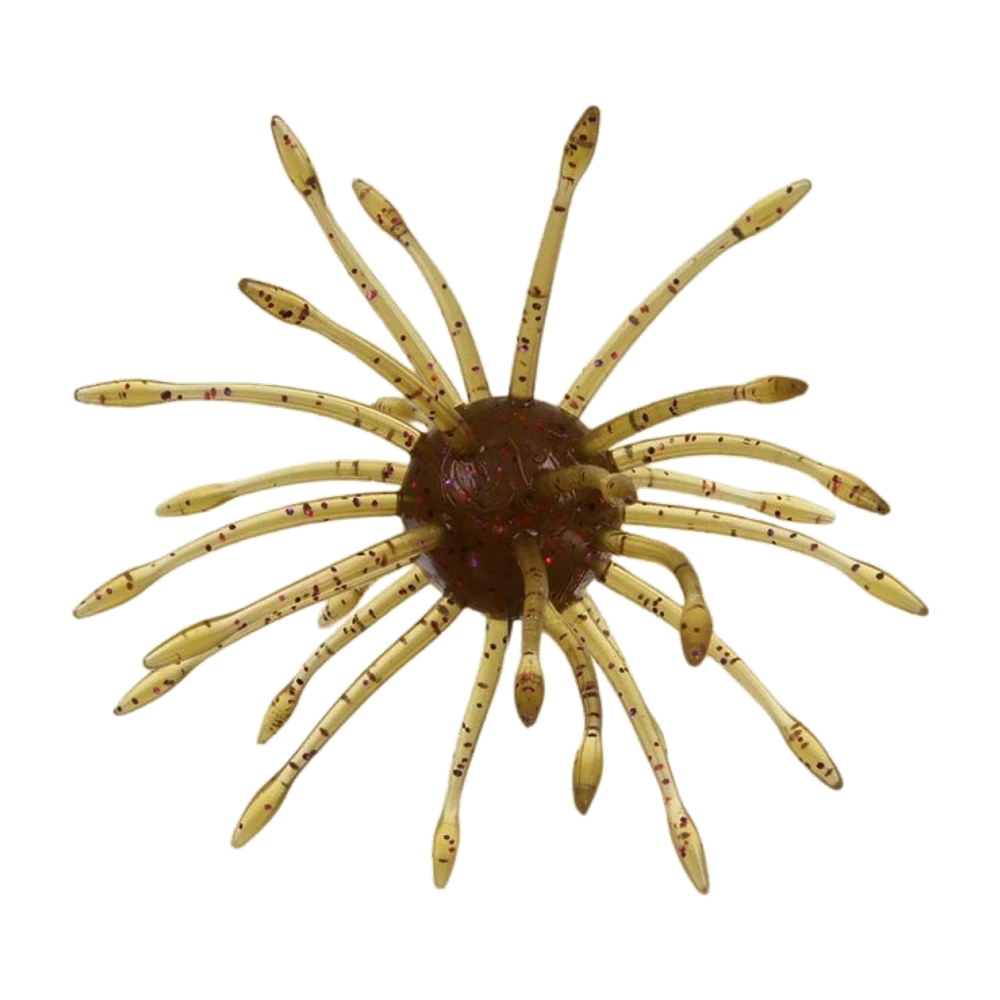
Some days the fish aren't gone, they're just bored. A lake that gets hit every weekend, bass clearly marked on a hump, and fifteen years of craws, worms and swimbaits already paraded past their noses. In those conditions changing colour achieves nothing: you have to change silhouette. The Gary Yamamoto Uni offers a shape the fish has almost never seen — a sea urchin.
What the manufacturer actually publishes, and what it doesn't
Watch the trap on this one: the only dimension Yamamoto gives is a 13 mm core body, and the table column is explicitly headed "length (core size)". So it is not the size of the finished bait, nowhere near. The appendages radiate well beyond that central ball, and the overall span with the appendages out isn't published anywhere. Order on the strength of "13 mm" alone and you'll receive something considerably bulkier than the figure suggests.
There's no per-piece weight either. The maker limits itself to saying the plastic formula was worked to enhance buoyancy and appendage action. That's a manufacturer claim, not a measured density class: you can't conclude from it that the bait floats, only that it's built to stay light at the end of a weighted rig. In practice that shows up as appendages that stay fanned out and horizontal instead of collapsing against the body.
One last thing to know before ordering: the Uni is packaged one per pack. At shop prices that makes it one of the most expensive soft baits per piece you can put in a box. This isn't a search bait you sacrifice on a laydown, it's a bait you pull out on a fish you've already found.
A shape that imitates nothing, and that's the point
Most soft plastics copy a prey item: crawfish, baitfish, goby, larva. The Uni copies nothing. Its spherical body bristling with around twenty slim appendages, each tipped with a small bulb, matches no animal a European bass ever meets. That's exactly its value on an educated fish, which has learned to recognise — and refuse — the silhouettes it sees every week.
The stated action rests entirely on those appendages: they shimmy, twitch and quiver continuously, including while the bait is sinking, with no input from you. Each appendage is thin enough to react to the smallest water movement and long enough for that movement to be visible from a distance. The result is a bait sitting motionless on the bottom that keeps moving while you do nothing.
Drop it in a bucket before you fish and watch it for ten seconds. You'll understand immediately why you must not work it: it already moves more on its own than most baits people shake.
The two rigs the manufacturer stands behind
Drop shot
This is the obvious one. The Uni hooked through the core body or through the base of an appendage, suspended twenty to fifty centimetres above the weight, stays at the fish's level while the crown of appendages works by itself. Drop shot also makes the best use of the claimed light plastic: the bait sits horizontal instead of hanging limp.
Use a 5-10 g cylinder weight and a fine diameter, 0.20-0.25 mm fluorocarbon. The rod's job here is to do nothing: tighten, slacken, wait. The mistake is pulling, because pulling drags the bait down towards the bottom and destroys the height you just set.
Neko rig
A nail weight inserted into the spherical body and the Uni settles on the bottom propped up, crown of appendages standing. This is the rig for fish glued to the substrate, in high summer or late autumn, when they won't lift off any more. Very short tip shakes are enough to set every appendage vibrating at once.
The mistake to avoid
Rigging it Texas-style on a wide gap hook and dragging it like a standard creature bait. The spherical body gives no logical purchase for a Texas hook, and dragging flattens the appendages against the body: you lose the exact thing you paid for. The manufacturer names only the drop shot and the neko rig, and that isn't a coincidence.
Where and when it makes the difference
The Uni works on a shallow edge as well as on a deep spot — the maker presents it as usable in both, and it's the rig's weight that makes the difference, not the bait. Its ground is the apathetic fish: heat, stable water, fishing pressure, a fish sitting on the bottom that no longer follows anything.
In Europe it's also worth trying on big gravel-pit perch late in the season, drop-shotted on a fine diameter. The bristling silhouette triggers the same reflex in them as in a wary bass, and the compact 13 mm core is swallowed without trouble.
Not sure what to tie on?
Photograph your spot: CarnaFish reads the scene, cross-checks the conditions and gives you the zone, the lure and the retrieve. Free on iOS and Android.
Colour by water clarity
- Clear to lightly stained water: Green Pumpkin with red flake, the colour in the photo, discreet enough not to alarm and contrasted enough to stay visible on the bottom.
- Bright light, very clear water: Watermelon, a translucent green that blends into submerged vegetation.
- Dark water or low light: Black Blue, the classic clean silhouette for when fish read outline rather than colour.
Alongside the other finesse baits
The Uni doesn't do the same job as a Yamamoto Senko 5, which leans on a shimmying fall and fishes everywhere, or a Zman TRD Ned Rig, built to stand up and be dragged on the bottom. It sits better next to a 6th Sense Ned Fry Worm in the same box: same slow-fishing philosophy, radically different silhouette. That gap in shape is exactly what you're buying.
An unusual bait is only worth something if you put it in the right place, and that's precisely what CarnaFish is for: a photo of the spot is enough to get a zone, a depth and a presentation type suited to the day's conditions. To go back over finesse tackle and spot-reading basics, our beginner's guide to bass fishing is still a solid starting point.
Key takeaways
- The only published dimension is a 13 mm core body: that is not the size of the bait with the appendages out, which the manufacturer doesn't give.
- No weight published, and buoyancy only claimed as enhanced by the formula, not a measured class.
- Two rigs, and only two according to the maker: drop shot and neko rig.
- Sold one per pack: this is a bait for a located fish, not a search bait.
FAQ
How big is the Uni really?
Yamamoto only states a 13 mm core body. The overall span with the appendages out is considerably larger but isn't published anywhere — don't order on the 13 mm figure alone.
Does the Uni float?
The maker mentions a formula worked to enhance buoyancy, without giving a density class. So you can't say it floats: what you do see is that the appendages stay fanned out instead of collapsing along the body.
Which rig should I start with?
The drop shot, with a 5-10 g cylinder weight and 0.20-0.25 mm fluorocarbon. It's the rig that lets the appendages work best and lets you hold a precise height above the bottom.
Should I work the Uni?
As little as possible. The appendages already quiver on the fall and at rest. A wide sweep flattens them against the body and kills the movement you came for.
Can I rig it Texas-style like a creature bait?
It isn't designed for that, and the spherical body suits it poorly. The manufacturer names only the drop shot and the neko rig. Dragged Texas-style, you lose most of the action.
Does it catch anything other than bass?
Yes, big perch take it on a drop shot with a fine diameter, especially on gravel pits late in the season. The compact core goes into their mouths without trouble despite the apparent bulk of the appendages.
The full bass lure guideSeason-by-season strategy: which family of lure, when, and why.Go from theory to fish
CarnaFish reads your spot from a photo and gives you the game plan: zone, lure, retrieve. Free on iOS and Android.