Gary Yamamoto Scope Shad: the soft minnow built for sonar fishing
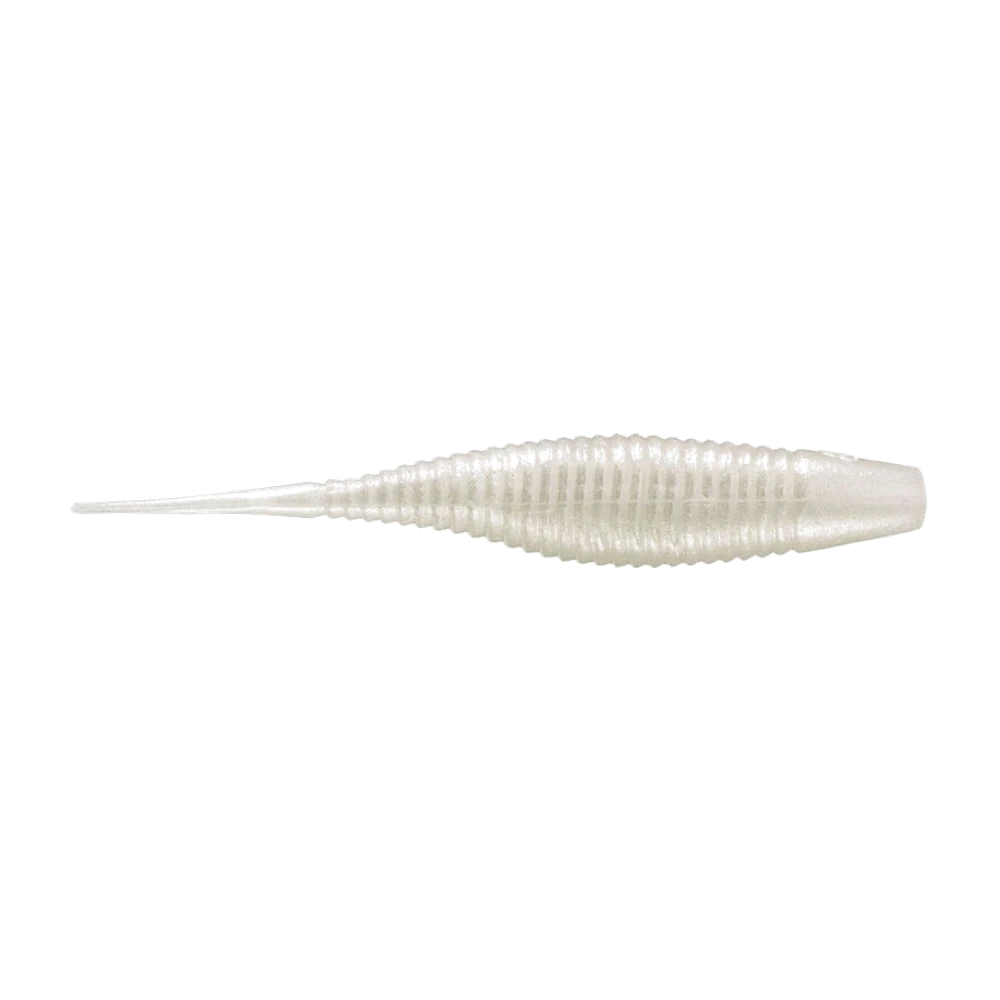
This lure shines under specific conditions. CarnaFish tells you in 10 seconds if today is one of them.
You have the fish on screen. It rises two metres, comes to look, stops ten centimetres from the lure — and drops back down. You have just watched, live, the refusal you never even suspected before you owned a forward-facing sonar. The Scope Shad came out of that exact frustration: a lure that gives as few reasons to say no as possible, and that stays readable on screen while you steer it.
Three sizes, and what the table really says
The maker's description ends with a very compact table that is worth unfolding: three versions exist, 3 in in packs of 10, 3.5 in in packs of 8 and 4 in in packs of 6. In metric that is 7.6 cm, 8.9 cm and 10.2 cm.
That is all the table contains. No per-bait weight is published for any of the three sizes, and there is no buoyancy class column. The maker's copy says the bait is moulded in the Mega Floater formula and sits perfectly horizontal when paused, but that is a claim on their part, not a figure you can check on the sheet. For a lure whose main argument is precisely how it behaves at rest, that is a number you would like to see — in the meantime, a bucket of water and two minutes will tell you exactly where your sample sits.
To choose between the three, start from the size of the forage present rather than the size of the fish you want. The 3 in covers this year's fry, the 4 in a second-year bleak or roach.
A quiver, not a swimming action
The body takes a baitfish profile that tapers down to a small forked tail. There is no blade, no paddle, nothing that moves water: the maker talks about an ultra subtle quiver, and that is exactly what you get.
That choice is not a weakness, it is the brief. On a fish you watch react live, a lure that vibrates hard gives a clear signal — and a clear reason to refuse when the fish is under pressure. A lure that only quivers stays ambiguous for longer, and that fuzziness is often what tips the decision. So there is nothing to gain by speeding up: the retrieve that works is the one that just barely keeps the quiver alive, no more.
That is the difference in philosophy with a paddle-tail shad such as the Keitech Shad Impact 3, which sets out to be noticed from a distance. Both approaches are valid, they simply answer different situations.
Staying level at rest
The second argument sits in the plastic. Yamamoto states that the Mega Floater formula lets it stay perfectly horizontal when you stop the retrieve, and explicitly makes it a good candidate for the drop shot.
If you fish with sonar, the point is obvious: a lure that tips over or noses down on the pause drops out of the fish's cone of vision at the worst moment, the one where it is making up its mind. A lure that stays flat keeps its full silhouette for the whole hesitation. On a pure drop shot, five or six metres down over a suspended school, that is the difference between a follow that ends in a bite and a follow that stops ten centimetres short.
When the fish rises on the screen, stop everything. The reflex is to work the lure harder to trigger; with this type of bait, the opposite is what works. You cut the action, the lure settles level, and the fish comes to close the distance itself.
Not sure what to tie on?
Photograph your spot: CarnaFish reads the scene, cross-checks the conditions and gives you the zone, the lure and the retrieve. Free on iOS and Android.
The rigs
Flat-faced jighead
The maker designed a flat-cut nose so it seats squarely against the collar of a jighead. A head of 1.5 to 5 g covers most cases — heavier and you get down faster but lose the ability to hold a precise depth. This is the default rig for working a located fish in mid-water.
Underspin
The flat face also suits underspins, those jigheads with a blade slung underneath. You add flash and a slight vibration without touching the bait's own action, which helps when the water colours up or the light drops.
Drop shot
Nose-hooked, twenty to sixty centimetres above the weight, the Scope Shad makes the most of its level attitude. Small drop shot hook, fine fluorocarbon leader, and an animation built from dead time rather than from pulls.
The classic mistake
Going heavy out of habit. A 10 g head gives better contact, but it flattens the body quiver and forces you to reel to hold depth — exactly what this bait does not ask for. Stay with the lightest weight that still lets you read your depth on screen.
An honest note on species: the maker presents this bait for bass only. That said, a 7.6 cm finesse minnow on a light head or on a drop shot matches the codes of soft-plastic perch fishing, widely practised in Europe, and the small size fits right in.
Colours by light
- Clear water, bright light: Pearl White, the finish on the photographed sample. Opaque pearl white, it stays perfectly readable for you and for the fish without throwing harsh flashes.
- Clear, slightly green water: Smoke Silver, more neutral, for days when white looks too loud.
- Pressured, wary fish: Green Pumpkin Pearl, a dark back over a pale belly that lowers overall contrast.
The maker specifies that the colour range chosen for this bait targets clear water first, which fits its use: nobody fishes with sonar in water they cannot see into anyway. What remains is finding the school, and that is the work CarnaFish can get started — one photo of the spot, and the AI suggests the zone and the presentation that match the conditions of the moment. To go further on finesse, our guide to lure fishing for perch covers sizes and rhythms.
Key takeaways
- Three sizes in the table: 7.6 cm by 10, 8.9 cm by 8 and 10.2 cm by 6, with no per-bait weight published.
- Deliberately minimal action: a quiver of the ribbed body, not a pronounced swim. Slow is the setting, not a shortcoming.
- Level attitude at rest claimed by the maker through the Mega Floater formula, with no buoyancy class in the table.
- A flat face designed for a jighead or an underspin; the drop shot remains the rig that best uses the pause.
FAQ
What sizes and pack counts are available?
The size table gives three versions: 3 in (7.6 cm) in packs of 10, 3.5 in (8.9 cm) in packs of 8 and 4 in (10.2 cm) in packs of 6. No per-bait weight is published for any of them.
Does the Scope Shad float?
The maker says it is moulded in the Mega Floater formula and claims it stays perfectly horizontal when paused. No buoyancy class appears in the size table, however, so we keep that as a description rather than turning it into a specification. A bucket test settles it in two minutes.
Why is it tied to forward-facing sonar?
Because it is built for a fish you watch reacting: minimal action so as not to hand over a reason to refuse, and a level attitude at rest so it stays visible through the whole hesitation. The flat-cut nose also makes it easy to seat on a jighead or an underspin, the two tools of that style of fishing.
What jighead weight should I use?
Between 1.5 and 5 g in the vast majority of cases. The criterion is not depth but the ability to hold a given level without reeling: the moment you have to crank to stop it sinking, the head is too heavy.
Does it suit perch?
The maker presents it for bass only. In practice, the 7.6 cm size on a drop shot or a light jighead fits soft-plastic perch fishing very well. A Zman Finesse ShadZ plays in the same register if you want to compare.
How does it differ from other Yamamoto Mega Floater baits?
The formula is the same as on the Gary Yamamoto 5.5 Slinko Floater, but the use is the opposite: the Slinko Floater uses it to stand its tail up off the bottom, the Scope Shad to stay flat in mid-water. Same plastic, two different problems.
The full bass lure guideSeason-by-season strategy: which family of lure, when, and why.Go from theory to fish
CarnaFish reads your spot from a photo and gives you the game plan: zone, lure, retrieve. Free on iOS and Android.