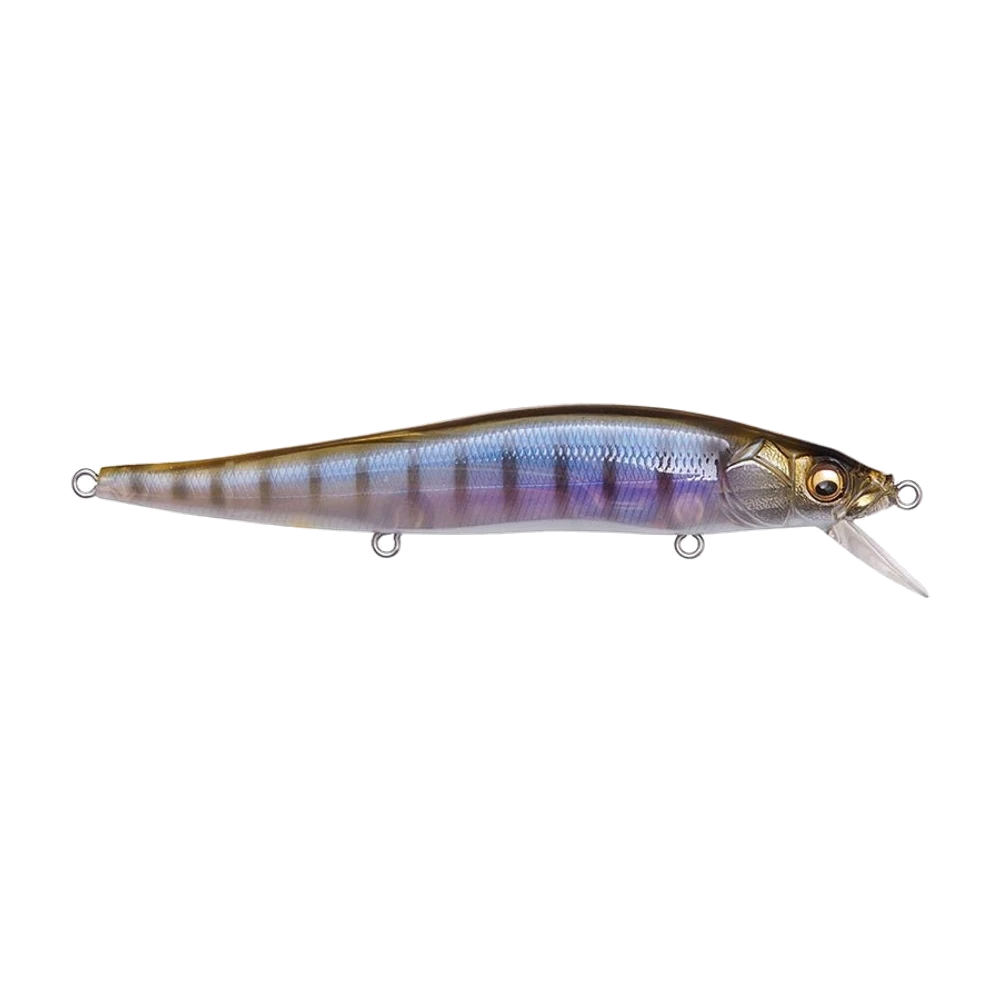
Megabass Vision 110: the Japanese jerkbait that hangs dead still on the pause
One lure, endless conditions. CarnaFish reads your spot from a photo so you are not just guessing.
A Vision 110 easily costs two to three times a generic jerkbait. The question everyone asks the first time they hold one: what justifies that? The answer comes down to one word — suspension. This bait hangs perfectly still on the pause, dead level, neither rising nor sinking, which is far from trivial to achieve consistently on a mass-produced bait.
What "suspending" actually means
Plenty of baits marketed as suspending slowly rise or imperceptibly sink on the pause. The Vision 110 is tank-tested and tuned at the factory, bait by bait, to hold near-perfect neutral buoyancy in 15-18°C (60-65°F) water. That total stillness, held for several seconds, is what pushes a wary bass to close in and finally eat what looks like a dying baitfish sitting in place — a behaviour no floating or sinking bait can replicate for as long.
Tuning buoyancy by season
The factory-tuned suspension matches a specific water temperature. Once the water shifts noticeably, the bait drifts slightly toward floating (colder, denser water) or sinking (warmer water).
- Cold water (under 12°C / 54°F): the Vision 110 tends to rise slightly on the pause. A small strip of lead wire taped under the belly restores perfect suspension.
- Warm water (over 20°C / 68°F): it can sink gently instead. Remove any added lead, or switch to a more buoyant model for summer.
A jerkbait that rises too fast on the pause loses the whole point: the fish needs time to watch it "die" in place before it commits.
The retrieve cadence
The go-to twitch: two or three short, sharp rod snaps, followed by a three-to-five-second pause. In cold water, stretch that pause further — up to ten seconds isn't excessive in the dead of winter, when a bass's metabolism is at its slowest. In warmer water, shorten the pauses instead and string twitches closer together to target active fish.
The mistake that spooks the fish
Restarting the retrieve too soon, before the pause has run its course. Most strikes come in the last second of the pause, once the bass has finally made up its mind. Cutting the pause short pulls the bait away right before the strike.
The weight-transfer system that adds casting distance
The Vision 110 uses an internal ball that shifts backward on the cast to add distance, then returns to a neutral position during the retrieve so it doesn't disturb the balance. That's a big reason this jerkbait casts noticeably farther than an equivalent model without the system — a real asset for covering water from the bank without a boat.

Not sure what to tie on?
Photograph your spot: CarnaFish reads the scene, cross-checks the conditions and gives you the zone, the lure and the retrieve. Free on iOS and Android.
Colour by light
- Clear water, bright sun: Ghost Minnow, translucent and subtle.
- Overcast skies: French Pearl, a pearl-white tone that catches diffuse light without being gaudy.
- Slightly stained water: Fire Tiger, a high-contrast pattern that stays visible even as clarity drops.
Vision 110 against the competition
The premium suspending jerkbait segment is competitive. A Duo Realis Jerkbait 120SP offers a similar philosophy with a slightly wider swim, while a Rapala X-Rap Jerkbait 10 remains a more affordable alternative with a tighter action. The choice mostly comes down to how much subtlety you need: the warier the fish, the more the investment in fine suspension pays off.
The best jerkbait in the world can't replace reading the spot: depth, temperature, the day's activity level. That's exactly what CarnaFish helps with: a photo of the spot, and the app suggests a zone and a retrieve suited to the conditions. For the species fundamentals, our beginner's guide to bass fishing is a solid base.
Key takeaways
- Factory-tuned suspension, worth fine-tuning slightly by water temperature.
- Long pauses in cold water (up to 10 seconds), shorter ones in warm water.
- Never restart the retrieve too soon — the strike often comes right at the end of the pause.
- Internal weight-transfer system adds real casting distance.
FAQ
Why does the Vision 110 cost more than a standard jerkbait?
Mainly for the precision of its neutral-buoyancy tuning, calibrated bait by bait at the factory, and for its weight-transfer system that boosts casting distance without hurting the swim.
How do I know if my Vision 110 is tuned correctly?
Let it sit still in clear open water: it should stay perfectly level, neither rising nor sinking, for at least 5 to 10 seconds. If it drifts, add or remove a small strip of lead wire depending on the direction of the drift.
How long should the pause be in winter?
Don't hesitate to go up to 8-10 seconds in very cold water. A bass's slowed metabolism needs far more time to decide to strike than during warmer months.
Does the Vision 110 work in murky water?
Less well than in clear to lightly stained water, since its effectiveness relies heavily on the fish visually tracking the suspended bait. In very murky water, favour a bait with strong vibration instead.
Should I swap the stock hooks?
The stock trebles are good quality and generally sufficient. Some anglers swap them for lighter hooks in very cold water to avoid disturbing the fine-tuned suspension balance.
What's a cheaper alternative to the Vision 110?
A Rapala X-Rap Jerkbait 10 delivers much of the performance at a more accessible price, with a tighter action and less precision on fine suspension tuning.
The full bass lure guideSeason-by-season strategy: which family of lure, when, and why.Go from theory to fish
CarnaFish reads your spot from a photo and gives you the game plan: zone, lure, retrieve. Free on iOS and Android.