Damiki Abyss 90: the suspending jerkbait that works at 2.4 m
Not sure this lure fits YOUR spot today? CarnaFish tells you in 10 seconds, from a photo.
Late February, the water is at eight degrees and the fish have stopped moving. They are there — the sonar shows them, pinned to a break between two and three metres — and nothing that crosses that layer makes them commit. What works in those conditions is almost never a question of speed: it is a question of time spent under the fish's nose. The Damiki Abyss 90 is built for exactly that — get down fast to the right depth, then stay there without rising or sinking.
A long lip, and a depth that holds
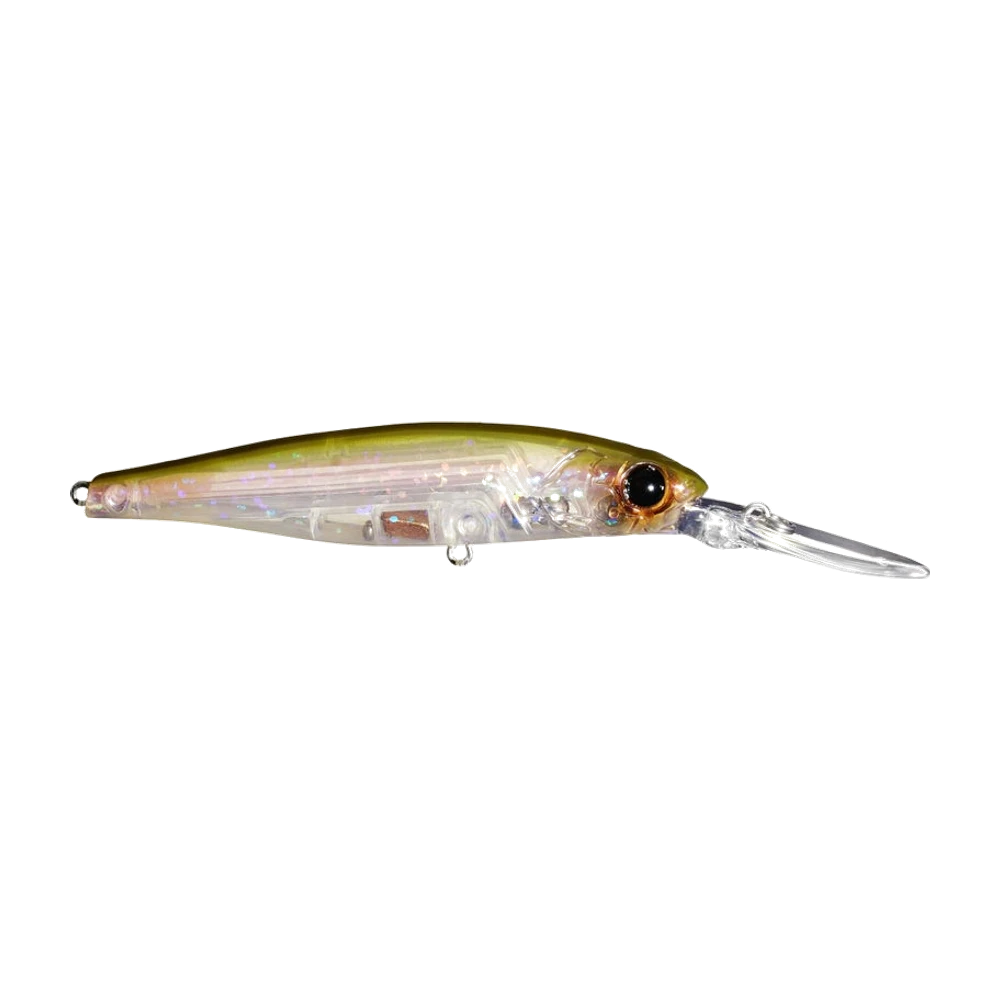
Damiki lists 2.4 metres (8 feet) for the Abyss 90, reached quickly after the cast. The long clear lip you can see in the photo explains both things at once: its angle forces the nose down from the first turns of the handle, and its surface area keeps the bait at that depth once it levels off. The lure dives on a diagonal over six or seven metres of retrieve, then runs roughly flat.
In practice that means there is nothing to adjust: a few fast turns to bring the bait to its floor, then you switch to working it. On a shallower jerkbait like an Illex Squad Minnow 95SP you top out around one to one and a half metres and have to play with rod angle to steal another thirty centimetres. Here the 2.4 metres come from the lip, not from your technique.
There is a trade-off worth knowing: a long lip catches more on cluttered bottom, and the bait rises slowly when you stop reeling. Over a rocky break at two metres, you will make contact. That is intentional — contact often triggers — but it means fishing a line that forgives and not skimping on split-ring quality.
A tight wobble, and above all a genuine suspension
The manufacturer describes a tight wobbling action, and that is exactly what you feel through the rod: a fast, low-amplitude tremor rather than a wide roll. That is the classic cold-water jerkbait signature. When the water is cold, baitfish barely move and predators will not travel for a prey item making too much noise; a tight roll reads as a sluggish fish, not as an escape.
The point that really matters is the behaviour at rest. The Abyss 90 is listed as suspending — on the pause it neither rises nor sinks, it settles dead level. Through the clear body you can see the transfer weight that both sends the bait a long way on the cast and balances it once the swim is established. A true suspension is what allows five, eight, sometimes fifteen second pauses without leaving the layer the fish are holding in. A floating jerkbait would climb out of the zone on every stop, and a sinking model would end up in the rocks.
A jerkbait's suspension is never perfect everywhere. Cold water, salt water, braid pulling upward and a slightly heavier treble are enough to turn a suspending model into a slow floater or a slow sinker. Check it once, rod in hand, beside the boat or the bank: thirty seconds of watching saves you a whole day fishing beside the layer.
Working it in cold water, the job it was drawn for
Damiki positions the Abyss 90 squarely on cold water and the very start of spring. That is the season where the suspending jerkbait has no serious competitor, because it is the only bait that can sit still at depth without ever leaving the strike zone.
The rhythm below ten degrees
Two or three short, sharp wrist jerks, not wide rod sweeps — the aim is to make the bait pivot on itself, not travel a metre. Then the pause. And the pause is long: start at five seconds and stretch to ten or twelve if nothing comes. Almost every bite happens during that stillness, and they rarely announce themselves with a clean pull: the line moves sideways, or you simply feel weight when you start again. Set the hook on doubt.
When the water climbs toward fifteen degrees
The pattern flips: jerks become faster and more numerous, pauses drop to one or two seconds. The bait turns back into a search tool to run along banks, drowned timber and rock heads. That is also when it becomes interesting for perch and zander in Europe, over the same spots usually fished with a soft shad.
Rigging, knot and hooks
The Abyss 90 ships with three trebles, and the retailer itself suggests considering an upgrade. That is not a free swipe at the factory hooks: on a suspending bait, changing trebles changes the balance. A heavier treble makes it sink slowly, a lighter one makes it float slowly. If you swap, stay at equivalent mass and check the buoyancy before fishing it seriously.
As for the connection, a tight knot straight onto the lip eye restricts the lateral movement of the nose and kills the on-the-spot pivot that makes the bait worth fishing. A loop knot or a small snap gives it back its freedom of angle either way. A 0.20 to 0.25 mm fluorocarbon leader suits bass and zander; as soon as pike are on the spot you need a bite-resistant leader, accepting that it stiffens the action a little.
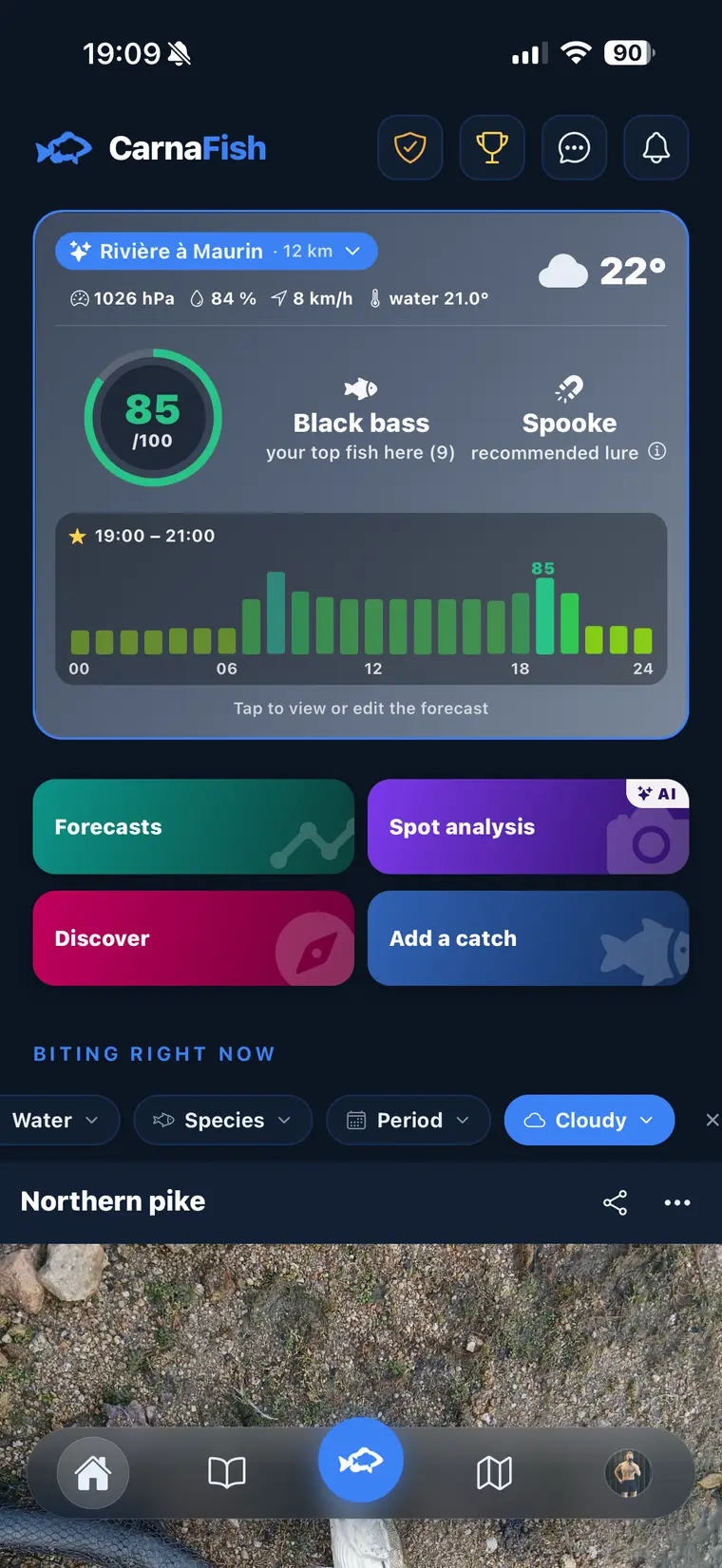
Not sure what to tie on?
Photograph your spot: CarnaFish reads the scene, cross-checks the conditions and gives you the zone, the lure and the retrieve. Free on iOS and Android.
Colour by water clarity
- Clear water: the translucent flaked finish from the photo, which lets light through and gives back only a diffuse flash — exactly what you want when the fish has all the time it needs to inspect the bait.
- Lightly stained water: a more contrasted roach or ayu pattern with a defined back, to keep a readable silhouette at two metres down.
- Low light, dark water: a genuinely dark back. At that depth, late in the day, what counts is the outline against the ambient light, not the exact shade.
Damiki offers the Abyss 90 in a range of realistic colours rather than aggressive ones. That fits its job: a bait you stop for a long time in front of a fish has to survive inspection.
One spec to take with a pinch of salt
The manufacturer's table gives 3.5 inches, 2.4 metres of depth, suspending class, and a weight listed as 3/7 oz. That fraction is unusual in the trade — you see 3/8 and 7/16, not sevenths — and it would correspond to roughly 12 grams. So treat that figure as an order of magnitude rather than a certified value: 12 g for a 9 cm long-lipped jerkbait is plausible, but a scale will give you a more reliable answer than the product sheet.
Knowing that a suspending jerkbait is the right tool still does not tell you where to cast. That is exactly what CarnaFish makes easier: a photo of the spot, and the app suggests the zone, the depth and the kind of presentation that fit the day. To get the seasons straight and understand why cold water changes everything, our season-by-season guide to predator fishing pairs well with this page. And if you want a longer jerkbait for the same technique, the DUO Realis Jerkbait 120SP and the Rapala Shadow Rap work in neighbouring registers but shallower.
Key takeaways
- The long lip delivers 2.4 m quickly after the cast, with no rod-angle tricks needed from you.
- Listed suspending class: on the pause the bait stays level in the layer, which allows very long stops.
- In cold water, two or three sharp jerks then five to twelve seconds of stillness; the bite almost always comes during the pause.
- The listed 3/7 oz weight, roughly 12 g, is an unusual fraction best treated as an order of magnitude.
FAQ
How deep does the Abyss 90 actually run?
The manufacturer lists 2.4 metres, reached in a few turns of the handle thanks to the long lip. In practice depth also depends on your line: thin braid gets a little deeper than thick fluorocarbon, which drags more.
How long should the pause be?
Five seconds minimum in cold water, up to ten or twelve if nothing comes. It feels long and counter-intuitive, but that stillness is when the vast majority of bites happen.
Does this jerkbait float or sink at rest?
It is listed as suspending, so it hangs. Be aware, though, that temperature, salinity and treble weight are enough to make it slowly float or slowly sink. Check it yourself before fishing.
Should I change the factory hooks?
Not necessarily, but if you do, stay at the same weight. On a suspending bait, a heavier or lighter treble shifts the balance and turns a suspending model into a sinker or a floater.
Can you catch zander on the Abyss 90?
Yes, in Europe this size and depth suit zander and perch well over river breaks and bank edges, especially in spring. The action stays the same, with slightly shorter pauses.
What exactly does the Abyss 90 weigh?
The manufacturer states 3/7 oz, an unusual fraction that works out to about 12 grams. Treat it as an order of magnitude rather than a verified figure.
The full bass lure guideSeason-by-season strategy: which family of lure, when, and why.Go from theory to fish
CarnaFish reads your spot from a photo and gives you the game plan: zone, lure, retrieve. Free on iOS and Android.