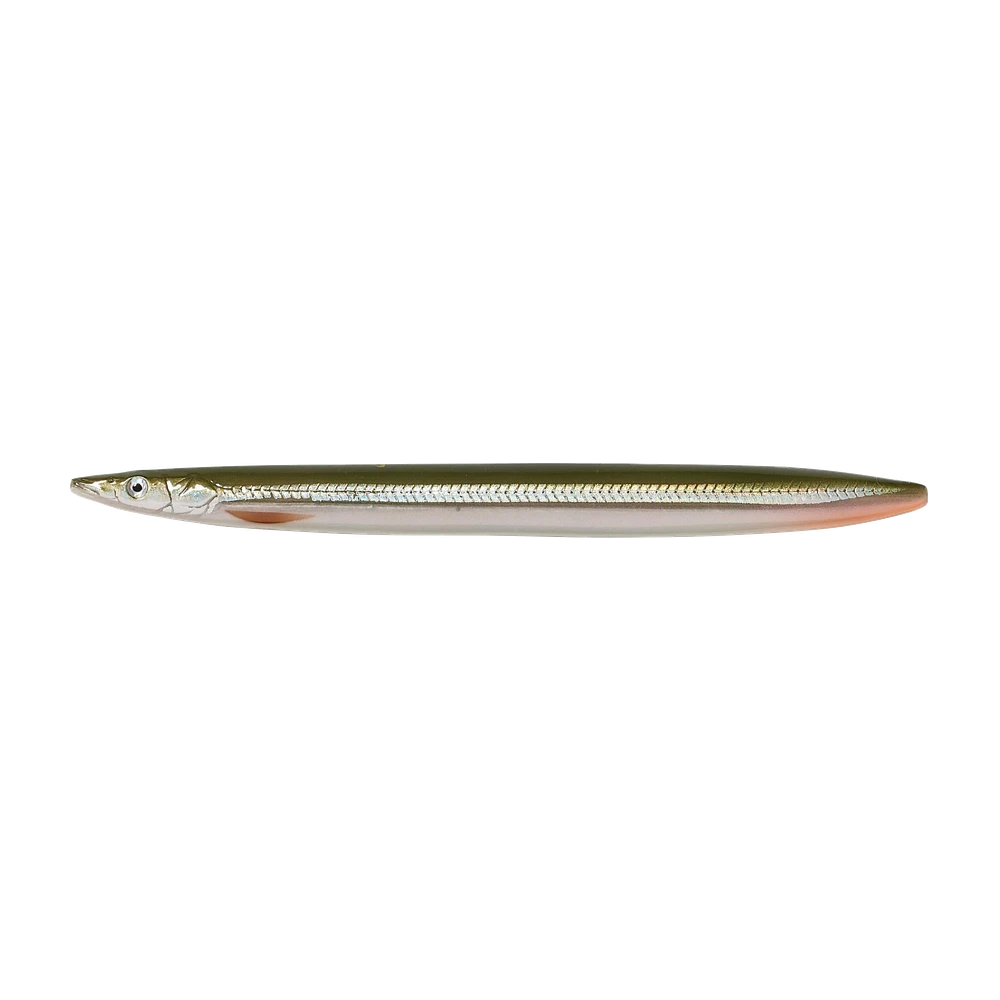
Savage Gear 3D Line Thru Sandeel: why the through-line rig lands big bass
Before tying this one on, it helps to know if the spot actually calls for it. CarnaFish reads the scene from a photo.
A big sea bass shaking its head right at the surface is often exactly when it's lost — not because the hook never set, but because the fish uses the lure's own weight as leverage to pop it loose. The line-thru system on the 3D Line Thru Sandeel was built specifically to remove that leverage, and it's what sets this lure apart on big-bass ground.
How the through-line rig actually works
On a standard lure, the line attaches to a split ring fixed to the body: during the fight, every headshake works that connection, and the swinging body can be enough to open the hook or tear the hookhold wider. On the Line Thru Sandeel, the line runs straight through the whole body and connects directly to a free-swinging hook at the tail end. The result: the lure's body is no longer in line with the pulling force during the fight — it slides freely along the line while tension stays applied purely between the rod and the hook.
Field rule: on a big bass thrashing its head at the surface, it's often the rig that decides who wins the fight, not the power of the rod.
Where this rig genuinely makes a difference
This system earns its keep in three specific situations:
- Big rock-mark bass, which throw repeated violent headshakes near the surface before tiring out — exactly the ground where a standard rig loses the most fish at the critical moment.
- Deep drop-off fishing, where the fight plays out over a longer distance and every second of poorly distributed tension matters.
- Structure-heavy marks, where a fish diving for cover puts sudden, repeated stress on the connection.
How to work it without losing its appeal
The 3D Line Thru Sandeel swims in a light S with its head slightly raised, a behaviour triggered by a slow-to-medium retrieve worked as a continuous ripple rather than sharp jerkbait-style sweeps. Breaking that rhythm with overly violent twitches throws off the swim axis and costs the lure some of its realism — unlike a vibrating sandeel built for a nervous retrieve, this one prefers consistency.
Controlling depth without a swappable head
Since the body has no removable jighead, depth is set purely through retrieve speed and pauses:
- Slow retrieve with short pauses: swims high, for scanning just under the surface on actively feeding bass.
- Steady, continuous medium retrieve: the most versatile setup, for covering the mid-depth of a drop-off or rocky point.
- Letting it sink a few seconds before starting: to reach a fish holding deeper, especially in cooler water.

Not sure what to tie on?
Photograph your spot: CarnaFish reads the scene, cross-checks the conditions and gives you the zone, the lure and the retrieve. Free on iOS and Android.
Bite resistance: a real edge on big bass
The Line Thru Sandeel's ABS body handles bites far better than a standard soft plastic, which matters against big bass whose jaws mark a softer body badly on the very first missed strike. A lure that survives several sessions without tearing also represents a real saving on marks where hits from big fish come often.
Colour by water clarity
- Clear water, normal daylight: natural Sandeel, a faithful tone that doesn't stand out.
- Very clear water, wary fish: Ghost, a translucent tone that keeps the artificial silhouette to a minimum.
- Stained water after a blow: Motoroil, darker and more contrasted to stay visible.
The fight is only the last step of a session that's decided first by choosing the right mark and tide — our guide to fishing sea bass on lures breaks down the rocky marks where big bass hold most often. And to avoid picking the wrong window on a demanding spot like a rocky point, CarnaFish reads the tide and current marine conditions from a photo and tells you when it's actually worth the trip.
Key takeaways
- The line-thru rig removes the lure body's leverage during the fight, a real edge on big bass.
- Best on rocky marks, deep drop-offs, and structure-heavy ground.
- Work it with a continuous retrieve, no sharp jerks, to preserve the S-swim.
- Bite-resistant ABS body survives multiple sessions without tearing.
FAQ
How does the line-thru rig differ from a standard rig?
The line runs straight through the entire body to a free-swinging hook, instead of attaching to a ring fixed to the body. The body slides freely during the fight, which stops it acting as leverage for the fish to throw the hook.
Does this rig genuinely reduce lost fish?
Yes, especially on big fish that throw repeated headshakes at the surface. That's precisely the kind of fight where a standard rig most often loses the fish.
How do I control running depth without a removable jighead?
Purely through retrieve speed and pauses: a slow retrieve with short pauses keeps the lure high, while letting it sink before starting reaches a fish holding deeper.
Does this lure need a special retrieve?
A continuous retrieve at slow-to-medium speed, without sharp jerks, better preserves its natural S-swim than a nervous, jerkbait-style retrieve.
Does the body hold up against big bass teeth?
Yes, the ABS construction handles bites far better than a standard soft plastic, reducing premature wear on marks with a high density of big fish.
What colour should I prioritise in very clear water?
The translucent Ghost tone, which keeps the artificial silhouette to a minimum for a wary bass in clear water.
The full sea bass lure guideSeason-by-season strategy: which family of lure, when, and why.Go from theory to fish
CarnaFish reads your spot from a photo and gives you the game plan: zone, lure, retrieve. Free on iOS and Android.