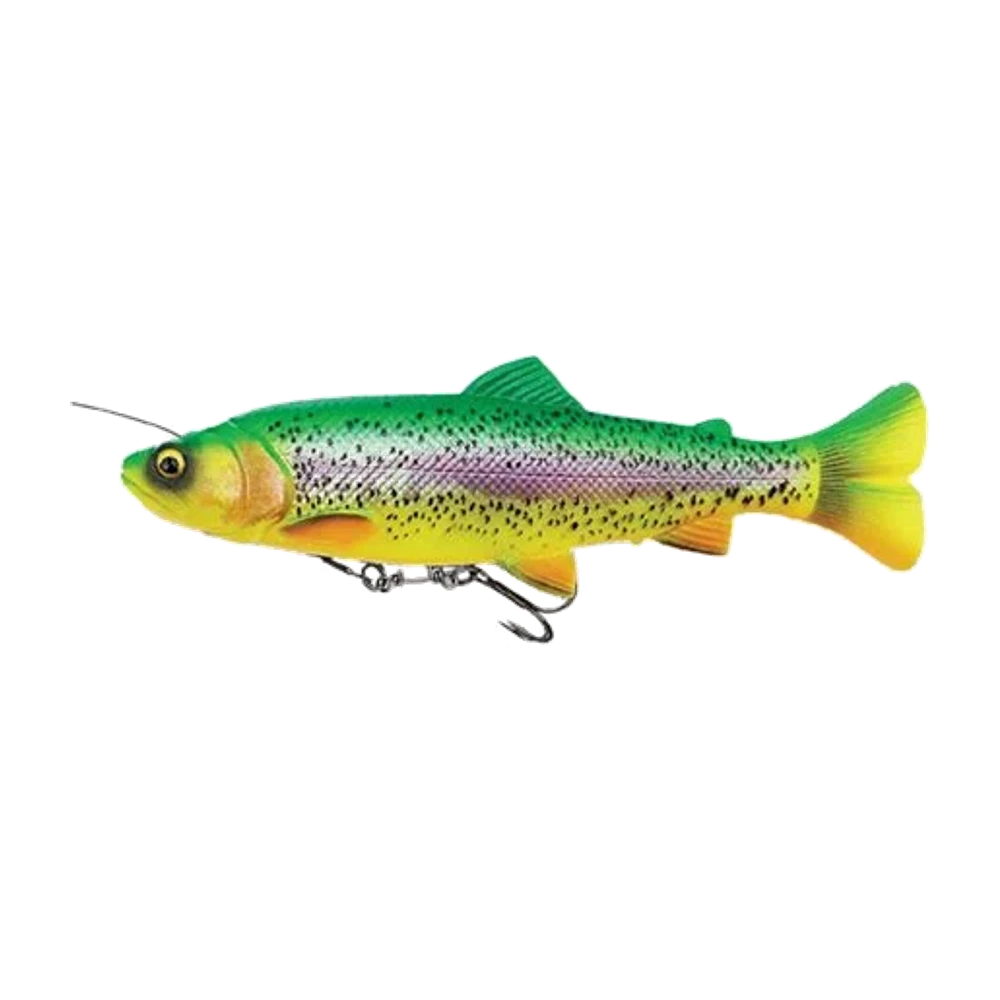
Savage Gear 4D Line Thru Pulsetail: the lure that slides up the line on the hookset
One lure, endless conditions. CarnaFish reads your spot from a photo so you are not just guessing.
A big pike throwing the hook three metres from the bank is almost always the same mechanism. The fish shakes its head, and the lure — a block of several dozen grams hanging from its jaw — acts as a lever. The treble twists, opens, or pulls out of the hole it made. The heavier and stiffer the lure, the more violent that lever.
The line-thru rig removes that leverage. The line does not attach to the lure: it runs right through it, head to tail, and ties to a hook sitting behind. Once the fish is hooked, the lure body slides freely up the line. All that is left in the jaw is a hook, with no mass hanging off it.
Savage Gear's Pulsetail applies that principle to an imitative body with a very mobile paddle tail. Two benefits for the price of one: fewer lost fish, and a lure that does not get shredded during the fight.
What the line-thru rig really changes
Three concrete consequences, well beyond the sales pitch.
Fewer dropped fish. That is the original aim. On lures of 20 cm and up, on pike tail-walking in open water, the difference shows over a season.
The body survives. During the fight the lure is pushed up the line, out of reach of teeth and rakers. A standard soft lure this size often tears after two or three fish; a line thru takes far more punishment.
Unhooking is simpler. You slide the body up the line, you get clear access to the hook, and you work in an uncluttered mouth. On a big pike in the net, that is far from trivial.
The trade-off is that the rig demands a little method. The line has to run cleanly, the knot has to be solid, and you need to check the head stays seated while the lure swims. A body that slides during the retrieve, before any bite, kills the action.
Rigging it correctly
- Run the line through the channel in the lure, front to back, using the supplied needle or a baiting needle.
- Tie the hook at the tail exit. A strong-wire treble or a double, depending on whether you want more hooking power or fewer snags.
- Check the body seats properly back against the hook and that everything is aligned. A lure sitting slightly crooked will swim in a spiral.
- Add the steel or titanium leader above it. That is not optional for pike.
- Test it at your feet over two metres before casting. You should see the tail beating clearly without the body rolling on itself.
If the lure spins, it is almost always because the line does not exit in line. Run it through again.
The retrieve: slow is a decision
The Pulsetail works on a slow retrieve. The tail is designed to beat at low speed; speeding up simply flattens it and ruins the action.
The slow straight retrieve. That is the baseline. You cast, let it sink to the layer you want, and retrieve barely faster than the minimum that keeps the tail working. You should feel a steady beat through the rod.
The straight retrieve with stops. Every five to seven turns, stop for one to two seconds. The lure noses down and sinks, wobbling. On a following pike, that break triggers a lot of attacks.
Soft pulls for zander. On the smaller sizes in the range you can fish near the bottom with slow rod pulls followed by a controlled drop, like a big conventional shad.
On the water: with this kind of swimbait, when you think you are fishing slowly you are still fishing too fast. Set your speed at the minimum that keeps the tail beating, and hold it there. Big cold-water pike do not chase.
Choosing the size and weight
| Size | Context | Tackle |
|---|---|---|
| around 16 cm | rivers, zander and average pike, searching | 20-60 g rod, 0.20 mm braid |
| around 20 cm | all-round pike, lakes and big canals | 40-100 g rod, 0.25 mm braid |
| 25 cm and up | hunting big fish, slow deep fishing | 60-150 g rod, 0.30 mm braid |
A line thru's weight is fixed: unlike a jig head, you cannot adjust the sink rate by changing the lead. To cover several layers you play on the size of the model and on how long you let it sink after the cast.
Reckon on roughly one second per metre in free fall, then adjust according to what you see on your first contact with the bottom.
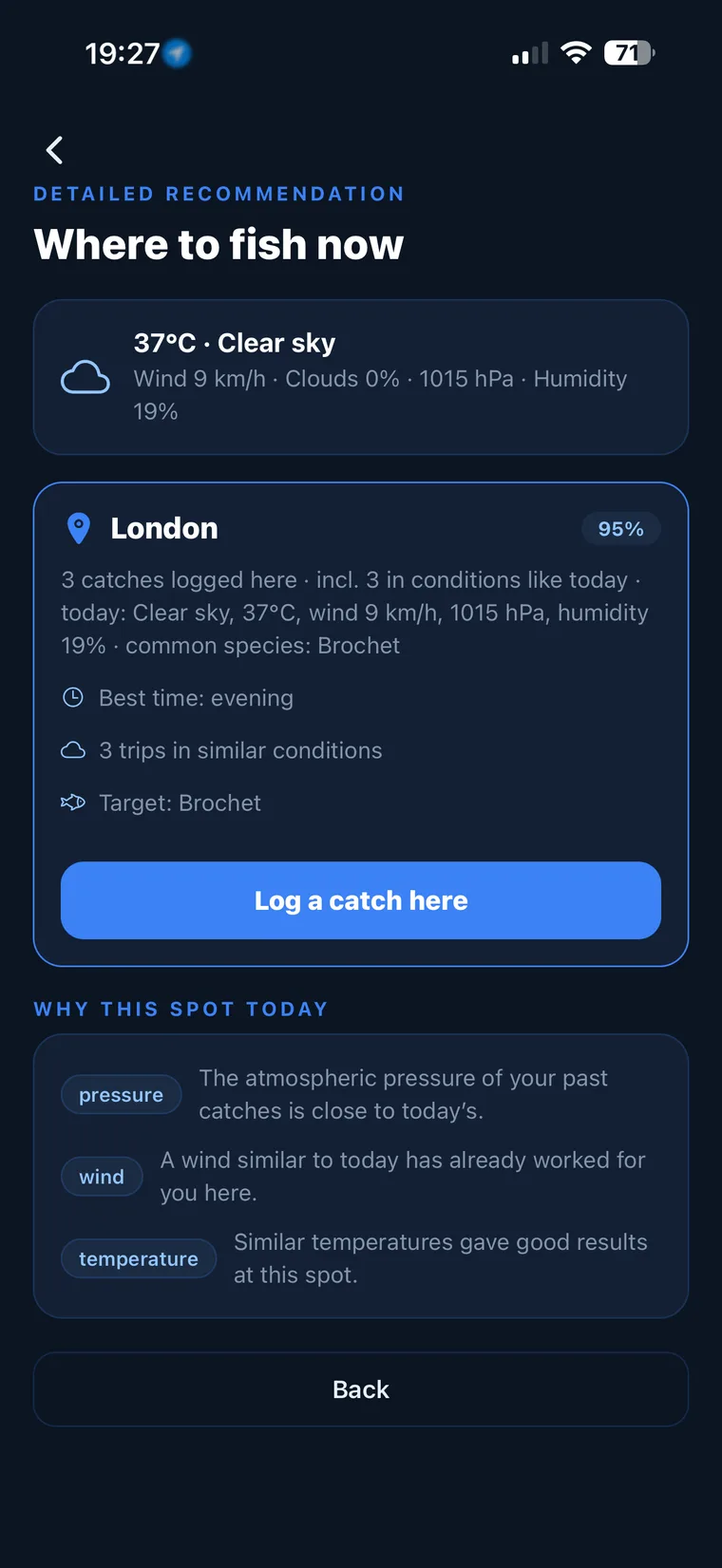
Not sure what to tie on?
Photograph your spot: CarnaFish reads the scene, cross-checks the conditions and gives you the zone, the lure and the retrieve. Free on iOS and Android.
Where it does not belong
This is not a fast searching lure. Over a large unknown expanse you will cover far more ground with a shad on a jig head or a vibrating lure.
It is also poorly suited to heavily cluttered ground: the hook sits bare at the tail exit and collects branches. And on smaller fish, a 20 cm lure remains a selective lure: fewer bites, but bigger fish.
Finally, in summer on active fish, the enforced slowness becomes a handicap. This is a cold-season lure for a spot you already know.
Pulsetail or a shad on a jig head
Against a Fox Rage Big Eye Pro Shad XXL on a jig head, the Pulsetail loses on versatility and on how fast you can change things: a jig head is swapped in ten seconds to explore another layer, a line thru is not.
It wins, however, on two precise points: keeping the fish once hooked, and the lifespan of the body. On a big-pike session where every bite counts, that is no detail.
Against a Savage Gear Line Thru Seeker, a hard line-through lure built for trolling and saltwater, the rigging logic is the same but the use is completely different: the Seeker is a fast hunting lure, the Pulsetail a slow imitative one.
Our guide to choosing a pike lure places big swimbaits within a fishing season. And if you are unsure which size to tie on when you reach the bank, CarnaFish analyses a photo of the spot and answers.
Key takeaways
- The line runs through the body: on the hookset the lure slides up and stops acting as a lever.
- Fewer lost fish on big pike, and a body that lasts far longer.
- A slow retrieve is mandatory: the tail only works at low speed.
- Steel or titanium leader every time, hook tied at the tail exit.
- A cold-season lure for a known spot, not a fast searching tool.
FAQ
How do I rig a line thru lure?
You run the line through the channel in the body with a needle, tie the hook at the tail exit, and slide the body back against it. A steel leader goes above the lure for pike.
Does the line-thru rig really reduce lost fish?
Yes, because the body no longer stays attached to the hook during the fight. Without that mass acting as a lever on every headshake, the hook holds far better, especially in the big sizes.
What retrieve speed should I use?
The slowest you can manage while still feeling the tail beat through the rod. Speeding up flattens the tail and removes the action. In cold water you can go one notch slower still with one to two second stops.
What size should I choose for pike?
Around 20 cm for all-round use, 25 cm and up if you specifically target big fish and accept fewer bites. Sizes around 16 cm suit a mix of zander and average pike better.
Do I need a steel leader?
Yes, every time pike are present. The lure is often taken sideways and fluorocarbon, even in very heavy diameters, gives way on a tooth. A supple steel or titanium trace of 30 to 40 cm is enough.
Can it be fished in weed?
Barely. The hook at the tail exit sits bare and collects vegetation. In cluttered water, go for a Texas-rigged soft plastic or a chatterbait, both far more forgiving around structure.
The full pike lure guideSeason-by-season strategy: which family of lure, when, and why.Go from theory to fish
CarnaFish reads your spot from a photo and gives you the game plan: zone, lure, retrieve. Free on iOS and Android.