Smith D-Contact: the heavy crankbait that casts far and accurately for trout
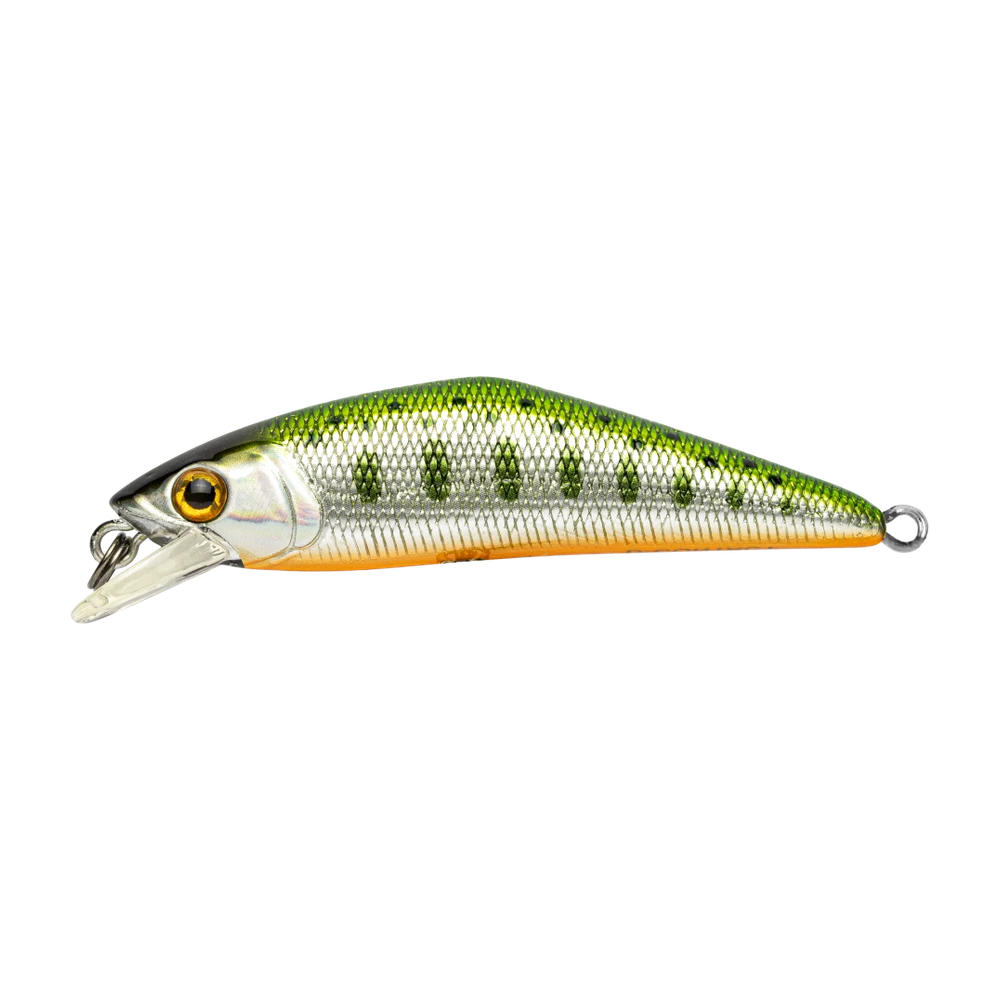
This lure shines under specific conditions. CarnaFish tells you in 10 seconds if today is one of them.
On a trout river choked with willows and brambles, the problem is almost never the lure — it's putting it exactly where it needs to be, under a low branch, without snagging. Smith's D-Contact was built to solve exactly that very Japanese problem — Japan's trout streams are often just as narrow and cluttered as ours — with a body unusually heavy for its size that flies straight and far, even on a hard, flat cast.
A heavy body for pinpoint casting
Most small trout crankbaits weigh 3-5 g at 5-6 cm, which makes them wind-sensitive and hard to place accurately. The D-Contact flips that logic: at a comparable size, it packs noticeably more internal mass, which stabilises its flight and allows surgical casts into a gap between two branches, several metres out.
Sizes 50/63/72/85: which one to pick
- 50 mm (4.5 g): small streams, very short casts, wary wild brown trout.
- 63 mm (7 g): the most versatile size, for most medium-sized trout rivers.
- 72-85 mm (9-14.5 g): wider rivers, bigger fish, or when you need noticeably more distance.
Start with the 63 mm if you don't yet know the water: it's the safest compromise between stealth and ease of casting.
Swim action: the inertial glide that matters
Unlike a standard minnow that swims continuously on the retrieve, the D-Contact uses its weight to glide on inertia after each rod snap — closer to a jerkbait, but with a short lip that keeps it running shallow. In practice:
- A sharp rod snap makes the lure accelerate and dart slightly to one side.
- The body carries on for a split second after the motion stops, coasting almost freewheeling.
- Trout very often strike during that glide, when the lure appears to naturally slow down like a tiring baitfish.
Field rule: don't try to swim the D-Contact on a pure straight retrieve like a standard minnow — the twitch and the glide are the whole point, not continuous cranking.
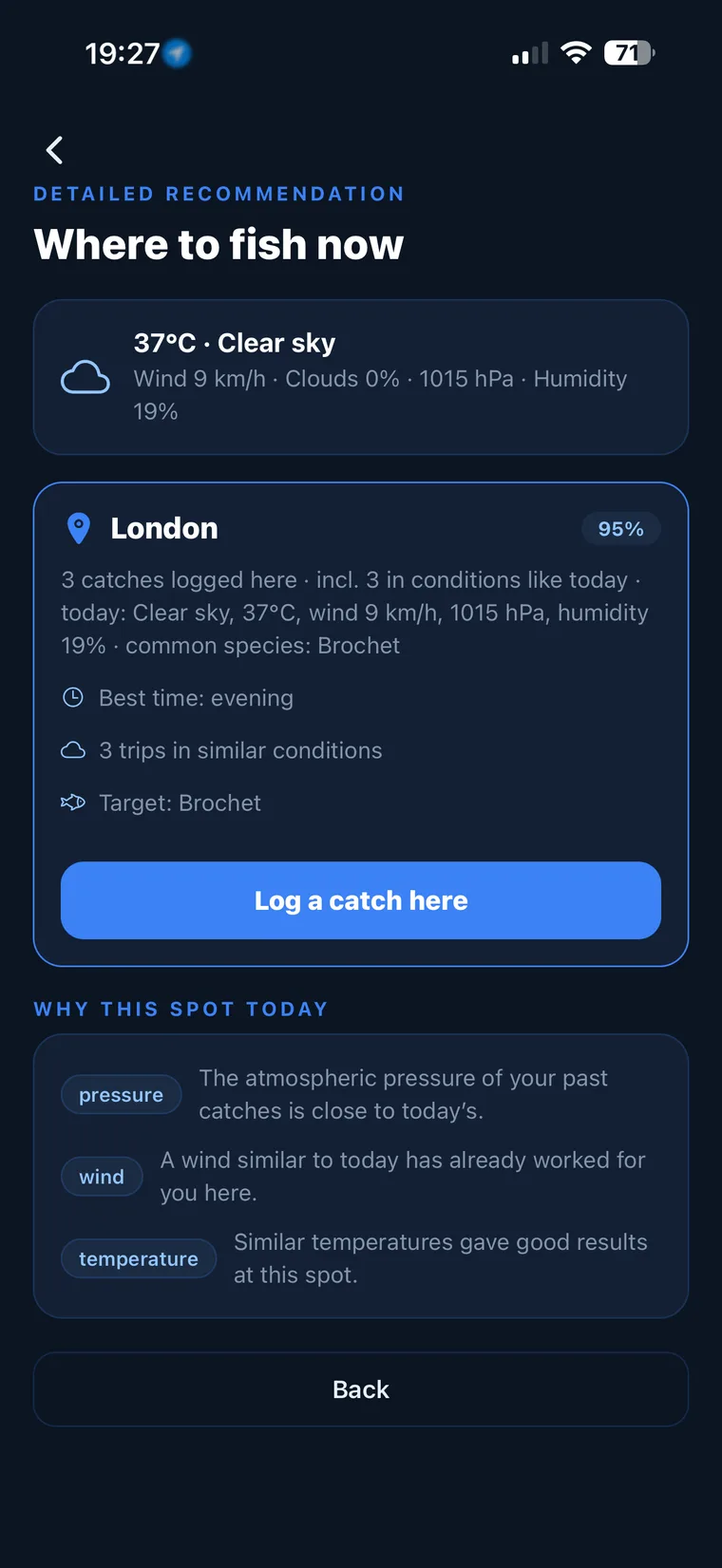
Not sure what to tie on?
Photograph your spot: CarnaFish reads the scene, cross-checks the conditions and gives you the zone, the lure and the retrieve. Free on iOS and Android.
Perch along the drift
The D-Contact isn't just a trout lure: its flat, highly reflective sides and pronounced glide also make it an excellent choice for perch in rivers or canals, especially drifted along a dock wall or a reed edge, where an ambushing perch watches for a baitfish that seems to briefly falter.
The detail that protects the swim
The D-Contact's weighted body makes the swim sensitive to split-ring size: one too thick or off-centre can slightly throw off the glide. Favour a good-quality fine ring, and check it after any snag in the branches.
Accurate casting never replaces reading the spot — that's exactly what CarnaFish offers, reading a photo of your spot to tell you where to aim before you even pick up the rod. For reading spots and approach on rivers, our guide to river trout fishing remains the reference.
As a complement, a sinking minnow like the Rapala CountDown lets you dial in a precise depth when the D-Contact, which runs shallower, isn't enough to reach a trout holding lower in the water column.
Box-ready summary
- A weighted body that flies far and accurately, even on a hard cast under branches.
- 63 mm (7 g) as a versatile starting point, 50 mm for narrow streams.
- Fish it with twitches: the inertial glide after each snap triggers most strikes.
- Also effective on perch drifted along developed riverbanks and docks.
FAQ
What size D-Contact should I start with?
The 63 mm model (7 g) is the best starting point: light enough to stay subtle, heavy enough to cast with precision. Save the 50 mm for very narrow streams and the 72-85 mm for wider rivers.
How do you properly fish the D-Contact?
With twitches: sharp rod snaps followed by an inertial glide where the lure naturally slows down. Most strikes come during that glide phase, not during a continuous straight retrieve.
Why is this crankbait so heavy for its size?
It's deliberate: the internal weight stabilises the cast and lets you reach precise gaps under vegetation, a real advantage on narrow, cluttered trout rivers.
Can you catch perch on the D-Contact?
Yes, it's one of its good secondary uses. Its flat sides and pronounced glide make it effective drifted along docks, walls and reed edges in rivers or canals.
What leader should I pair with this lure?
A 16-20 lb fluorocarbon leader suits most situations, balancing stealth with enough strength against obstacles near the bank.
Does this lure work on rivers cluttered with branches?
That's exactly where it excels: its weight allows accurate, flat casts into tight gaps, where a lighter lure would drift off course or fall short.
The full trout lure guideSeason-by-season strategy: which family of lure, when, and why.Go from theory to fish
CarnaFish reads your spot from a photo and gives you the game plan: zone, lure, retrieve. Free on iOS and Android.