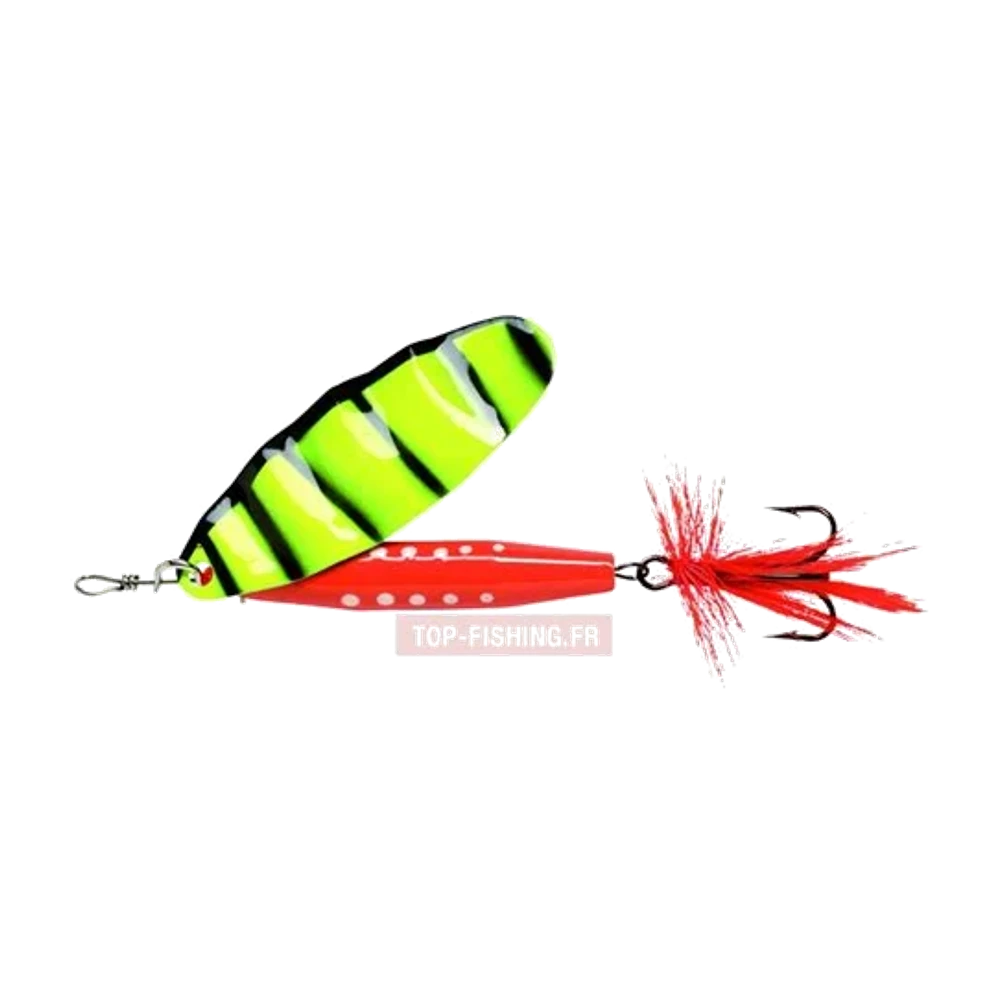
Abu Garcia Reflex: the spinner that reaches the far bank
One lure, endless conditions. CarnaFish reads your spot from a photo so you are not just guessing.
Some spots never get fished because nobody can reach them. The far margin of a thirty-metre canal. The end of the breakwater when the wind blows straight down it. The rocky point forty metres from the only access. You end up fishing what is within range, which is what everyone else fishes.
The Reflex exists for those spots. It reinvents nothing about spinner mechanics: it is a classic blade mounted on a heavy, compact body of 7, 12 or 18 g. What changes is that the weight is packed into a very small volume, which gives the lure a flat, stable flight, including into the wind.
In other words, its first quality is not what it does in the water — it is where you can put it.
Weight in very little volume
Compare this lure with a classic spinner carrying the same blade size: you will often find twice the weight. That density produces three effects on the bank.
- The flight stays low and flat. A compact, heavy lure does not balloon and is not pushed off line by a side gust. You land where you aim, not three metres away.
- A headwind becomes manageable. That is the situation where a light spinner loses half its distance. The 18 g keeps most of its own.
- The lure drops decisively as soon as you stop winding, which lets you work through depth bands on one spot without changing model.
The trade-off: a heavy body behind a classic blade needs a minimum speed to stay expressive. This is a steady-retrieve spinner, not an ultra-slow one.
The cast is the main move in this style of fishing
With this lure, the useful action is not the winding, it is the placement.
- Aim at a precise point, not a zone: the corner of a jetty, a standing stump, the weed line on the far bank.
- Cast flat, over the shoulder, accelerating at the end of the stroke rather than forcing at the start.
- Feather the line with your index finger as the lure arrives over the target. It then drops vertically, without overshooting, and enters the water quietly.
- Close the bail immediately and start winding. The blade kicks in within a second of splashdown.
- If you want to fish deeper, count one to four seconds before starting — the lure drops roughly forty centimetres per second depending on the weight.
On the water: feathering the line is not only about accuracy. By stopping the line just before splashdown, you make the lure enter nose first instead of letting it slap down flat. On a shallow margin where the perch are tight to the bank, that difference in entry noise often decides whether the spot is still fishable or already burnt.
The first three metres
On a precise spot, most bites come within three metres of splashdown. Three habits to build.
Be ready before the lure hits the water. Hand on the handle, rod already lined up. One second of hesitation and the lure has sunk below the useful zone.
Do not lift the rod as you start. Keep the tip low and in line: you hold the lure in the band it entered instead of pulling it straight back up.
Slow down after three metres, not before. Once out of the hot zone you can drop into a holding retrieve until the next cast.
Weight, target and distance
| Weight | Useful distance | Typical target |
|---|---|---|
| 7 g | 20 to 25 m | Medium river, trout, close-in spots |
| 12 g | 30 to 35 m | Canal, gravel pit, perch on the far margin |
| 18 g | 40 m and more | Big water, breakwater, settled headwind |
The 12 g is the most-used compromise from the bank: heavy enough to beat the wind, moderate enough to stay fishable over two metres of water without dragging.
Not sure what to tie on?
Photograph your spot: CarnaFish reads the scene, cross-checks the conditions and gives you the zone, the lure and the retrieve. Free on iOS and Android.
Its water, and where it has no business
It shines on big water fished from the bank: wide canals, gravel pits, reservoirs, breakwaters, slow river mouths. It is also very effective on roaming perch shoals, because it lets you reach a school spotted at distance before it moves on.
It is unsuited to the small cluttered stream, where its density takes it to the bottom between two rocks. It is no good either for very slow cold-water fishing: the blade needs pull and the body drags downwards. And in crystal-clear, calm water on educated fish, a lighter, subtler model will do better.
On rigging, a heavy body behind a spinning blade means guaranteed line twist. Rolling swivel fifty centimetres up, changed as soon as it stiffens.
Line of 0.20 to 0.22 mm for the 7 g, 0.24 to 0.26 mm for the 12 and 18 g. If jack pike use the spot — common in canals — add twenty centimetres of 0.50 mm fluorocarbon at the front: you lose very little in subtlety and you avoid leaving a lure behind.
Reflex or Aglia size 3
The Mepps Aglia size 3 weighs around 6.5 g for a comparable blade size. It is the reference spinner at short and medium range, very expressive at low speed, perfect on rivers and on spots within easy reach.
The Reflex, with an equivalent blade, often weighs twice as much. It loses in finesse what it gains in range: you have to wind it a little faster, it is less at home in a stream, but it reaches spots the Aglia will never touch from the same bank.
Within the same brand, the Abu Garcia Atom takes over when you need a big profile and long pauses for pike: two bank lures, two opposite rhythms. Our guide to perch lure fishing covers how to work spot after spot on a big water. And if you are unsure which margin to aim at when you reach the bank, CarnaFish analyses a photo of the spot and answers.
Key takeaways
- High weight in a small volume: a flat, accurate flight that resists a headwind.
- Feather the line before splashdown so the lure enters nose first, without a slap.
- Be ready to wind before the lure lands: bites come in the first three metres.
- The 12 g covers most bank-fishing situations.
- Too dense for a cluttered stream and poorly suited to very slow retrieves.
FAQ
What weights does the Abu Garcia Reflex come in?
The common models are offered in 7, 12 and 18 g. The 7 g covers medium rivers and trout, the 12 g is the all-round bank-fishing choice, and the 18 g is for when you need forty metres or have to fight a headwind.
Why does it cast better than a classic spinner?
Because its weight is concentrated in a compact body. The flight stays flat instead of ballooning, and a side gust has far less to grip. For the same blade size it often weighs twice as much as a classic spinner.
How do I fish it slowly?
With difficulty, and it is not its ground. It needs a minimum of pull for the blade to stay expressive, and the body drags it down as soon as you slow. For genuinely slow fishing, a lighter spinner is a better choice.
What depth does it work at?
Between 0.5 and 2.5 m depending on weight, speed and the sink time you allow. Count on roughly forty centimetres of drop per second when stopped: a three-second pause before starting is enough to completely change the band you fish.
Do I need a specific leader?
A rolling swivel fifty centimetres up is essential against line twist. On a canal or gravel pit where jack pike hang around, add twenty centimetres of 0.50 mm fluorocarbon at the front: it is barely visible and it prevents clean bite-offs.
Is it suitable for river trout?
Yes in the 7 g, on medium-sized rivers and open spots. On a narrow, shallow stream its density becomes a handicap: the lure hits bottom before it has swum and snags between the rocks.
The full trout lure guideSeason-by-season strategy: which family of lure, when, and why.Go from theory to fish
CarnaFish reads your spot from a photo and gives you the game plan: zone, lure, retrieve. Free on iOS and Android.