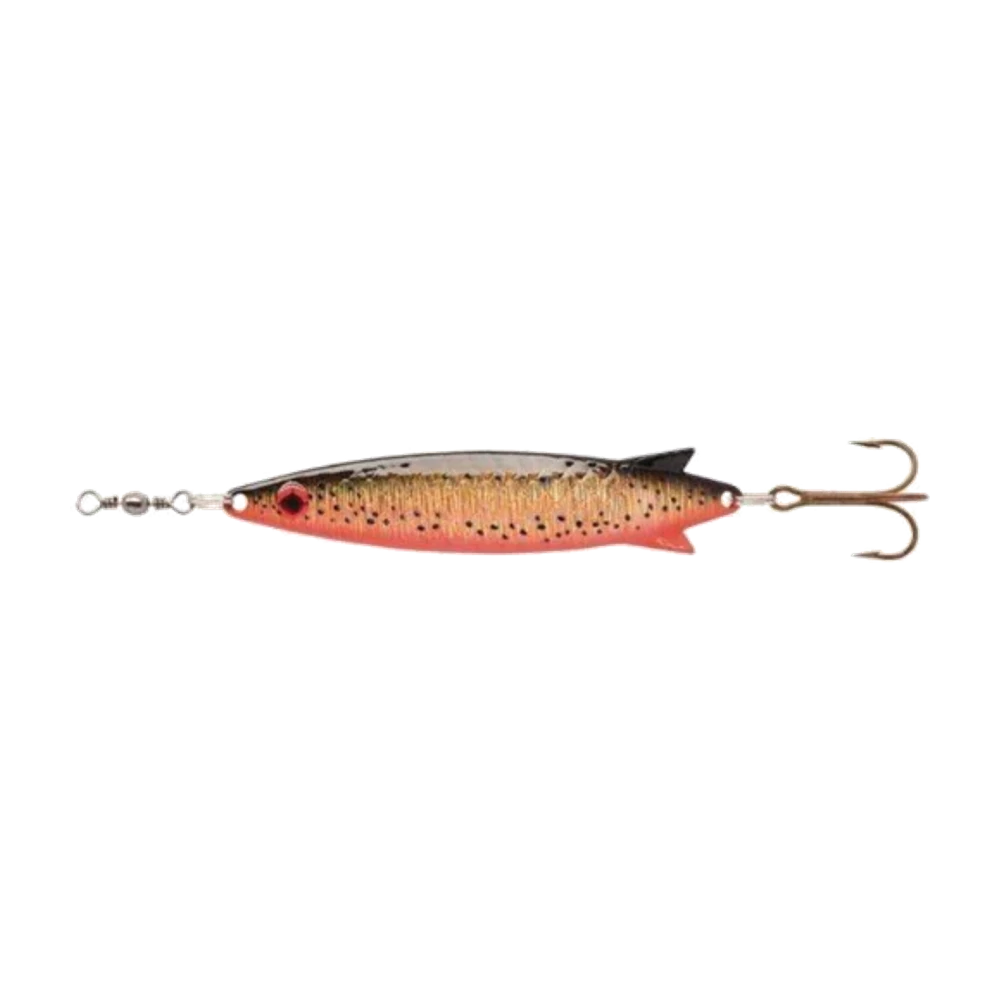
Abu Garcia Toby Veteran: same silhouette, twice the range
Before tying this one on, it helps to know if the spot actually calls for it. CarnaFish reads the scene from a photo.
A breakwater, a three-quarter headwind, and sea bass hunting sixty metres out. You cast your usual spoon: it balloons up, lies over in the wind and drops at thirty metres. You go up a size: it carries a little better, but it becomes too big for what the fish are eating, and it thrashes instead of swimming.
The problem is not the weight of the lure, it is its density. A wide, thin spoon of a given weight offers more grip to the wind and more drag in the water than a narrow, thick one. That is exactly the parameter the Toby Veteran plays with: keep the silhouette that made the Toby, but with a thicker body for the same apparent length.
The result is not "a heavier Toby". It is a lure that fishes differently, with its own strengths and its own blind spots.
What the thick body really changes
Four consequences, all measurable at the water's edge.
- Casting distance. A more compact profile for a given mass cuts through the air better and stabilises in flight. On a windy breakwater, the difference in range against a thin spoon of the same weight is obvious, of the order of several metres.
- Sink rate. It goes up clearly. Where a thin spoon planes and takes its time reaching the bottom, the Veteran drops on a more direct line. That is an advantage when you want to reach a precise depth band, a drawback over snaggy ground.
- A tighter wobble. More mass per unit of surface means less lateral travel. The Veteran does not sweep wide, it vibrates short and fast. The flash is more frequent but briefer.
- Better hold in current and swell. The dense body keeps swimming in a flow that would make a light spoon stall.
Conversely, everything that makes a thin spoon gentle — the fluttering fall, the wide wobble at low speed — fades away. That is the price.
Choosing the weight for the spot
| Context | Indicative weight | Retrieve |
|---|---|---|
| Reservoir trout, from the bank, calm weather | 12 to 15 g | slow to medium, fanned casts |
| Big river, strong current | 15 to 20 g | cast three-quarters upstream, tight swing |
| Shore sea bass, breakwater or rocky point | 20 to 28 g | medium, just fast enough to feel the vibration |
| Strong headwind or distant hunting fish | 28 to 30 g | fast, almost on the surface while the fish are up |
The tuning principle is simple: pick the weight that lets you reach the spot first, then adjust depth with sink time and rod angle, never the other way round. A lure too light to reach the fish catches nothing, however good its action.
The retrieve: find the minimum speed first
A dense spoon has a minimum speed below which it stops swimming and simply sinks while spinning. The whole game is staying just above that threshold.
- Cast and count the descent, one second at a time. Note the number at which you touch bottom: that is your reference for the whole session.
- Start the retrieve with a sharp lift of the rod tip to kick the wobble into life, then go steady.
- Slow down progressively until you feel the vibration die out in the tip. You have just found the minimum speed. Come up one notch and stay there.
- Slip in a slack moment every five to ten turns: you cut the pull for a second, the lure tips and dives, then you start again. That is the main trigger for trout as much as for sea bass.
- Finish the retrieve with the rod low and out to the side, so the lure climbs at an angle along the margin rather than lifting vertically.
On the water: with a dense spoon, do not look for the bite during the controlled descent, look for it in the second that follows the slack moment. A lure losing tension tips onto its flank and sends out a single flash, very different from the steady blinking of the retrieve. That change of signal is what decides a fish that was following without committing, not the sink itself.

Not sure what to tie on?
Photograph your spot: CarnaFish reads the scene, cross-checks the conditions and gives you the zone, the lure and the retrieve. Free on iOS and Android.
Where it takes the lead, where it is the wrong call
Its windows:
- Shore sea bass fishing from a breakwater, a jetty or a rocky point, where distance drives everything.
- Big trout reservoirs, when the fish are off the bank and you have to fan casts across a hundred and eighty degrees.
- Big fast rivers, where a light spoon is swept away before it has worked.
- Any windy conditions, where finesse becomes a handicap.
Its blind spots:
- Small trout streams, where it is too heavy, too fast and too noisy. A light spinner does everything better.
- Shallow, cluttered bottoms: it drops fast and snags.
- Lethargic fish in very cold water, which want a gliding descent and a slow wobble — precisely what a dense body cannot produce.
- Very slow fishing in general. Below its threshold, it stops swimming.
Toby or Toby Veteran: which to choose
The classic Toby remains the all-round reference: a thinner curved body, a wide S-shaped wobble, a slower descent, and a much broader speed range at the low end. It is the lure to take if you mostly fish medium rivers, sheltered lakes, or if you like slow retrieves broken up by long sink phases.
The Veteran does not replace it: it extends the range towards distance and heavy current. Reach for it when the main constraint is reaching the fish, not subtly convincing it. If you fish both situations, the two models complement each other in the same box without overlapping.
Against an Acme Little Cleo, another spoon cut out for current, the difference is shape: the Cleo relies on a concave face that steadies it in fast flow with a wide roll, the Veteran on pure density and a tighter vibration. In a powerful river, the Cleo keeps a more readable action at low speed; on a very long cast into the wind, the Veteran wins.
Our guide to sea bass lure fishing covers the tide windows where distance changes everything. And if you are unsure what weight to tie on when you get to a breakwater, CarnaFish analyses a photo of the spot and answers.
Key takeaways
- The Veteran keeps the Toby silhouette but with a denser body: more range, faster sink rate.
- A tighter, faster wobble, short repeated flashes rather than a wide sweep.
- Find the minimum swimming speed, then fish just above it, with a slack moment every five to ten turns.
- Its window: distance, wind, strong current, big lakes and the coast.
- The wrong choice in streams, over shallow snaggy ground and in very slow cold-water fishing.
FAQ
What exactly is the difference with the classic Toby?
The Veteran is denser for a comparable silhouette: it casts further, sinks faster and wobbles tighter. The classic Toby keeps a wider wobble and a much broader slow-speed range, which makes it more versatile in still water.
Do I need a swivel with this spoon?
Yes, every time. Any spoon eventually twists the line, especially at a firm speed. A good rolling swivel forty or fifty centimetres above the lure solves it without spoiling the action.
What weight for shore sea bass?
Between 20 and 28 g in most cases from a breakwater or a point. Drop to 15 g on a flat calm sea with fish close in, go up to 30 g when the wind is in your face or the fish are hunting out of range.
Can it be trolled slowly?
That is not its ground. Its action needs a minimum speed to exist, and on a very slow troll it just follows along spinning. A thin, wide spoon does far better in that role.
Treble or single hook?
A treble for sea bass at sea, where the take is often violent and brief. A single, inverted if you like, on trout rivers and anywhere regulations or catch-and-release require it: you lose little in hooking power and unhooking is cleaner.
What colour on clear lake water?
Silver or a trout pattern, with the minimum of fluorescent. On a clear lake in strong light the flash of the body is plenty, and a colour that is too loud makes followers turn away a metre from the lure.
The full trout lure guideSeason-by-season strategy: which family of lure, when, and why.Go from theory to fish
CarnaFish reads your spot from a photo and gives you the game plan: zone, lure, retrieve. Free on iOS and Android.