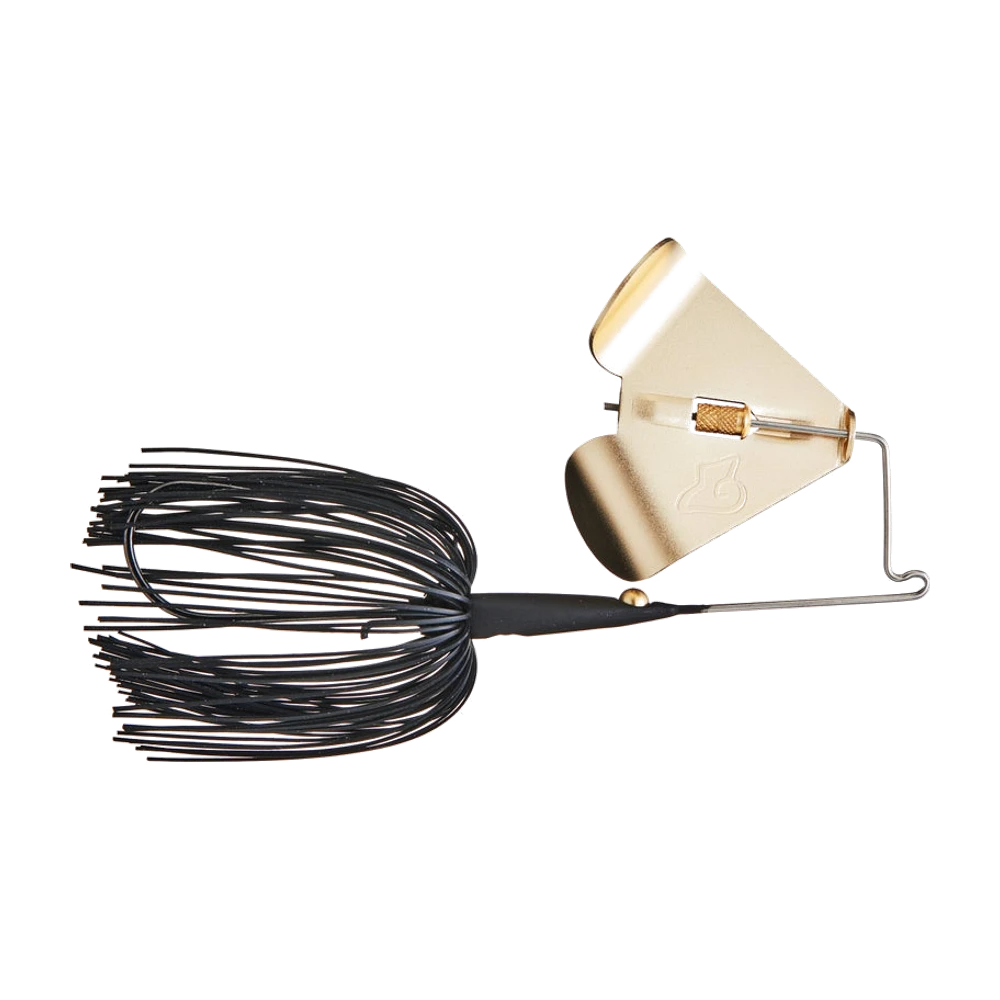
Teckel Maxqueaker: the buzzbait that squeaks straight out of the bag
This lure shines under specific conditions. CarnaFish tells you in 10 seconds if today is one of them.
There is a precise moment in late summer when a backwater lily pad flat becomes impassable for just about everything in your box. Crankbaits load up, swimbaits pick up filaments within a metre, and the fish is very much there, sitting under a pad waiting for a frog to take a wrong turn. A buzzbait is one of the few answers to that situation, provided it squeaks. Teckel built the Maxqueaker around that single obsession.
A squeal you do not have to earn
A conventional buzzbait has to be broken in. You retrieve it ten, fifteen, thirty times so the blade wears its rivet and finally starts to sing. The Maxqueaker removes that step: it is built to squeak right out of the package.
Teckel's answer is not a better machined rivet, it is a different architecture. The rear rivet, the part that normally holds the blade at the end of the shaft, is simply gone. In its place, a knurled brass locker sits at the centre of the blade. The blade no longer turns around a single point at the tip of the wire, it rubs across several surfaces at once against a piece of brass, and soft metal rubbing on soft metal screams far louder than a steel eyelet turning on a steel shaft.
That sound is not a gimmick. On the surface, in water carpeted with vegetation, a bass locates a silhouette very poorly: it hears first and sees afterwards, in the last metre.
A flat, keeled head that holds its posture
The Maxqueaker's head is flat and keeled, and that detail decides almost everything. A round or badly balanced head rolls over as soon as you change speed: the lure runs crooked, the blade comes half out of the water, the noise turns ragged and the hookset becomes guesswork. The keel forces the bait to stay upright, hook up, at any retrieve speed.
In practice you can slow down to the point where the blade barely turns without the body tipping over, which is what lets you fish the Maxqueaker very slowly at dusk, when fish will not chase.
The brass knocker, or two lures in one
A brass ball sits inside the head. Depending on how the wire is flexed, it either clacks against the head on every turn or stays clear and leaves nothing but the squeal of the blade.
This is an adjustment, not a factory option. A slight bend of the wire brings the blade closer to the head and you get a clacking lure that carries a long way in wind-chopped water. Bend it the other way and the ball no longer makes contact: only the squeak remains, often the right version on a calm, clear pond holding fish that have already seen plenty of traffic.
Mark the wire position that gives you the clack. After three or four fish and a couple of snags the wire will have moved and you will have slipped from one version to the other without noticing. The day the lure stops producing, that is usually the reason, not the fish.
Moving through vegetation without combing it
Dropping the rear rivet has a consequence the weed angler spots within three casts: there is no longer a protruding part at the end of the shaft to catch filaments. A conventional rivet, with its shoulder and peened head, is a genuine weed comb. Without it, the wire simply ends in a keeper bend and vegetation slides off.
That does not make the Maxqueaker weedless in the sense that a hollow body frog is. The hook stays exposed, shielded only by the skirt. Inside a closed pad field, a Booyah Pad Crasher or an equivalent frog still does the job. But across everything that counts as reed edge, submerged grass sitting a foot under the surface, scattered milfoil or a duckweed film, the buzzbait goes through and catches more fish than a frog because it covers three times the water per hour.
The tackle that goes with it
A powerful casting rod, braid of 30 to 40 lb straight through, no fluorocarbon leader, because fluoro sinks and pulls the nose of the bait down.
The factory Gamakatsu hook is sharp and strong enough for this work, and the shaft carries a wire bait keeper that locks a soft plastic trailer in place. That trailer is not decoration: a grub tail or a 3 to 3.5 in swimbait adds buoyancy, lowers the minimum retrieve speed further and gives the fish something to grab behind the skirt.
Speed is the only real adjustment
A buzzbait has no action to impart. You cast, you start reeling before the lure even lands so the blade catches immediately, and you hold a constant speed all the way back to the boat. Everything else comes down to choosing that speed.
The starting rule: the slowest speed that keeps the blade on top. At that speed the lure leaves its bubble trail inside the fish's window of vision for the longest time. You speed up only to cross unproductive water, or to provoke a fish that followed without committing.
The classic mistake
Setting the hook on the sound. Half the time the fish has not got the lure in its mouth yet and you pull it away from its nose. Keep reeling at the same speed until you feel the weight in the rod, then set sideways rather than upwards.
Not sure what to tie on?
Photograph your spot: CarnaFish reads the scene, cross-checks the conditions and gives you the zone, the lure and the retrieve. Free on iOS and Android.
Colours by light and water clarity
- Low light, dawn, dusk, night: black skirt with a brass blade, as pictured. Black gives the cleanest silhouette seen from below against a pale sky.
- Clear water and bright sun: a light skirt with a nickel blade that throws plenty of light and mimics a small baitfish panicking on top.
- Stained or green water: chartreuse, which keeps a readable contrast where natural tones vanish at half a metre.
Where and when to pull it out
The buzzbait is a warm season lure. In Europe the useful window runs from late spring to early autumn, as soon as the water climbs past the mid teens in Celsius and fish agree to come up. The best hours are the first two and the last two of the day.
The spots are a frog angler's spots, fished faster: reed edges, laydowns, pad points, channels between two grass beds, and above all breaks in the vegetation. The Maxqueaker works as a search tool. When it draws strikes without converting, come back through with a bladed jig such as the Molix Chatter Bait or a spinnerbait to work the foot of water underneath.
Lure choice never replaces reading the spot, which is exactly what CarnaFish does: send a photo of the swim and the AI suggests the zone, the depth and the lure family that match the day's conditions. For the groundwork on topwater bass fishing, our beginner guide to bass fishing sets the scene.
Key takeaways
- Removing the rear rivet and adding a central brass locker gives an immediate squeal, with no break-in, and far more volume than a conventional buzzbait.
- The brass knocker is adjusted by flexing the wire: clacking version for chopped water, squeak only for calm, clear water.
- The flat keeled head keeps the lure upright from minimum to maximum speed, which is what allows a genuinely slow retrieve.
- Set the hook on the weight you feel in the rod, never on the sound of the strike.
FAQ
Does the Maxqueaker need breaking in?
No, and that is its whole point: the blade squeaks from the first turns of the handle thanks to the central brass locker and the deleted rear rivet. A conventional buzzbait often needs several dozen casts before it reaches full volume.
How do I switch between clacking and quiet?
By slightly flexing the wire shaft to bring the blade closer to, or further from, the brass ball housed in the head. Close, it clacks on every turn; clear, only the squeal remains. Note your reference position, because the wire moves with use.
Exactly how much does this buzzbait weigh?
The manufacturer's description gives neither length nor weight, and it is better to say so than to quote an invented figure. In the hand it has the bulk of a standard buzzbait and casts without difficulty on a medium heavy casting outfit.
Does the Maxqueaker replace a frog in the pads?
Not inside a closed canopy: the hook is exposed and will eventually find a leaf. It is, however, faster and louder than a frog along edges, over submerged grass and through channels, which makes it an excellent search bait before you switch to weedless.
Can the blade be changed?
Yes, the shaft is grooved for it. You can replace a damaged blade or change finish without changing lures, which is rare on a buzzbait and seriously extends its service life.
Do pike hit this kind of lure?
Regularly, in shallow warm water, on the same spots as bass. Fit a short supple wire trace: a buzzbait retrieved on top gets hit broadside, and bare braid does not often survive the teeth.
The full bass lure guideSeason-by-season strategy: which family of lure, when, and why.Go from theory to fish
CarnaFish reads your spot from a photo and gives you the game plan: zone, lure, retrieve. Free on iOS and Android.