War Eagle Buzzbait: the keeled head that gets on plane straight away
This lure shines under specific conditions. CarnaFish tells you in 10 seconds if today is one of them.
The buzzbait carries an unfair reputation: people think of it as a lure for big American lakes and spectacular July blow-ups. In reality it is the fastest search bait there is over a shallow flat, and it works as well on a two hectare pond as on a river backwater. It only has to climb to the surface from the first turn of the handle, otherwise half the cast is wasted. That is precisely what War Eagle built this model around.
Getting on plane, the real test of a buzzbait
A buzzbait sinks. The moment it lands it starts going down, and until it reaches the surface it makes no noise, no bubbles, nothing at all. The distance it burns getting back up is called getting on plane, and it is what separates a good buzzbait from a bad one.
The War Eagle head is flat and keeled, shaped to generate lift as soon as the lure moves. It climbs fast and settles on top within a few tens of centimetres. On a cast tucked against a stump or under a low branch, that is the difference between a lure that fishes the whole path and one that only starts fishing halfway back.
The keel also governs posture. A round head rolls onto its side as soon as you speed up, the blade comes out of the water and the squeak turns ragged. The flat head keeps the hook pointing up at any speed, and on a topwater, hook up is also what stops you collecting every strand of weed on the way.
Light wire, a deliberate choice
War Eagle builds its buzzbaits on wire thinner than average. It is a trade-off worth understanding before you buy.
On the plus side, thin wire passes the blade's vibration far better. You feel the lure working constantly in the rod, and above all you feel the instant it stops working: a strand of grass in the blade, a slowdown, a change of rhythm. That running commentary matters when you are fishing a lure you cannot see, at last light.
On the minus side, thin wire bends out of shape faster. After three or four fish and a few snags the geometry shifts, and the blade ends up either touching the head or standing too far off it. Get into the habit of holding the lure up against the light every hour and straightening it by hand: thirty seconds that restore the original squeak.
Always carry two identical buzzbaits, one new and one already tired. When the bites stop for no obvious reason, swap to the new one before you change colour or move spot. Half the time it is the bent wire, not the fish.
Blades and what they bring
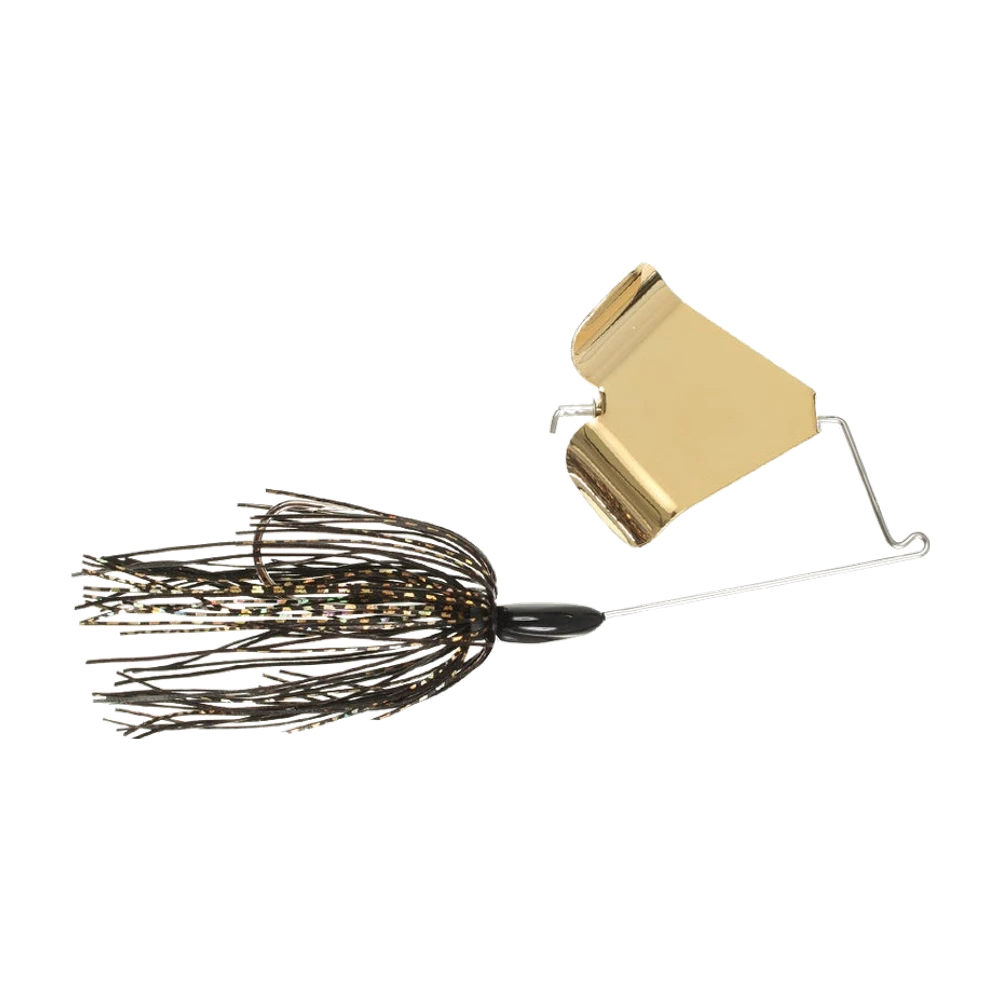
War Eagle offers the blades in several finishes, including prism versions that throw a far more aggressive flash than the polished brass in the photo.
The choice is not cosmetic. Under cloud or in stained water the flash does almost nothing and the sound does the work: a brass or painted blade is enough. In bright sun over clear water, the prism adds a visual signal that carries a long way and pulls fish from several metres. Too much flash can also put off an educated fish in very transparent water, in which case you go back to a dark or matt blade.
The squeak, and how to keep it
A new buzzbait does not always squeak loudly. The sound comes from the blade rubbing on its shaft, and it grows as the parts wear into each other. You can speed up the break-in by burning the lure back at high speed for a few casts: it marks the eyelet slightly and the sound settles in.
What kills the squeak is silt and sand. A buzzbait dragged across a muddy bank comes back with particles between the blade and the shaft, and it goes mute. Rinse it, spin the blade between two fingers, and the sound returns.
The slip-on skirt, an underrated asset
War Eagle skirts are slip-on skirts, held on a collar rather than glued. You can pull one off and replace it in thirty seconds without a tool.
That changes two things. First the running cost: a skirt torn by a pike does not send the lure to the bin. Second, and more importantly, the speed of a change on the water. You can go from gold flake brown to white because the sky cleared, without retying, without changing lures, and without losing the three minutes that often separate a fish from a blank.
It also lets you tune the volume: trimming two centimetres off the skirt with scissors reduces drag, speeds up planing and clearly raises the hookup rate when fish are striking short.
Not sure what to tie on?
Photograph your spot: CarnaFish reads the scene, cross-checks the conditions and gives you the zone, the lure and the retrieve. Free on iOS and Android.
Rigging and the mistake to avoid
Medium heavy casting rod of 6 ft 6 in, 30 to 40 lb braid tied straight through. No fluorocarbon: it sinks and pulls the nose down, exactly what you are trying to avoid. In pike water, a short supple wire trace, no argument.
The factory Mustad Ultra Power Point hook is sharp, but it is a single exposed hook. Plenty of anglers add a trailer hook, which works, but which also increases snagging in vegetation sharply. Save it for open water.
The classic mistake is the same on every buzzbait: setting the hook on the sound. Fish often blow up beside the lure, and a reflex hookset pulls it away from the nose. Keep reeling at the same speed until you feel the weight in the rod, then set sideways. It feels wrong for the first ten fish, after which it becomes automatic.
Colours by light
- Clear water over timber or rock: gold flake brown as pictured, with a brass blade. Restrained and natural, it is the do-everything combination.
- Baitfish on top, clear sky: a white skirt with a nickel or prism blade, imitating a scatter of small fish.
- Dusk, night, dark water: solid black. Seen from below only the silhouette counts, and black stands out best against whatever light is left.
At this price a buzzbait is a consumable: buy two or three rather than one premium model and keep the money for the rod. Our budget predator tackle guide works through that trade-off. And as always, the lure does not replace reading the swim: from a single photo of the spot, CarnaFish suggests the zone and the lure family that fit the day's conditions.
To round out the box in this register, the Booyah Buzz sits in the same price bracket, the Teckel Maxqueaker brings a markedly louder squeal for three times the money, and the War Eagle Double Colorado takes over as soon as the fish refuse to come up.
Key takeaways
- The flat keeled head gets the lure on the surface within a few tens of centimetres, which makes every cast useful along its whole length.
- Light wire passes vibration well but bends out of shape fast: check the geometry every hour and straighten it by hand.
- The slip-on skirt changes in thirty seconds and lets you adjust colour and volume without retying.
- Prism blades earn their keep in clear water and bright sun; under cloud it is the sound that works, not the flash.
FAQ
Which weight should I start with?
The manufacturer does not give weights in its description and the catalogue shows at least two price points, so at least two versions. As always on a buzzbait, the lightest model you can still cast with your outfit is the right one: the lighter it is, the lower the minimum retrieve speed.
Should I add a soft plastic trailer?
It is not compulsory, but a small swimbait or toad adds lift, lowers the minimum speed and gives the fish a longer target. If you are missing a lot of strikes, it is the first thing to try before changing lures.
My buzzbait has stopped squeaking, what now?
First check for silt or sand between the blade and its shaft, because a rinse and a few spins by hand often fix it. If the sound stays weak, the lure is probably still too new and needs a few fast casts to mark the shaft.
What is the best season for this lure?
In Europe, from late spring to early autumn, peaking once the water climbs past the mid teens in Celsius. The first two and the last two hours of the day are the most productive, and an overcast sky with a ripple beats a mirror surface.
Can you catch pike on a buzzbait?
Yes, over warm shallow flats, and the strikes are often violent. Fit a short supple wire trace, because without one the lure is lost one time in three and the fish leaves with hardware in its mouth.
Why is the slip-on skirt a genuine argument?
Because it turns a wear part into a replaceable consumable. A torn skirt changes in thirty seconds with no tools, and you can adjust the colour or trim the volume right there on the water, without retying or swapping lures.
The full bass lure guideSeason-by-season strategy: which family of lure, when, and why.Go from theory to fish
CarnaFish reads your spot from a photo and gives you the game plan: zone, lure, retrieve. Free on iOS and Android.