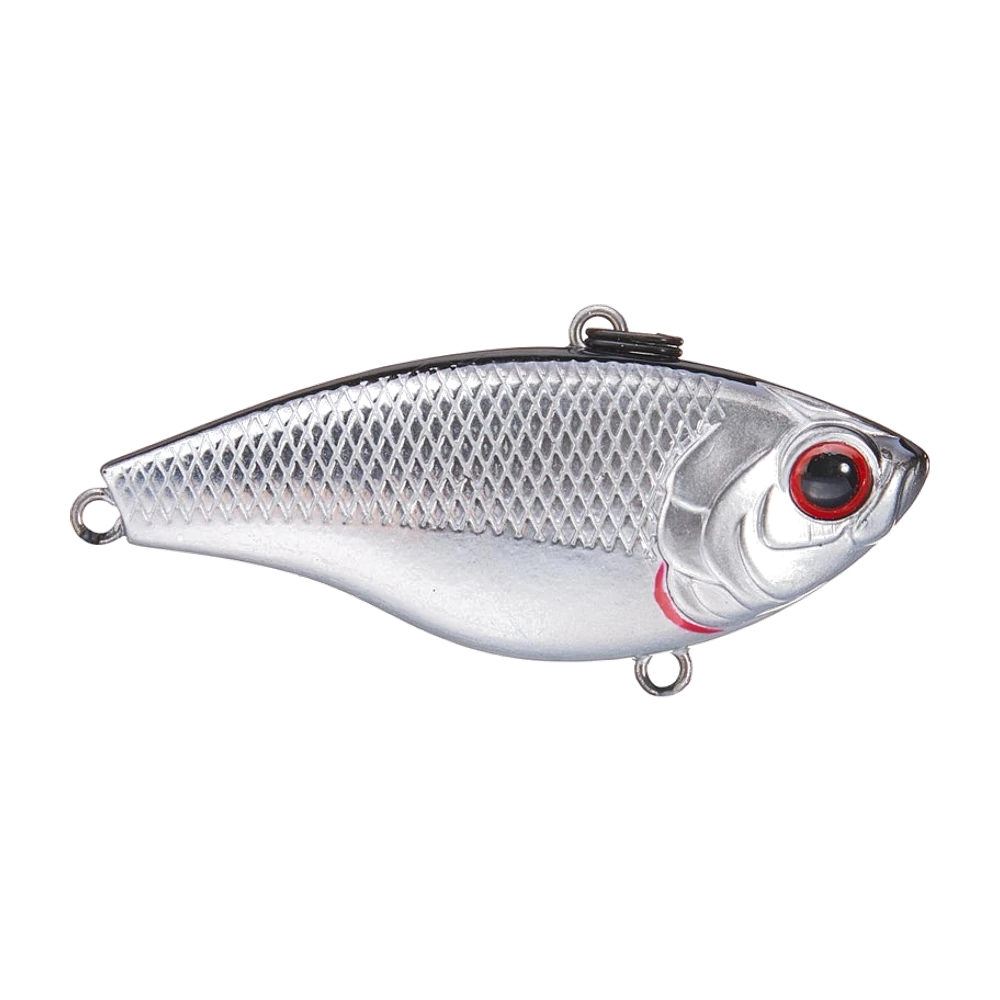
6th Sense Duke: the compact lipless heavy enough to rip grass
Rather not fish it blind? Photograph your spot — CarnaFish cross-checks the conditions and points you the right way.
Late summer, a flat of submerged grass topping out at about a metre and a half, water still warm, and pods of baitfish blowing up at the surface without warning. That's the exact situation where a lipless takes over from everything else in the box: you cast long, you reel fast enough that the bait shaves the tips of the vegetation, and the moment it loads up you snap the rod tip to tear it free. 6th Sense built the Duke around that one motion, and its weight-to-length ratio says so better than any sales copy.
Short and dense, a deliberate trade
The Duke comes in two sizes. The Duke 55 measures 5.7 cm / 2.25 in for roughly 10.5 g / 3/8 oz, the Duke 65 runs 6.4 cm / 2.5 in for roughly 17.5 g / 5/8 oz, and both sink. Hang on to that second number, because it is the whole story: 17.5 g on a 6.4 cm body is very high density for a lipless. Most vibrating baits in this class stretch the body out to reach that weight. 6th Sense went the other way, keeping a short silhouette that still looks like an easy mouthful while holding on to all the mass it needs.
That density has three concrete consequences on the water. The bait casts a long way, even into the wind, which matters when you are picking apart a flat tens of metres across from a boat. It drops fast, so you reach the top of the grass in two or three seconds instead of swimming it uselessly near the surface. And it stays in contact with the line: you feel the vibration in the rod tip the whole time, which tells you at every instant whether you are touching vegetation or not. A lipless that is too light does the opposite — the current carries it, and you end up fishing blind without realising it.
The flat head, the vibration and the noise
The front end of the Duke is deliberately flat and wide. That is what gives this type of bait a tight, fast wobble rather than a wide swim. The body barely rolls, but it vibrates hard, and it moves more water than the average lipless of the same size. In the hand the feel is unmistakable — this is a bait that knocks in your palm, not one that undulates.
On top of that sits an internal rattle chamber built to be loud on purpose. In stained water, or over thick grass where the fish only sees the bait at the last second, sound does part of the locating work for you. That is something the Duke shares with a Strike King Red Eyed Shad, and what separates it from the quieter lipless baits you would rather reach for in very clear water on pressured fish.
Ripping over the grass
Ripping is the technique this bait was calibrated for, and it has nothing in common with a straight retrieve. You cast past the zone, let the bait sink until you feel the first contact with vegetation, then reel fast — fast enough that it brushes and grabs the grass tips. When it loads up, you stop reeling and snap the rod cleanly, sideways or upward, to tear it free. The bait releases, takes off vibrating, and that is where everything happens.
Don't start reeling again the second it rips free. Give it half a second of slack while the Duke drops back down on a slightly loose line. Eight bites out of ten come inside that window, and if you wind in straight away you will barely feel them.
Why the fall after the rip makes the difference
A fish sitting in the grass won't chase a bait running fast above its head. It clocks the bait, gets ready, and waits for a mistake. The rip followed by a fall reproduces exactly that mistake: a prey item that got stuck, tears loose in a cloud of debris and sinks back down out of control. The strike is reflexive and violent, and it is usually taken on the slack. Which is why you want to keep a small reserve of loose line rather than staying tight the whole way in.
The yoyo for deeper spots
On a drop-off, a riprap bank or a hard edge with no vegetation, the Duke 65 changes jobs completely. You let it fall to the bottom on a count, give two turns of the handle to lift it off, let it drop again, and repeat. The vibration on the lift wakes the fish up, the fall triggers it. This yoyo works just as well on zander in Europe as it does on bass, as long as you slow the rhythm down: on zander, stretch the pauses to three or four seconds and let the bait touch the substrate on every cycle.
That vertical use is where the Duke runs straight into a Rapala Rippin' Rap, which is cut more for deep zander work, while the Duke keeps the edge on fast coverage in shallow water.
Not sure what to tie on?
Photograph your spot: CarnaFish reads the scene, cross-checks the conditions and gives you the zone, the lure and the retrieve. Free on iOS and Android.
Rigging and hooks
Nothing complicated here, but three details matter. Run a quick snap or a loop knot: a knot cinched straight to the nose ring cuts down the vibration amplitude, exactly the way it would on a billed crankbait. For line, 0.30 to 0.35 mm fluorocarbon suits straight retrieves and cushions sharp strikes nicely, but if you are genuinely ripping in the grass, switch to thin braid with a short leader. It takes real force to tear a loaded bait free, and braid does not forgive a bent hook.
The factory trebles are black nickel and properly sharp, so there is no rush to swap them out. Do check the rear treble after every ripping session, though. It is the one that collects debris, and the first one to open up.
The classic mistake
Setting the hook with a hard upward lift, rod high, the way you would on a soft plastic. A lipless carries two trebles on a rigid body with no cushioning at all, so a violent hookset tears the fish's mouth or rips the points out. Work with a low, sideways sweep instead, following the bite rather than fighting it. And pick a rod with a moderate, semi-parabolic action rather than a stiff tip — you will lose far fewer fish at the end of the fight, when the bait starts working as a lever.
Colours by water clarity
- Clear water: a chrome with a blue back, throwing light in short flashes and imitating a silver baitfish. Avoid it under high overhead sun, where it sometimes turns too aggressive.
- Stained water, especially in spring: a craw red. On a lipless, that shade has long been tied to shallow fish in warming water.
- Murky water or low light: a black back over gold flanks, for a silhouette that reads up close even when visibility drops below half a metre.
What the Duke doesn't do
Worth saying plainly: this is not a finesse bait. On a wary fish in very clear, cold water, a short, heavy, noisy lipless pushes fish away rather than pulling them in. It is also not a bait that forgives truly dense weed — in a matted canopy a topwater or a Texas rig stays the right tool, and a Strike King KVD Squarebill comes through dead timber far better. The Duke is a fast search bait for submerged vegetation and hard edges, and inside that frame it is hard to beat.
The right bait never replaces reading the spot, and that is exactly where CarnaFish saves you time: photograph the water and the AI suggests the zone, the depth and the lure family that fit the day's conditions. To build the tackle and spot-type fundamentals first, our beginner's guide to bass fishing is still a solid way in.
Key takeaways
- A short 5.7 or 6.4 cm body carrying 10.5 to 17.5 g, so a high density that buys casting distance and permanent contact through the line.
- The wide flat head produces a tight wobble and a lot of water displacement, backed by a distinctly loud rattle chamber.
- The reference technique stays ripping over grass, with a fall pause right after the rip.
- Not a finesse bait: in clear, cold water on educated fish it is too loud and too fast.
FAQ
Which Duke size should I start with?
The Duke 65, 6.4 cm for roughly 17.5 g, covers the most ground: it casts long, sinks fast and takes to ripping and the yoyo equally well. The Duke 55 becomes interesting when the forage is small, or when you are fishing in under a metre of water and the 65 drops too quickly.
Does the Duke snag a lot in vegetation?
It does, and that is intended — the technique is precisely to touch the grass and then tear free. In light to moderate grass it stays manageable with braid. In a dense, matted canopy, change lure families instead of fighting it.
Can you catch zander on this lipless?
Yes, on a yoyo near the bottom along drop-offs, with long three to four second pauses and firm substrate contact on every fall. For dedicated deep zander work, a Rapala Rippin' Rap remains more specialised.
Should I change the factory hooks?
Not right away, since the factory black nickel trebles are sharp out of the box. Just check the rear treble after each ripping session, because it is the one that opens up and dulls first from being torn out of vegetation.
How should I attach it at the nose?
A quick snap or a loop knot. A knot cinched directly to the ring restricts the vibration and you lose part of the action, exactly like a crankbait with a choked bill.
Why do I keep losing fish on a lipless?
Almost always down to the hookset and the rod. Two trebles on a rigid body with no cushioning tears out fast, so set with a low sideways sweep, and favour a semi-parabolic action over a stiff tip.
The full bass lure guideSeason-by-season strategy: which family of lure, when, and why.Go from theory to fish
CarnaFish reads your spot from a photo and gives you the game plan: zone, lure, retrieve. Free on iOS and Android.