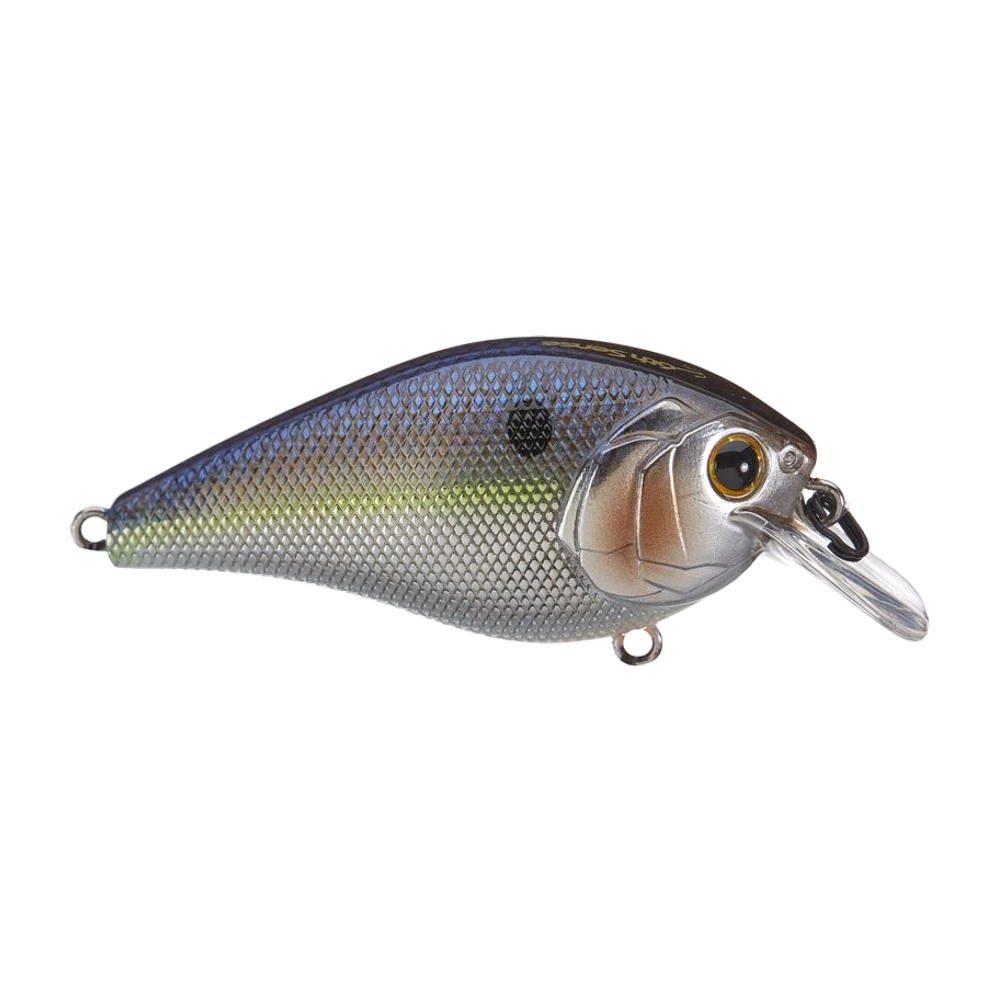
6th Sense Crush Silent Squarebill 50S: the squarebill with no noise
Before tying this one on, it helps to know if the spot actually calls for it. CarnaFish reads the scene from a photo.
A twelve-acre pond in October, clear water, no wind, not a ripple on the surface. You can hear your own crankbait clacking thirty feet out. The bass hear it coming from a lot further, and on water that gets fished every weekend that clacking has become an alarm rather than a dinner bell. The Crush Silent Squarebill 50S answers that exact problem: it is a squarebill that makes no noise whatsoever.
Silence is not a detail, it is a strategy
For twenty years crankbait design has run in one direction: more beads, more resonance chambers, more volume. The logic holds in murky water, where sound is the main way fish locate a lure. It turns against the angler on clear, heavily fished water.
A fish learns quickly to associate a repeated signal with a bad experience. On a pond where loud crankbaits go past every week, the rattle becomes precisely the thing that makes a fish back off six feet short of the lure. The 50S offers the opposite: the silhouette, the square bill's vibration and the flash, but nothing to hear. The fish only detects the lure at the last moment and has to decide in a fraction of a second.
It is also a second-pass lure. You have combed a bank with a noisy model, had two missed bites and then nothing. Go back over the exact same water with the 50S: some of the fish you alerted without hooking are still there, and a mute lure catches them.
A compact size, calibrated for fish that refuse bulk
At 2.25 in and 3/8 oz, the 50S is noticeably smaller than the squarebill norm. 6th Sense built that size to trigger fish that reject a standard profile, without dropping all the way into genuine finesse territory.
The weight stays high enough to cast properly on a casting reel and to hold a line in a light wind. Below this class you move to the Crush Mini 25X, which runs shallower and asks for a lighter rod. Above it, the Crush Squarebill 100X takes over with a far bulkier body.
High buoyancy: the detail that changes fishing in wood
6th Sense pushed the 50S's buoyancy up. In practice, the moment you stop reeling, the lure rises hard.
That has two very practical consequences. First, getting through cover: when the square bill wedges in a branch or a stump, a one-second pause is often enough to float the lure up over the snag, where it frees itself. So you fish much closer to the wood, which is where the fish are.
Second, it arms the contact-and-pause. Bump the bill into something, stop reeling for a second, let the lure climb a few inches, then start again. That slow vertical rise after an impact is one of the most reliable triggers there is on an inactive bass.
A square bill is not a diving bill, it is a bumper. Its job is to absorb the impact, kick the lure sideways and keep the trebles from hitting the obstacle first. If you are fishing a squarebill out in the middle of the lake and touching nothing, you have the wrong tool on.
The hunting action, and how not to ruin it
The 50S is weighted to break randomly to one side on a steady retrieve, the behaviour Americans call hunting. It is not a manufacturing flaw, it is the goal. Two precautions let it happen.
First, a free connection point. A fine snap or a loop knot lets the lure's nose pivot; a knot cinched straight onto the eye removes part of the wander. Second, a constant speed: the breaks appear when water pressure on the bill stays stable long enough to unbalance the body. Constantly speeding up and slowing down gives you a regular swim — exactly what you were trying to avoid.
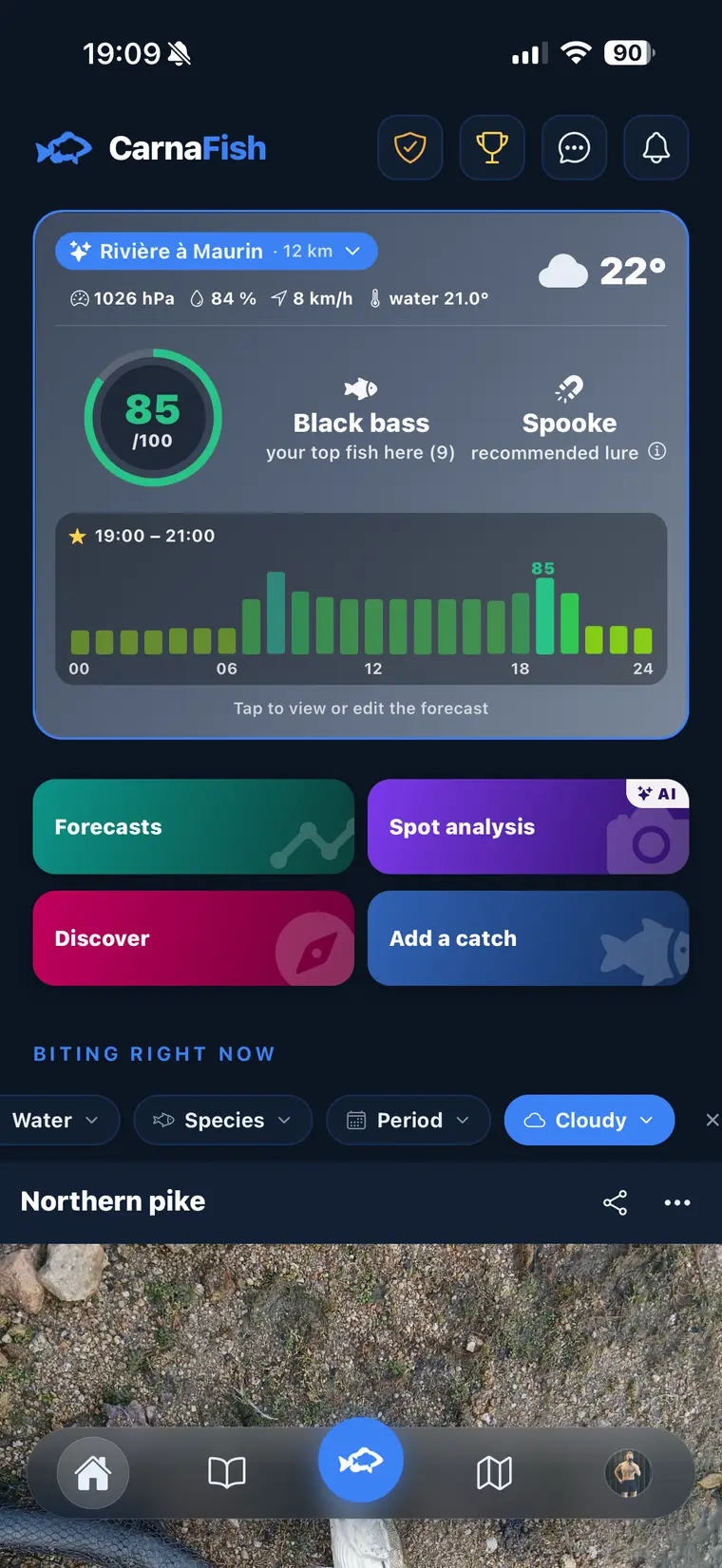
Not sure what to tie on?
Photograph your spot: CarnaFish reads the scene, cross-checks the conditions and gives you the zone, the lure and the retrieve. Free on iOS and Android.
Colors by water clarity
- Clear water: a translucent shad, which passes light through and avoids a hard contrast when the fish has time to examine the lure.
- Spring, gravel or rock bottom: red craw, the finish matching real crayfish coloration at the time bass are actively hunting them.
- Lightly stained water: black-back chartreuse, to regain visibility as soon as clarity drops.
Its place in a squarebill box
Against the Strike King KVD 1.5 Squarebill, the 50S trades a strong rattle and a wider body for silence and a reduced profile. Against the Bomber Square A it is the more modern lure in terms of erratic action, though the Bomber keeps the edge on price and toughness. And if the fish are truly glued to bottom and refuse anything that vibrates, a suspending jerkbait like the 6th Sense Provoke works a completely different register, built on long pauses.
Knowing whether a silent squarebill, a noisy model or a jerkbait is the right call comes down first to clarity, depth and the type of cover. That is exactly what CarnaFish gives you from a photo of the spot: a zone, a depth and a lure family that match the day. For the rest, our beginner's guide to bass fishing covers tackle and reading water.
The short version
- A total absence of rattle is an asset on clear, heavily fished water and a handicap in murky water.
- The compact 2.25 in size triggers fish that turn down a standard squarebill.
- High buoyancy lets you fish right against wood and free the lure with nothing but a pause.
- The hunting action needs a free connection at the nose and a constant retrieve speed to show up.
FAQ
Is the Crush Silent Squarebill 50S genuinely silent?
Yes, that is its whole reason for existing: no beads, no resonance chamber. The fish detects it through the bill's vibration and by sight, not by sound.
When does a silent lure out-fish a noisy one?
In clear water, on regularly fished venues, and on a second pass after you have alerted fish with a noisy model. Conversely, in murky or loaded water a rattle is still useful so the fish can locate the lure.
How deep does it run?
Between 2 and 5 ft depending on speed, line diameter and cast length. It is a bank-and-shallow-flat lure, not a diver.
Why does my 50S wander off to one side?
That is deliberate, and it is called the hunting action. The ballast makes it unstable so it breaks off course at random, which destroys the regularity of a mechanical retrieve and triggers bites.
Should I replace the trebles?
No. It comes fitted with size 4 VMC black nickel trebles that are sharp out of the pack. Just check the points after several passes through riprap.
Can you fish it for perch?
Yes, the 2.25 in size suits good perch well, especially on riprap and weed edges. The silence is actually an asset on a school of perch you do not want to scatter on the first cast.
The full bass lure guideSeason-by-season strategy: which family of lure, when, and why.Go from theory to fish
CarnaFish reads your spot from a photo and gives you the game plan: zone, lure, retrieve. Free on iOS and Android.