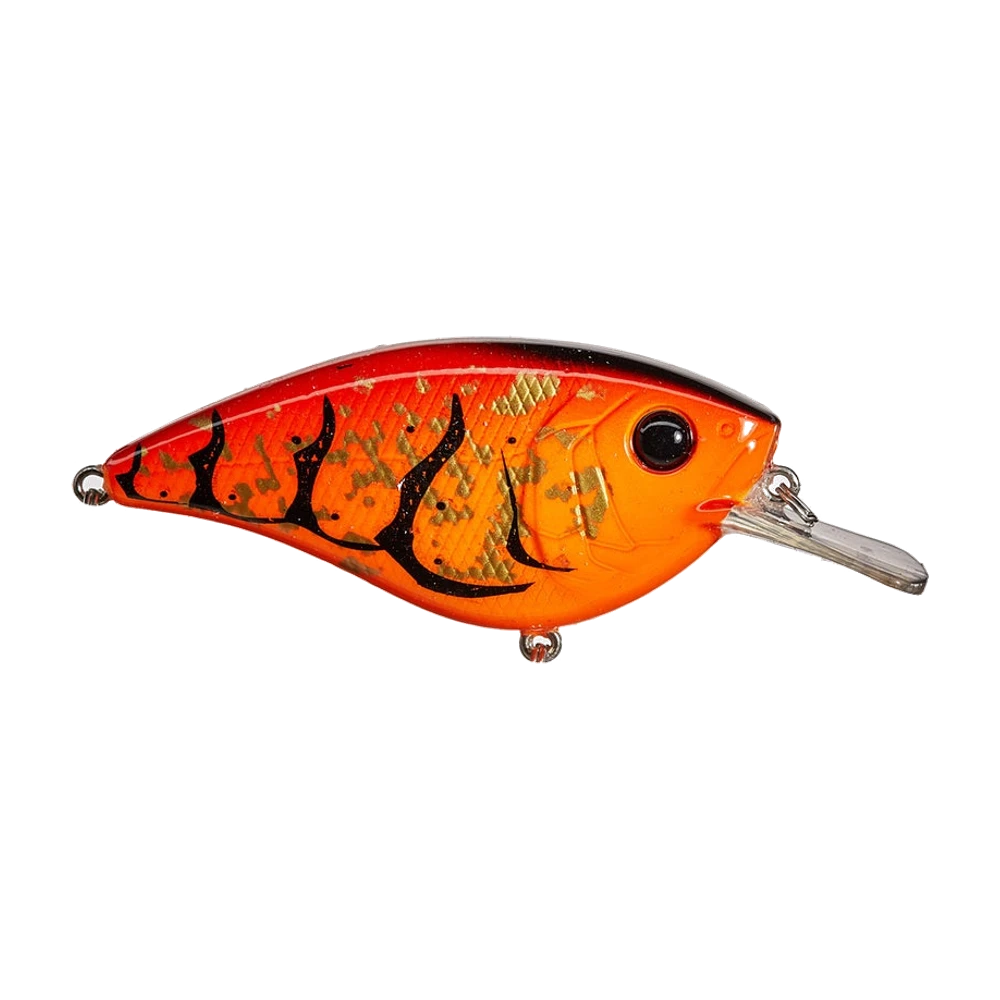
6th Sense Crush Flat 75X: the flat side built for bigger fish
Rather not fish it blind? Photograph your spot — CarnaFish cross-checks the conditions and points you the right way.
Late September, the water drops a degree a night and bass push back up onto grass flats to follow bait. You are fishing five feet of water with vegetation topping out in patches. A round crankbait hangs up, a standard squarebill gets ignored because the fish have already seen three this season. That is exactly the Crush Flat 75X's ground: a flat side built deliberately bigger than the norm, designed to sort fish by size.
Why a flat side does not vibrate like a round body
The difference between a round-bodied crankbait and a flat-sided one is purely hydrodynamic. A round body pivots around its axis with a wide sweep at a low frequency: the familiar wobble. A laterally flattened body presents two large vertical surfaces to the water, which makes it unstable on its axis and sets it rolling fast, with less amplitude but a much higher frequency.
For the fish, that changes two things. First the flash: on every roll, flat sides bounce light like a mirror, producing a far harsher glint than a rounded body. Second the vibration: tight and quick, it reads more like a baitfish shivering in trouble than the heavy sway of a conventional crank. That is why a flat side stays deadly in cooling water, when fish go off wide, slow signals.
Going big on purpose, and what that costs
6th Sense gave the Crush Flat 75X a body deliberately bulkier than most squarebills on the market. At 2-2/3 in and 5/8 oz, it sits above the 1.5-class standard almost everyone carries.
That choice has an accepted consequence: you will get fewer bites, but on average bigger fish. A bulkier lure screens out part of the small bass that never commit, and it stays visible in stained water or on a windy day with the surface churned up. The 5/8 oz body also casts a long way, including into the wind — a concrete advantage when you have to cover a fifty-yard flat without drifting on top of it.
The flip side: this is not the lure for a calm day on very clear water over educated fish. In that exact case, a downsized profile like the Crush Mini 25X gets more bites.
Three ways to work it, three situations
The first and most obvious is a fast steady retrieve in open water. Cast, wind at a constant speed, let the vibration do the search work. Useful for finding fish on a flat you do not know.
The second, and this is where the lure really makes sense, is ripping it through vegetation. Wind it fast until it grabs a stalk, then snap the rod to tear it free: the lure breaks loose sideways, loses balance for a fraction of a second, then rights itself. That break in rhythm is what triggers the strike, not the steady swim.
The third is making it hit bottom or hard cover — stumps, riprap, bridge pilings. The flat-sided body deflects hard on contact, which creates the same surprise effect as ripping it out of grass. Aim at the cover deliberately instead of avoiding it.
The bill is not there to dive, it is there to collide. If you finish a day with a Crush Flat whose paint is untouched, you fished beside the cover instead of in it. A flat side that touches nothing catches almost nothing.
The classic mistake: too stiff a rod
The lure's own details matter, but the rod decides how many fish reach the boat. A crankbait is a treble-hook lure, and poorly held trebles tear out the moment the rod is too fast. Pick a medium, moderate-action rod — a dedicated parabolic cranking stick if you have one — and back the drag off a little. The fish runs with the lure crosswise, and it is the softness of the blank that keeps it pinned through the fight.
Second point people overlook: the almost-silent rattle housed in the body. 6th Sense deliberately chose a faint knock rather than a loud clack. On water where everybody throws noisy cranks, that is an advantage; in very murky water where fish have to find the lure by sound, a louder model will do better.
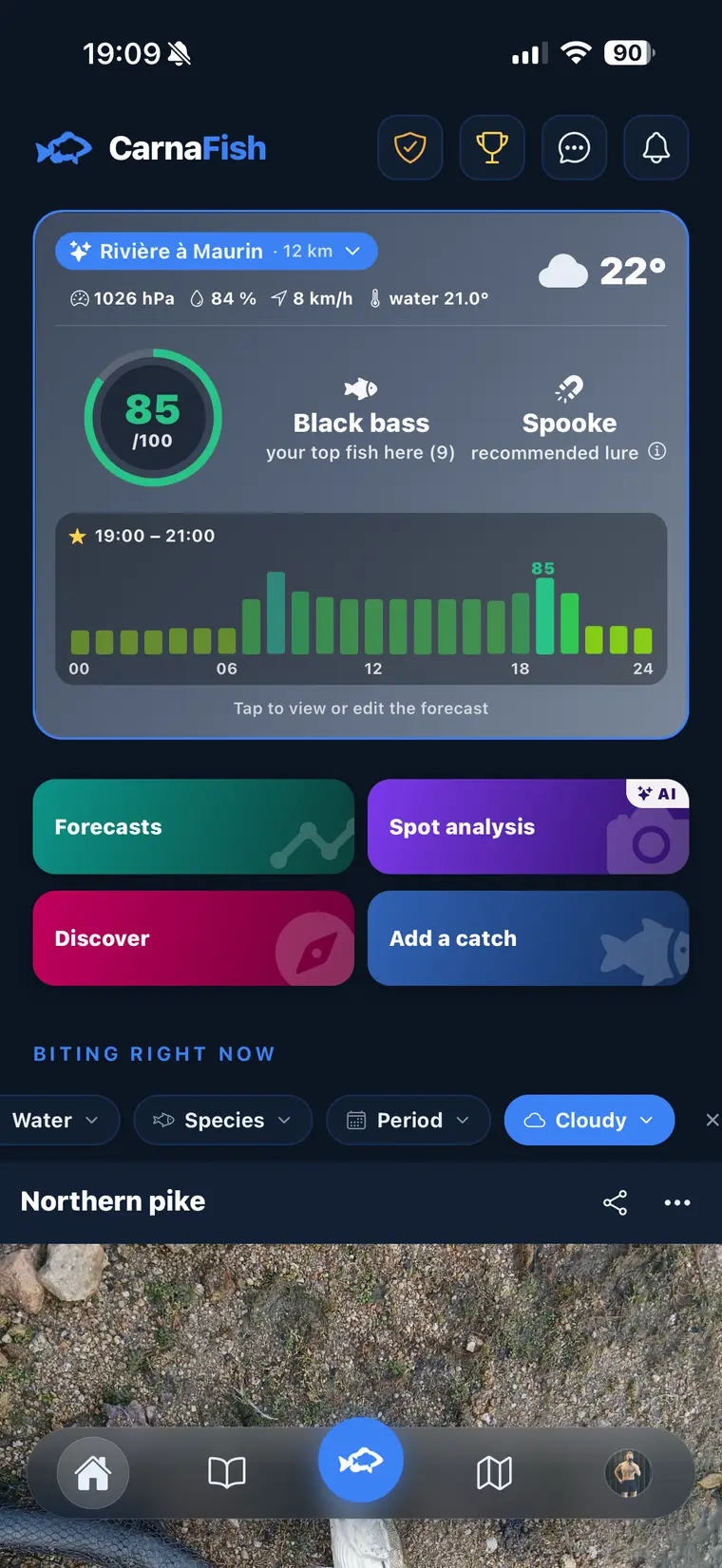
Not sure what to tie on?
Photograph your spot: CarnaFish reads the scene, cross-checks the conditions and gives you the zone, the lure and the retrieve. Free on iOS and Android.
Colors by water clarity
- Clear water: a natural silver shad finish, which exploits the flash inherent to flat sides without piling more on.
- Stained water: black-back chartreuse, the shallow-crank standard, visible at low clarity without looking fake.
- Early season, cold water: red-brown craw, the spring winner over gravel and riprap, the period when crayfish come out and bass actively hunt them.
Where it sits among the other shallow cranks
Against a Berkley Frittside, the other reference flat side in this slot, the Crush Flat 75X brings bulk and casting weight at the cost of finesse. Against a Strike King KVD 1.5 Squarebill, it trades the wide wobble for a faster, flashier roll. And if what you want is a genuinely erratic swim rather than a fast one, the Storm Wiggle Wart remains the other school of thought.
Knowing which of those three to tie on comes down to reading the spot: real depth, type of cover, clarity. That is exactly what CarnaFish does from a single photo of the water, handing you a zone and a lure family that match the day. For the rest of the tackle and the classic spot types, our beginner's guide to bass fishing lays the groundwork.
The short version
- Flat sides give a fast roll, a tight vibration and far more flash than a round body.
- The bulkier-than-standard body sorts fish by size: fewer bites, better average.
- The lure's real potential is released on contact, not on a free swim — make it collide with grass and hard cover.
- Medium moderate-action rod and a drag that is not cranked down, or the trebles pull on the hookset.
FAQ
How deep does the Crush Flat 75X run?
Between 2 and 5 ft depending on retrieve speed, line diameter and cast length. It is a shallow lure: past about 6 ft of water it will not reach anything worth reaching.
What is the difference from a standard squarebill?
Two things: the flat-sided profile, which produces a faster, flashier roll than a squarebill's wide wobble, and the body volume, deliberately above the class average to target bigger fish.
Can you hear the rattle?
It is deliberately very faint. That is an asset on fish conditioned to noisy crankbaits, and a limitation in very murky water where a louder sound helps the fish locate the lure.
Should I swap the factory trebles?
No. It comes fitted with VMC black nickel trebles that are sharp out of the pack. Just check the points after a session spent in riprap.
Does it work for perch?
Yes, especially on grass flats and banks where perch hunt in schools. The lure's size does the sorting on its own: you will get few small perch, but big ones take a crankbait of this class readily.
Fluorocarbon or braid?
Fluorocarbon, 12-20 lb, in most cases: it sinks slightly, cushions the hookset and stays discreet. Switch to braid with a fluoro leader only when you are fishing dense vegetation and need to rip the lure free hard.
The full bass lure guideSeason-by-season strategy: which family of lure, when, and why.Go from theory to fish
CarnaFish reads your spot from a photo and gives you the game plan: zone, lure, retrieve. Free on iOS and Android.