Basstrix HoverTrix: the soft minnow that holds still in open water
The right lure in the wrong spot still catches nothing. CarnaFish spots the zone that works, from a single photo.
Fish suspended at four metres over eight metres of water, visible on the sonar, perfectly still. You run a paddle tail past them: they look and do not move. You try a drop shot: the bait drops too fast, then hangs above the sinker without ever reaching their level. The Basstrix HoverTrix is built for that exact case, the fish that will not come down and will not come up.
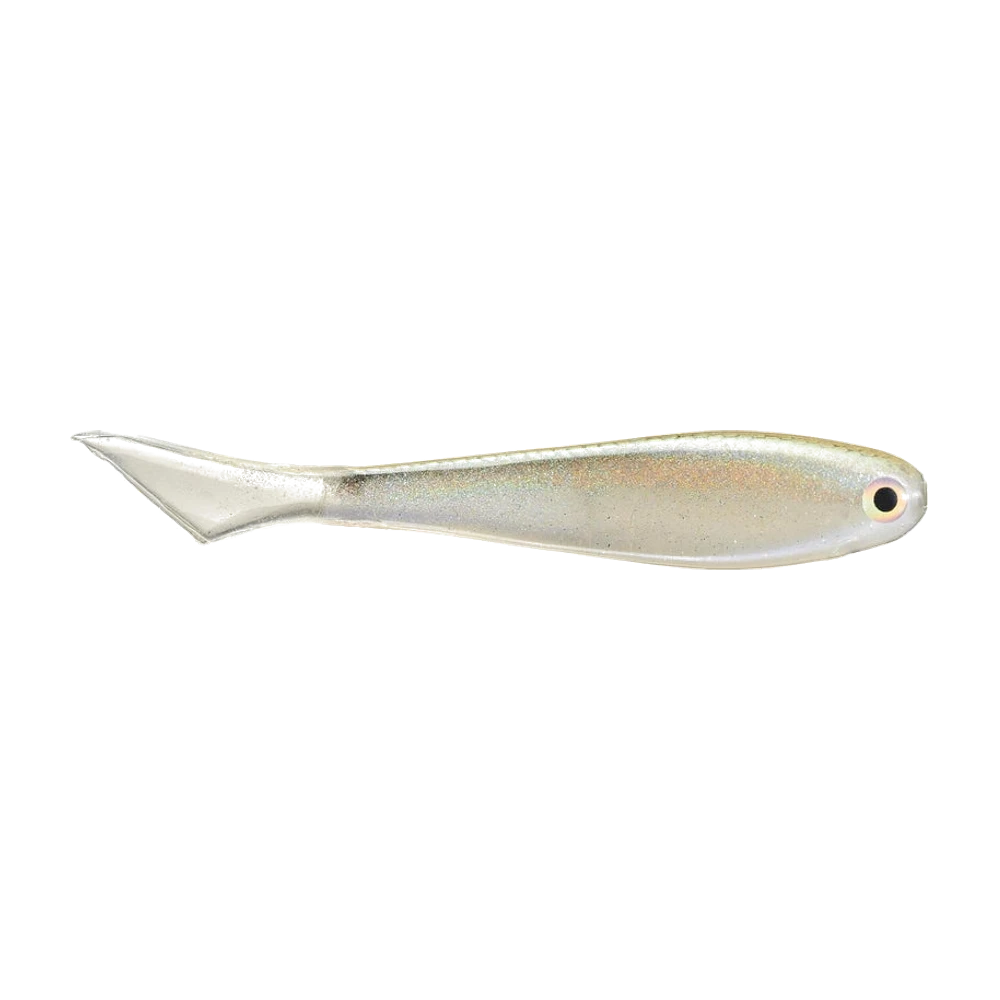
Hovering, and what the keeled tail is doing there
A bait that hovers does not swim, it holds. The goal is not to produce an action, it is to stay horizontal at a fixed depth for as long as possible, giving just enough signal to exist. That is the technical difficulty: a standard soft bait on a jig head noses over the instant you stop working it.
The HoverTrix answers that with the shape of its tail. It is flat, broad and keeled — a central ridge running its whole length. Two consequences follow. First, it gives a bearing surface that slows the bait tipping over when it stops: it stays in line longer. Second, it turns the slightest rod-tip shake into a subtle swim, without ever producing the hard thump of a paddle.
That is the technique Americans call minnow shaking: you do not pull, you do not reel, you shake the rod tip in place and simply let the line come tight. The bait quivers, rolls a quarter turn, comes back. It is an animation you learn in ten minutes and spend a season actually calibrating.
A hand-poured hollow body, and a missing weight
Basstrix pours the HoverTrix by hand around an internal cavity, like the rest of its range. The stated length is 4.3 in, so 10.9 cm, and the bag holds five pieces.
The maker gives no weight. That is not an oversight: on a bait meant for rigs where the lead does all the work, the weight of the bare body would teach you very little. But it does mean you cannot calculate your sink rate in advance, and you have to measure it yourself the first time, counting seconds until the line goes slack.
The hollow body brings the same advantage here as on the Basstrix Flash Trix: it compresses the moment the fish closes its mouth. On a presentation where the bite shows up as weight appearing, with no knock at all, that softness buys you reaction time. The trade-off is identical too — a hand-poured hollow body tears faster than a solid bait, and the jig head collar is the weak point. A drop of superglue on the collar easily doubles the number of fish per bait.
The two rigs it was made for
The hover rig
This is the rig the bait was moulded for, in collaboration with Core Tackle. The principle: a hook carried on a very lightly weighted shank that puts the centre of gravity under the body rather than ahead of it. As a result the bait stays horizontal at rest instead of nosing down, and it falls flat and slow.
This is the rig to choose when fish are located and stationary. It asks for patience: a descent can take twenty seconds, and the bite often comes during that descent.
The minnow jig head
Simpler and easier to come by: a slim 1 to 3 g jig head, nose-rigged. You lose the perfect horizontal hold, you gain casting ease and versatility. This is the version to favour when you are drifting and searching rather than working a located fish.
Either way, stay on a thin fluorocarbon leader, 0.20 to 0.25 mm. Straight braid transmits the micro-flaws in your animation far too well and the bait starts spinning out.
The adjustment that makes the difference is neither the lead nor the color: it is the angle of your rod. Tip at forty-five degrees, the line works on a diagonal and the bait climbs the moment you move it. Tip pointed at the water, almost vertical, and the bait holds its depth and simply quivers in place. That is the whole point of the rig.
The classic mistake
Working it too much. The natural reflex is to add movement when nothing is happening, and that is exactly what kills this bait. The HoverTrix lives on micro-shakes and long stillness. If you catch yourself making one-metre pulls, you are on the wrong technique — go back to a standard paddle tail and lose less time.
The color-shift paint, and the sonar question
The maker describes a color-shift paint job, designed to increase the bait's natural flash during a hovering or strolling presentation. In the photo that shows up as a translucent pearl body heavily loaded with glitter, whose shade turns with the angle of the light.
The selling argument is tied to forward-facing sonar, where the angler tracks the lure and the fish on the same screen. In Europe that gear is still a minority and it is banned or restricted in a fair number of competitions. That takes nothing away from the bait: dense glitter throws a flash the fish can see when the body rolls, and that is what you are after anyway. But it is worth knowing that mid strolling was built around electronics not everyone owns.
Without sonar, it stays relevant in known situations: a drop-off edge whose depth you know, a located sunken tree, a school of baitfish with predators sitting underneath. In Europe it is also a rig that works very well on zander suspended in winter on large reservoirs, where a Fox Rage Fish Snax Dropshot covers part of the same need with a fixed weight.
Not sure what to tie on?
Photograph your spot: CarnaFish reads the scene, cross-checks the conditions and gives you the zone, the lure and the retrieve. Free on iOS and Android.
Colors by water clarity
- Clear water: the glittered pearl with shifting highlights in the photo, which plays on the roll of the body rather than on a solid shade.
- Weedy bottom or green water: an olive back, which keeps the silhouette believable seen from below without standing out against the bottom.
- Low light or slightly veiled water: an opaque white, which keeps a readable silhouette when highlights are no longer any use.
In this kind of fishing, color comes a long way behind the exact depth and the length of the pauses. Vary those two before you touch the tackle box.
A situational bait, not a search bait
The HoverTrix is useless while you are still looking for the fish. It is a second-stage bait, the one you tie on when you know what depth they hold at and they have refused everything else. In that logic it complements a search bait such as the Basstrix Paddle Tail Swimbait, which is the one covering ground.
Knowing whether the day's situation calls for a suspended presentation rather than a bottom one is exactly what CarnaFish gives you: one photo of the spot, and the AI returns a zone, a likely depth and a lure family consistent with the conditions. To build the basics of vertical and drift fishing, our beginner's guide to zander fishing with lures covers the rigs and the rhythms.
Key takeaways
- 10.9 cm, hand-poured hollow body, five pieces per bag, weight not stated by the maker.
- The flat keeled tail exists to hold the bait horizontal at rest, not to produce a swim.
- Two rigs: the Core Tackle Hover Rig for a perfect hold, a light minnow jig head for simplicity.
- Work it less. Micro-shakes and long pauses, rod tip pointed at the water.
FAQ
What exactly is a hover rig?
It is a rig where the lead sits under the body of the bait rather than ahead of it, so the bait stays horizontal at rest. The HoverTrix was moulded to suit it, but it also works on a light minnow jig head.
What size is the HoverTrix?
The maker states 4.3 in, so 10.9 cm, in bags of five. No weight is given, which is logical for a bare bait whose behaviour depends entirely on the lead you choose.
Do you need forward-facing sonar?
No, but you do need to know where the fish are. The bait was designed around that technique, yet it stays very usable on a drop-off or a sunken tree whose depth you know. That gear remains a minority in Europe and is restricted in several competitions.
Is it suitable for zander?
Yes, and it is a good European transposition. A zander suspended in winter on a large reservoir is exactly the fish this rig targets: stationary, at a precise depth, unwilling to chase.
Does the hollow body hold on a jig head?
That is the weak point. The material is soft and the bait slides down the shank after a few fish. A drop of superglue on the collar solves it and easily doubles the working life of a bait.
How does it differ from the Flash Trix?
The Basstrix Flash Trix is shorter, 6.5 to 9 cm, and built around five different rigs. The HoverTrix is longer at 10.9 cm and specialises in one thing: holding horizontal in open water.
The full bass lure guideSeason-by-season strategy: which family of lure, when, and why.Go from theory to fish
CarnaFish reads your spot from a photo and gives you the game plan: zone, lure, retrieve. Free on iOS and Android.