Berkley Powerbait Power Switch: the bait built for forward-facing sonar
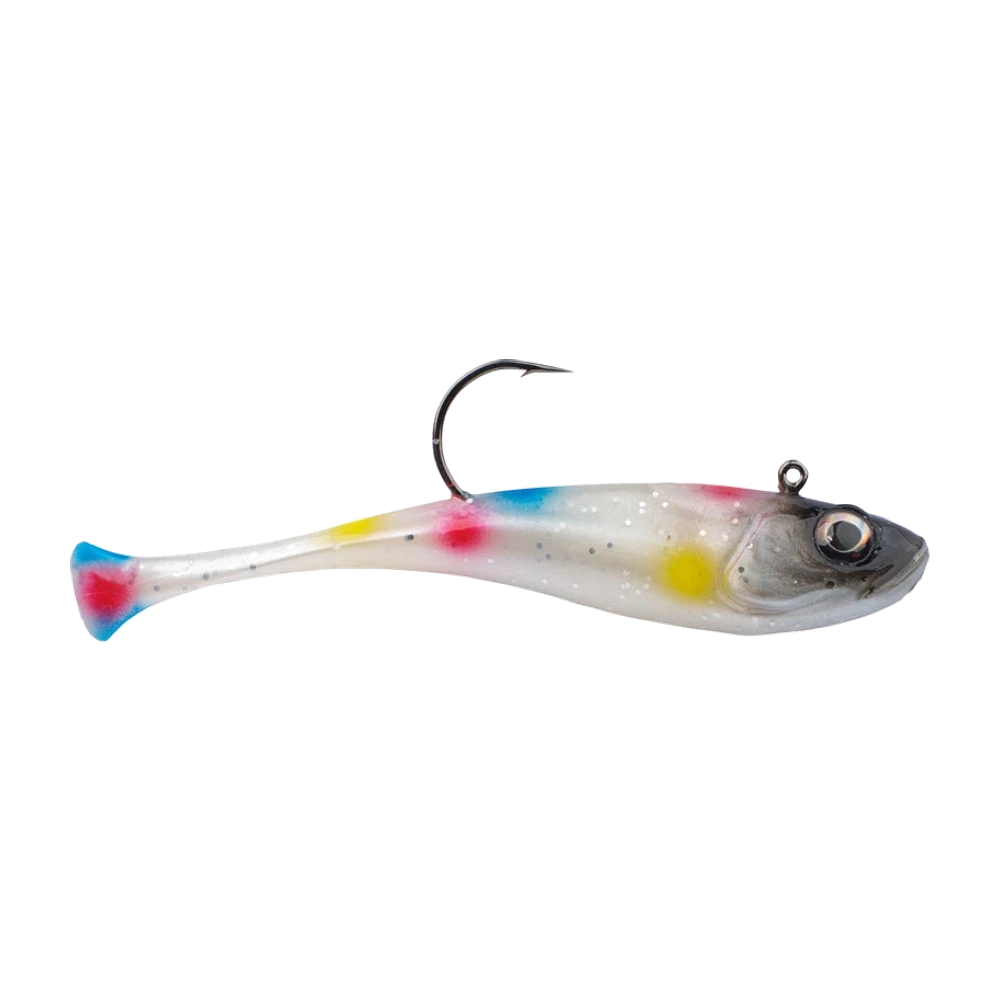
This lure shines under specific conditions. CarnaFish tells you in 10 seconds if today is one of them.
Fishing with forward-facing sonar changes the tempo completely. You see the fish, you see your lure, and you have five or six seconds to convince it before it turns off and leaves. Within that window, a bait that takes three seconds to sink and two more to settle has already lost. The Power Switch is built for that window, and for nothing else.
The forward weight, and what it allows
The whole design turns around a mass placed well forward in the body. Three concrete consequences.
First, the cast: a lure with its weight up front flies like an arrow and lands far out, precisely, even into a headwind. On a fish marked twenty metres away, that's the difference between landing on it and landing beside it.
Then, the drop. A weight-forward bait noses down and sinks fast, almost vertically, instead of gliding off at an angle. You reach the fish's depth within a few seconds, without drifting out of its field of view.
Finally, and this matters most, the suspension. Once the bait is at depth, the head weight lets it settle flat immediately, nose slightly down, and stay there. That's what Berkley calls the hover: the lure isn't swimming, it's holding its place in the strike zone while you decide on the moment.
The real difficulty of hovering isn't making the bait move, it's doing nothing for long enough. Count three full seconds after each small pop of the rod tip. Most bites land on the second or third second of the pause, just as the angler starts getting impatient.
Six sizes, and weights that matter
Berkley publishes a full chart, which is rare and welcome: 1.75 in for 4.4 cm and 1.8 g, 2.5 in for 6.4 cm and 7.1 g, 3 in for 7.6 cm and 10.6 g, 3.5 in for 8.9 cm and 17.7 g, 4.25 in for 10.8 cm and 28.3 g, and 5 in for 12.7 cm and 46.1 g.
What stands out is the density. A 7.6 cm body weighing 10.6 g is far heavier than a standard shad of the same length on a light jighead. That's exactly the intention: drop fast and hold depth, not glide.
In practice, the 6.4 cm and 7.6 cm cover perch and zander in ten to fifteen metres of water. The 8.9 cm at 17.7 g becomes the reference size as soon as wind or current makes holding vertical a problem. The two big sizes, 10.8 and 12.7 cm, are mostly for big bass and deep water; at 46.1 g you need a rod that can take it, and the bait sinks so fast you lose control in a shallow column.
The retrieves that work
Hover
This is the main mode. Cast or drop vertically, stop at the chosen depth, then give small sharp pops of the rod tip, spaced two to three seconds apart. Each pop sends the bait darting off in a disordered way — right, left, upward — with no predictable path. It's the unpredictability that triggers, not the amplitude.
Damiki rig
Vertical drop directly under the boat, stop just above the marked fish, and near-total stillness: the bait holds horizontal, nose slightly down, while you simply follow the fish rising or falling on the screen. It's a devastating winter technique on zander and perch in deep water.
Yo-yo and vertical jigging
On fish pinned to the bottom, lifts of 50 cm to 1 m followed by controlled free drops. The forward weight makes the bait nose down on the descent, which looks a great deal like a baitfish diving for the substrate.
It also takes a slow straight retrieve and skipping under docks, but that isn't where it stands out: for pure straight-line fishing, a Keitech Shad Impact 3 or a Megabass Hazedong Shad on a light head will do better.
The mistake that ruins the hover
Working it too hard and too often. The instinct, when you see a fish rising on screen, is to add more. That's precisely the moment to stop moving: a fish on the approach has already decided to look, and a sudden action gives it the one piece of information it needed to refuse. Rod tip still, line slightly tight, and you wait.
Second mistake: too heavy a leader. In sight fishing, the bait sits motionless under the fish's eyes for several seconds, sometimes at less than a metre. Fluorocarbon of 0.18 to 0.22 mm is plenty for perch and zander, and it changes the refusal rate noticeably compared with 0.30.
What to keep in mind about sonar fishing
Forward-facing sonar fishing is debated, and several competition circuits in Europe have restricted or limited it. Check the rules in force on your water and in the events you enter before investing in the electronics. On the fishing side, the Power Switch keeps all its value in classic vertical presentations above an ordinary sonar return: the Damiki rig did not wait for forward-facing sonar to work.
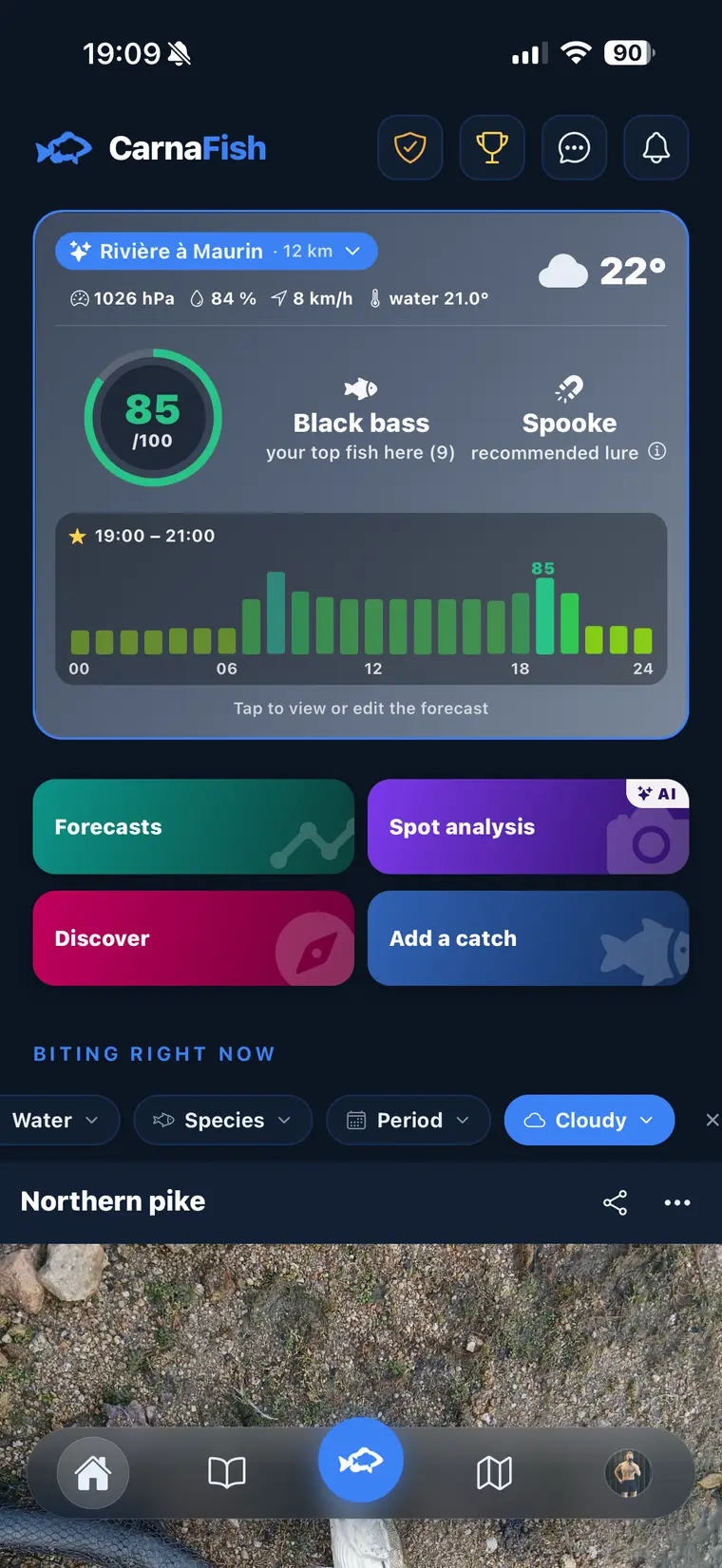
Not sure what to tie on?
Photograph your spot: CarnaFish reads the scene, cross-checks the conditions and gives you the zone, the lure and the retrieve. Free on iOS and Android.
Colour by water
- Clear water: a natural silver finish, which lets stillness do the work. On a hover, a loud lure gets inspected for longer, and the longer the inspection lasts, the more likely the refusal.
- Stained water: a pearl glitter pattern like the one in the photo, with its coloured dots. The glitter returns light even under poor illumination and gives a focal point.
- Low light or great depth: a dark back. Below ten metres the colour disappears and only the silhouette still counts.
Seeing the fish doesn't tell you where to look
A sonar shows what's in front of you, not where you should have gone. That's exactly the role of CarnaFish: a photo of the spot, and the app suggests the zone, the depth and the presentation suited to the day's conditions, before you even launch the boat. To build the logic behind lure choice for zander, our beginner's guide to zander fishing with lures covers the families worth knowing.
Key takeaways
- Forward weight: precise casts, a fast near-vertical drop, then a flat suspension inside the strike zone.
- Six documented sizes, from 4.4 cm / 1.8 g to 12.7 cm / 46.1 g; the 6.4 to 8.9 cm formats cover most perch and zander situations.
- The hover is won on the pauses, not the action: three seconds of stillness after each small pop.
- Pre-rigged on a single Fusion19 hook, to be tied to thin fluorocarbon to limit refusals in sight fishing.
FAQ
Is the Power Switch only useful with forward-facing sonar?
No. It's built for it, but the Damiki rig and vertical jigging above a classic sonar return work very well with it, particularly in winter for zander and perch.
What size should I choose for zander?
The 7.6 cm at 10.6 g and 8.9 cm at 17.7 g cover most situations. Move heavier as soon as wind or current stops you holding vertical.
Do I need to add a hook or a jighead?
No, the bait comes pre-rigged on a single Fusion19 hook with the weight integrated in the head. You tie it straight to your leader.
Why do fish refuse at the last second?
Two causes dominate: too heavy a leader, and an action given just as the fish approaches. On a hover, the moment the fish rises, stop moving and leave the line slightly tight.
Can it be fished on a straight retrieve?
Yes, it accepts one, but that isn't where it stands out. For a pure straight-line retrieve, a soft shad on a light head remains more suitable and more lively.
How many baits per pack?
Two to four depending on size: four in 4.4 cm, three in 6.4 and 7.6 cm, two above that. On a pre-rigged bait you depend on for a window of a few seconds, buy generously.
The full bass lure guideSeason-by-season strategy: which family of lure, when, and why.Go from theory to fish
CarnaFish reads your spot from a photo and gives you the game plan: zone, lure, retrieve. Free on iOS and Android.