G-Ratt The Rocker: the soft jerkbait that rolls on the spot
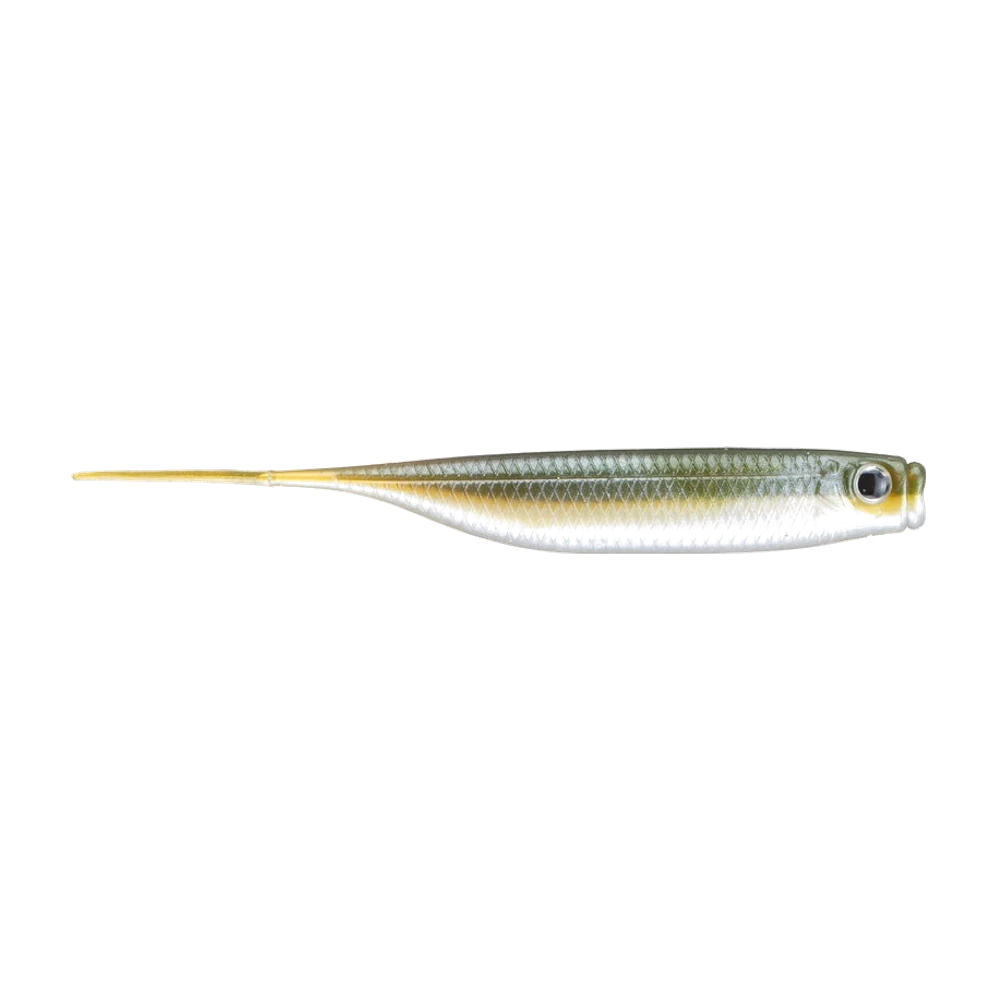
This lure shines under specific conditions. CarnaFish tells you in 10 seconds if today is one of them.
There is a family of soft baits that tries neither to swim nor to vibrate: it tries to stay in one place while looking alive. The G-Ratt Rocker belongs to it. Its whole reason for existing is an irregular rocking behaviour — the body tips from one flank to the other without ever settling into a clean track — and that only happens if you let it, instead of reeling it in. This is a slow-fishing bait, and that is not a presentation detail.
Three sizes, and a deliberately short spec sheet
The maker's table has two columns: length and pack count.
- 4 in, that is 10.2 cm, 7 per pack.
- 5 in, that is 12.7 cm, 6 per pack.
- 6 in, that is 15.2 cm, 5 per pack.
There is no weight and no class column. That is not an omission on our side: the maker does not publish them. Two consequences follow directly. First, the per-bait weight, which varies with the batch anyway and means little on a lure whose working mass comes from the head. Second, buoyancy: with no class given, we do not know whether the bare body floats, sinks or sits neutral, and inventing it would be dishonest. If you need to know before buying, the simplest test is to drop one in a bucket of water when the pack arrives.
The material is stated: a TPE described as both very soft and durable. Those two do not always go together — a very soft plastisol tears quickly around the hook hole — and that is precisely the maker's claim. On a bait fished with slow action and meant to catch several fish in a row, that is a concrete point: fewer baits binned after three bites.
Why "rocker", and what it implies
The stated action is not a swim, it is a roll. The body tips one way then the other, irregularly, without moving far. Two features of the silhouette explain it: a flat, deep forward body that offers a large surface to the slightest water movement, and a long, very fine thread tail, visible in the photo on this page, which acts as an unstable rudder instead of steadying the bait.
That is the exact opposite of what a paddle-tail shad does. Where a paddle converts forward motion into steady vibration, the Rocker converts stillness into disorder. A Zoom Super Fluke already plays in that no-vibration gliding register, but with a thicker body and a forked tail that brakes more.
A habit worth building with this kind of bait: count the seconds between inputs. What makes a fish react is not the twitch itself but the three to five seconds of apparent stillness that follow it. Most anglers work the bait twice as often as they should.
Two techniques, one bait
Jighead minnow
The basic rig: a slim jighead with an in-line eye, 2 to 7 g depending on depth and wind. The bait is threaded straight, the hook exiting a third of the way back. Cast, let it drop on a light contact, then alternate small twitches and long pauses. With a light head the descent is slow, and the bite very often comes during it.
On this rig the 4 in is the most versatile: 10.2 cm on a 3 to 5 g head is a format bass take without hesitation, and in Europe it interests zander on a river breakline too. The 5 and 6 in come in when you need to sort for size, or when the bait fish on the spot are over twelve centimetres.
Hover strolling
This is the other use the maker highlights, and the more technical one. The principle: hold the bait at a given depth, barely moving it forward, playing only on line tension and boat drift. The bait then sits in the water rolling on itself for long seconds, inside a volume the fish takes time to leave.
The copy explicitly mentions pairing it with forward-facing sonar, and that is honest: the technique was popularised with that tool, which lets you see bait and fish at once and adjust height to the centimetre. In Europe this kind of sonar is still a minority, and it should be said plainly that blind hover strolling is far harder — not impossible, but you lose the feedback loop that makes it worthwhile. Without sonar, a Berkley Finisher 5 FFS Jerkbait or the Rocker fish perfectly well on a standard jighead minnow rig, which remains the most accessible option.
Not sure what to tie on?
Photograph your spot: CarnaFish reads the scene, cross-checks the conditions and gives you the zone, the lure and the retrieve. Free on iOS and Android.
Where and when it works
The maker claims a bait that produces year-round, which is vague but not wrong for this family: something fished slowly and on the spot suits cold water, when fish will not chase, as well as high-pressure summer days when everything else has already been shown.
In practice the best spots are those where the fish is stationed and either visible or predictable: a breakline edge, the head of a hump, an isolated sunken tree, a bridge piling. Over a uniform flat where you need to cover water, the Rocker is a poor choice — it simply does not travel far enough to search. That limit is worth owning: this bait is there to convince a located fish, not to find one.
The classic mistake
Fitting a heavy head to "feel it better". The roll everything depends on disappears as soon as the weight dominates the body: the bait drops straight, stabilises and becomes a shad without a tail. Stay on the lightest head that keeps you in contact, even if it means waiting longer for depth. A light head on fine line sinks more slowly and catches more.
Colors by water
- Clear water: the natural green and gold finish in the photo, olive back and pearl flank, which mimics a small baitfish without overplaying the flash.
- Deep water or low light: a strong pearl white, easier for the fish to pick out and easier to read on a sonar screen, which matters when you are steering the bait's depth.
- Coloured water: a dark, plain tone, which gives a clean silhouette where a detailed pattern no longer serves any purpose.
A slow-action bait is only worth the quality of the spot you drop it on, and that is exactly what CarnaFish helps you narrow down: one photo of the water and the AI suggests the zone, the depth and the lure type that fit the day. To build the depth-and-structure logic that goes with this kind of presentation, our guide to getting started with zander on lures covers the basics, and the Basstrix Hovertrix offers another take on the same family.
Key takeaways
- Three lengths in the table: 10.2 cm in sevens, 12.7 cm in sixes and 15.2 cm in fives; no weight and no buoyancy class are published.
- The action is an irregular roll on the spot, not a swim: it disappears if the bait travels or if the head is too heavy.
- Two rigs are intended by the maker, jighead minnow and hover strolling, the second far more demanding without forward-facing sonar.
- A poor bait for searching a flat, a good one for convincing a fish you have already located.
FAQ
What sizes are there and how many per pack?
Three: 4 in or 10.2 cm in packs of 7, 5 in or 12.7 cm in packs of 6, and 6 in or 15.2 cm in packs of 5. Those are the only figures the maker publishes.
Does the Rocker float or sink?
The maker publishes no class column and no weight, so the question has no official answer. In practice the buoyancy of the bare body matters little, since the jighead determines how the rig behaves.
Do I need forward-facing sonar to use it?
No for the jighead minnow rig, which fishes perfectly well blind. Largely yes for hover strolling, whose whole value rests on seeing bait and fish at the same time and adjusting the height.
Which jighead should I choose?
Between 2 and 7 g depending on depth and wind, with an in-line eye and a slim head. Always take the lightest weight that keeps you in contact: a heavy head crushes the roll that makes the bait worth fishing.
Is the Rocker suitable for zander?
Yes. In Europe the 4 in version on a light head matches zander lies on breaklines and along deep edges, provided you fish very slowly. The maker, for its part, writes for a bass audience.
Why is the tail so thin?
Because it is not there to propel the bait but to unbalance it. A thread tail offers too little surface to steady the body, which sustains the irregular roll instead of correcting it.
The full bass lure guideSeason-by-season strategy: which family of lure, when, and why.Go from theory to fish
CarnaFish reads your spot from a photo and gives you the game plan: zone, lure, retrieve. Free on iOS and Android.