Berkley Gulp Paddleshad: the swimbait that still swims at a crawl
Before tying this one on, it helps to know if the spot actually calls for it. CarnaFish reads the scene from a photo.
Two in the afternoon, full sun, and the fast retrieve has given you nothing for an hour. So you slow down — and your usual swimbait simply stops swimming: the tail quits kicking, the bait drags behind the line like a piece of limp plastic. That exact speed band, the one where most paddle tails fall apart, is what Berkley built the Gulp Paddleshad to cover. With a scent trail the others do not have.
A tail that works when you stop working
Berkley describes this bait as producing a fast action through the body and tail working together, including at slow speeds. On the water you feel it in the rod tip: the paddle is wide relative to the slim section of the wrist carrying it, so it loads up with very little forward travel. You can reel barely faster than the current and the wrist still snaps, the body still rolls slightly on each beat.
That tolerance for slow speeds changes how you cover water. With a conventional paddle tail you have to keep a minimum of speed for the bait to exist at all, so you blow through the zones where fish are sitting tight. Here you can stay ten seconds in the same square metre, over a breakline or along a weed edge, without the bait going dead. It chases the same quality as a Keitech Easy Shiner 4, with one difference: the Keitech relies on very soft salted plastisol, the Paddleshad on paddle geometry and on scent.
The Gulp material, and the discipline it demands
Gulp is not plastisol. It is a water-based, porous material that releases attractant into the water rather than simply carrying it on the surface. Berkley makes scent dispersal the central argument for the bait, and it holds up: on a slow, bottom-oriented presentation where a fish has time to inspect before committing, it is often what turns a follow into a solid bite. It matters just as much in stained water, where predators hunt with the nose and the lateral line as much as with the eye.
The trade-off is that Gulp has to be handled differently from an ordinary soft bait. It dries out, and a dry one loses most of its point: it shrinks, hardens and stops dispersing. So you put it back in its juice after every session, you do not leave it baking on the gunwale for ten minutes, and you never store it loose with plastisol baits — the two materials degrade on contact. Durability is lower too: a bait torn by a strike does not get patched, it gets replaced. That is the cost of the system, and it is better known before you open the bag.
Four sizes, four jobs
Berkley offers the Paddleshad in 3, 4, 5 and 6 inches — roughly 7.6, 10, 12.7 and 15 cm — sold five, four, three and three to a pack respectively. No weights are published for those sizes, which makes sense for a bare soft bait: the mass that governs your casting distance and your rate of fall is the jighead or weighted hook you rig it on.
The 3 in is the perch and small bass size for pressured water, best on a 3 to 5 g head. The 4 in is the all-rounder of the range, a sound compromise for bass and zander in fresh water. The 5 in starts to interest better fish and works well in salt along breakwaters for sea bass. The 6 in is a big-fish search bait, worth tying on only where you know the volume is there — it selects, but it clearly cuts the number of bites.
The two rigs the bait was moulded for
Berkley states that the nose is shaped for EWG swimbait hooks and for jigheads. That is not catalogue filler: it is what decides whether your bait tracks straight or spins.
Weighted EWG Texas rig
This is the first choice as soon as there is wood, weed or sunken branches. Point buried in the back, a wide-gap hook that respects the body volume, a screw-in weight or weighted shank of 3 to 10 g depending on depth. The bait goes anywhere and keeps its action. In that role it covers the same ground as a Zman DieZel MinnowZ, with more scent and less durability.
Open jighead
Over clean bottom, on a straight retrieve or yo-yoed above a breakline, a plain jighead gives better hook-up rates and a more controlled descent. Choose a head whose collar actually matches the nose diameter: too wide and it tears the Gulp on the first strike, too narrow and the bait slides back and sits crooked.
The habit that makes the difference with Gulp: keep the juice. When the liquid is gone most anglers bin the bag — yet that liquid is what recharges and preserves the baits you have already used. A small airtight jar with the original juice in your box, and your opened Paddleshads still fish like new three trips later.
The classic mistake
Fishing the Paddleshad like a search bait, burning it back at spinnerbait speed. It works, but you give up both of its strengths: the action at low speed and the time the scent needs to spread. A bait that crosses the zone in six seconds has had nothing to say to the fish. Slow down, let it sink, make it work close to the bottom.
Not sure what to tie on?
Photograph your spot: CarnaFish reads the scene, cross-checks the conditions and gives you the zone, the lure and the retrieve. Free on iOS and Android.
Colours by water clarity
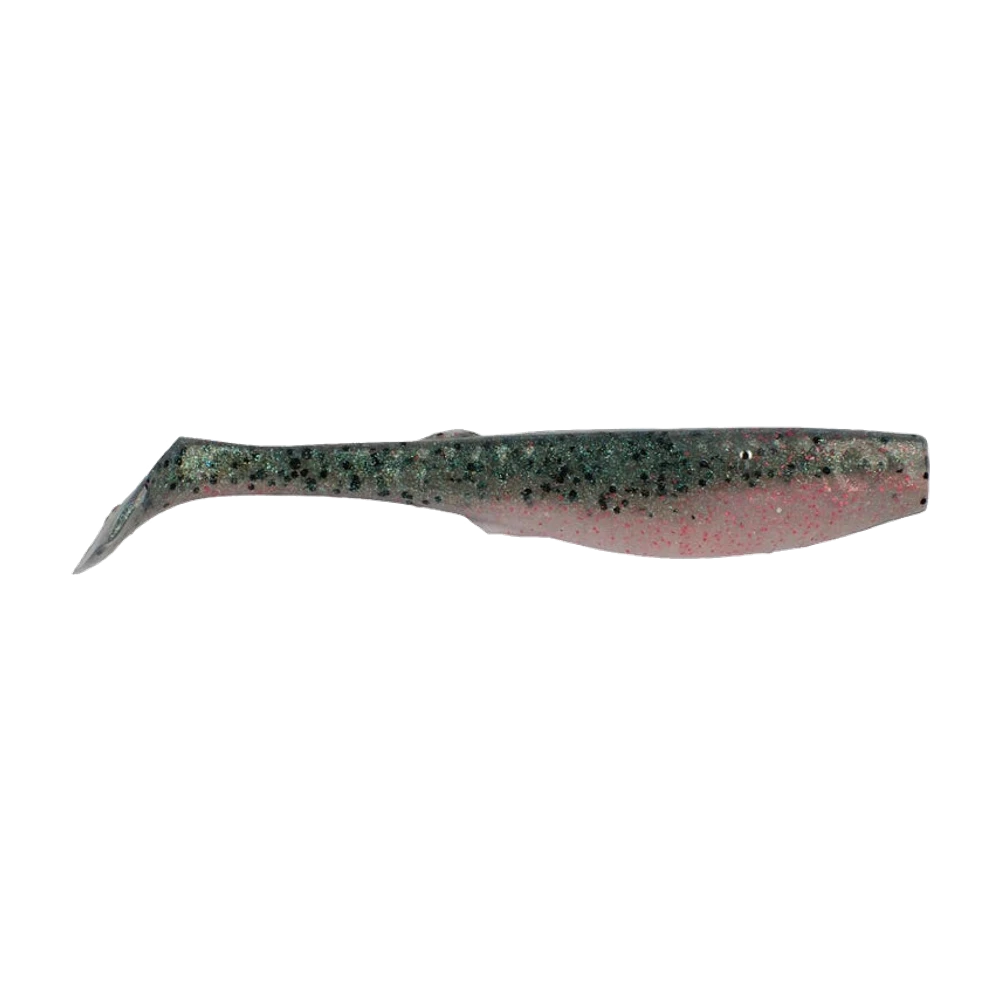
- Clear water: a natural speckled green back with pink belly, like the one in the photo, reproducing the pale underside of a baitfish without overdone contrast.
- Lightly stained water: pearl white or a pearl grey, readable at distance without being loud, still credible when visibility drops to a metre.
- Dirty water or low light: a dark tone for the silhouette, or a touch of chartreuse on the tail if the fish needs a target to aim at.
A scented bait in a box that has none
The Paddleshad does not replace your usual soft baits: it owns the slow days, the cold water and the fish that inspects before committing. Next to a Berkley Gulp Alive Minnow, which plays the finesse card with a slim profile, it brings volume and vibration. Carrying a bag of each covers most of the situations where scent is the deciding factor.
Which swimbait you tie on matters less than where you put it. That is what CarnaFish is built to simplify: a photo of the spot, and the AI suggests a zone, a depth and a presentation suited to the day's conditions. To build the groundwork on gear and typical lies, our guide to getting started on bass is the right place to start.
What to remember
- The wide paddle keeps a clean action at slow speeds, where many swimbaits simply go dead.
- Gulp really does disperse scent, but it dries out, wears quickly and must not be stored with plastisol baits.
- Four sizes from 7.6 to 15 cm; no weights published, your jighead provides the mass.
- The nose is moulded for EWG swimbait hooks and jigheads — stick to those two rigs and the bait tracks straight.
FAQ
Is Gulp genuinely better than an ordinary scented soft bait?
The principle differs: scented plastisol carries its attractant on the surface, Gulp is a porous material that releases it continuously. The gap shows mainly on slow presentations and in stained water, far less on a fast retrieve where the fish decides in a second.
Which size should I start with?
The 4 in, around 10 cm. It interests bass and zander alike, rigs naturally on a 5 to 10 g head, and stays compact enough not to select only the bigger fish.
How much does a Paddleshad weigh?
Berkley publishes no weight for this bait, which is sold bare. That is normal for a soft plastic: the weight that matters on the water is the jighead or weighted hook you choose for the depth and the wind.
Can it be used in salt water?
Yes, Berkley rates it for fresh and salt water alike. In 5 or 6 in on a 15 to 25 g head it works well along breakwaters and rocky plateaux for sea bass. Rinse it in fresh water and return it to its juice at the end of the session.
How do I store an opened bag?
Always put the baits back in the original liquid and seal it properly. Gulp left in the open air shrinks, hardens and loses its dispersal within a few hours of sun. Never store it touching plastisol baits, as the two materials degrade each other.
How does it differ from a Japanese paddle tail like the Keitech?
The Keitech Easy Shiner 4 relies on very soft salted plastisol, with a fine action and decent durability over several fish. The Paddleshad relies on dispersed scent and a paddle that works lower down the speed range, but it wears out faster. They are complementary tools, not rivals.
The full bass lure guideSeason-by-season strategy: which family of lure, when, and why.Go from theory to fish
CarnaFish reads your spot from a photo and gives you the game plan: zone, lure, retrieve. Free on iOS and Android.