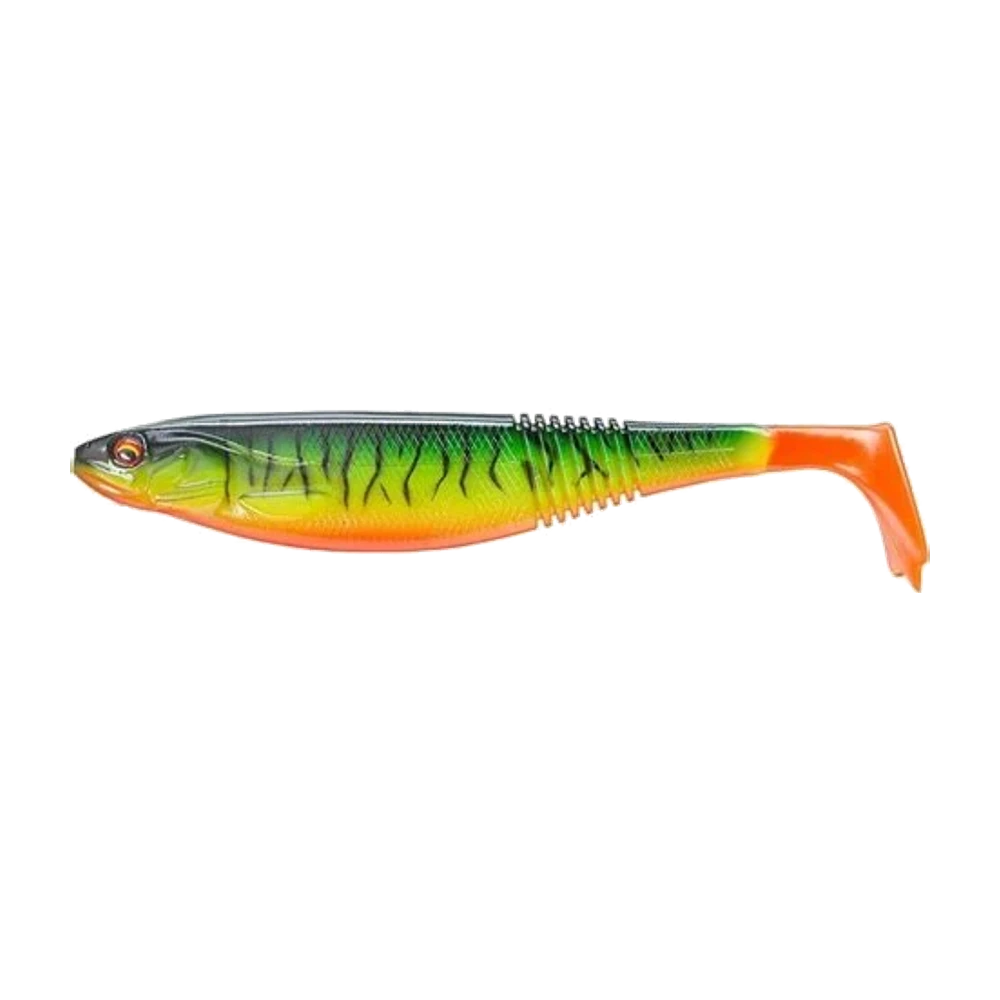
Daiwa Prorex Classic Shad: the shad that still works at minimum speed
This lure shines under specific conditions. CarnaFish tells you in 10 seconds if today is one of them.
February, a reservoir, eight degrees. The zander are there, pinned to the bottom along a gravel margin, and they will not follow anything moving faster than walking pace. You slow your retrieve down, then slow it further — and at some point you stop feeling anything in the rod. The shad's tail has stalled: the lure is still moving, but it is sending out no signal at all. You are fishing a dead piece of plastic.
That is the start-up threshold, and it is a characteristic no product sheet ever mentions. Some shads need real speed before their tail begins to beat. Others start up almost at a standstill.
The Prorex Classic Shad belongs to the second category. Its round, wide paddle mounted on a thin wrist comes to life at speeds where most flat-tailed shads are already dead. It is a lure of slowness, and by extension a lure for cold water and methodical searching.
A round paddle on a thin wrist
The geometry of the tail explains the lure's entire behaviour.
- The paddle is round and wide. It offers a large surface to the water, therefore plenty of torque for very little speed. That is the exact opposite of a small flat paddle, which needs flow to function.
- The wrist is thin and supple. That hinge zone acts as a lever: the paddle tips easily from one side to the other and passes the movement on to the body.
- The body is bulky and the material fairly firm. This is not a delicate finesse plastic that tears. It holds up on a big jig head, stands up reasonably to pike teeth, and above all it does not fold in half mid-retrieve in the larger sizes.
That last point deserves a note: a firm plastic passes the tail beat all the way through to the body, which then starts to roll slightly. You feel that pulse in the rod — it is your control. If you no longer feel it, the lure is no longer fishing. It is the best indicator there is for setting your speed.
The retrieve: hugging the bottom in a straight line
The basic way of fishing it is absolutely simple, and that is what makes it deadly when searching.
- Cast and count the drop until the lure touches bottom.
- Start the retrieve on contact, at the slowest speed at which you can still feel the tail pulsing.
- Let the lure touch bottom again every ten to fifteen turns, simply by stopping the handle for two seconds. That is how you check you are still in the right layer.
- Pick up again immediately after contact, with no pull.
- Change nothing until the lure is at your feet. The take almost always comes during the straight phase, or in the second that follows a bottom contact.
The variation for difficult fish is a single pull followed by a guided fall:
- One 40 cm sweep of the rod tip from the bottom.
- A full fall, tip lowered to follow it — the paddle keeps beating on the way down, which a flat-tailed shad does not do.
- Bottom contact, take up the slack, and start again.
On the water: on a shad, the first setting is never colour or size, it is head weight. If you are not feeling bottom contact at least one time in three, you are too light and you are fishing above the fish without knowing it. Go up 4 g before asking yourself any other question — most blank days in deep water are settled right there.
Sizes and head weights
| Size | Target species | Usual jig head | Typical depth |
|---|---|---|---|
| 7.5 to 10 cm | perch, small zander | 5 to 12 g | 1.5 to 5 m |
| 12 cm | zander, general use | 12 to 21 g | 3 to 8 m |
| 15 cm | deep zander, pike | 18 to 30 g | 5 to 10 m |
| 18 to 20 cm | pike, big zander | 30 to 45 g | 4 to 10 m |
Two rigging markers. Beyond 12 cm a stinger is not optional: the tail beat and the body roll concentrate attacks at the rear, and the main hook on its own lets a lot of takes get away — the stinger rig page covers how to fit one. For the basics of head weight and jig head rigging, see the simple jig head rig page.
Over snaggy ground, a weighted Texas rig beats a jig head. You lose a little of the tail beat, because the hook stiffens the body, but you get through.
Its windows, and its limits
- Searching large areas on a lake or gravel pit, from the bank or from a boat: this is a lure you cast a lot.
- Cold water, from November to March, when your speed has to drop below the working threshold of other shads.
- Stained water, where the water pushed by a wide paddle makes up for reduced visibility.
- Big sizes for pike, on a slow straight retrieve over dying autumn weed beds.
Conversely, it is not built for three things. Finesse in clear water on educated fish: the body volume and the width of the beat are too talkative, a slim shad will do better. Pure vertical fishing, where a wide-beating lure circles around the line instead of dropping straight. And very nervous multi-pull animations, for which a firm, bulky body lacks responsiveness.
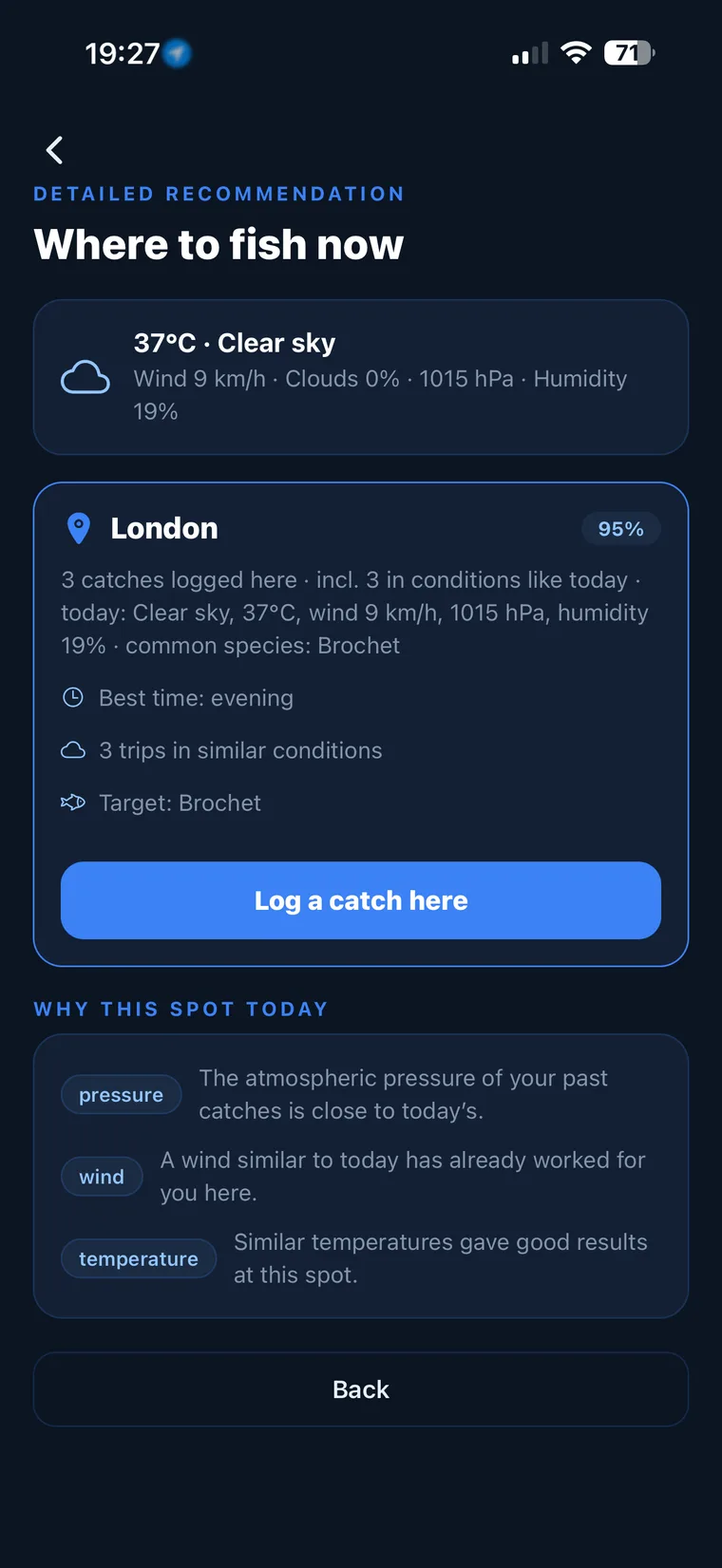
Not sure what to tie on?
Photograph your spot: CarnaFish reads the scene, cross-checks the conditions and gives you the zone, the lure and the retrieve. Free on iOS and Android.
Prorex Classic Shad, Shad Teez or Easy Shiner
Three shads, three uses better not confused.
The Westin Shad Teez is distinctly livelier: slimmer profile, faster beat, immediate reaction to the slightest pull. It is the shad for dynamic animations and active zander, fished on brisk lift-and-drops rather than a monotonous straight retrieve. It needs more speed to express itself fully.
The Keitech Easy Shiner 4 plays on another field: very soft salted material, ribs that trap micro-bubbles, a high beat frequency over a small amplitude. It is a finesse, clear-water lure, to be rigged light, unbeatable on perch and wary zander — but fragile and expensive to burn through when searching.
The Prorex Classic Shad occupies the volume-and-slowness slot, with a durability that lets you cast it without counting the cost. In my box it is there to find the fish; the other two are there to convert them once located. If you are instead after a slim Japanese shad for bass, look at the O.S.P HP Shad Tail, which pushes the finesse logic to the opposite extreme.
Our beginner's guide to zander lure fishing takes the jig head searching method from the top. And if you are unsure what head weight to fit when you arrive on a bank you do not know, CarnaFish analyses a photo of the spot and gives you an answer.
Colours
- Clear water: roach, pearl white, subtle green-backed patterns. The volume already does the signalling.
- Coloured water or deep ground: chartreuse, firetiger, a clear white belly. Below six metres, colour matters less than contrast.
- Autumn pike: bright, contrasting tones in the big sizes — here you are after a reaction, not realism.
Key takeaways
- Round paddle on a thin wrist: it starts up at speeds where flat-tailed shads go dead.
- The body rolls and pulses in the rod; if you no longer feel it, you are fishing too slowly for this lure.
- A straight bottom-hugging retrieve with a bottom contact every ten to fifteen turns.
- Too light is mistake number one: go up 4 g before changing anything else.
- Avoid it for finesse on educated fish and for pure vertical work.
FAQ
What size Prorex Classic Shad for zander?
The 12 cm covers most situations, rigged on 12 to 21 g depending on depth. Drop to 10 cm for difficult fish or shallow ground, and go up to 15 cm when you are after big specimens or fishing beyond eight metres.
Is a stinger compulsory?
Beyond 12 cm, yes. The tail beat concentrates attacks at the rear of the lure, and a main hook on its own lets plenty of short takes through, particularly with zander in cold water.
How do I know I am retrieving at the right speed?
By listening to the rod tip. As long as you feel the steady pulse of the paddle, the lure is working. The moment that sensation disappears, you have dropped below the start-up threshold and the lure is sending nothing out.
What is the difference with a Keitech Easy Shiner?
The Easy Shiner is a finesse lure: very soft material, a fast beat of small amplitude, to be rigged light in clear water. The Prorex Classic Shad is bulkier, firmer and slower, designed for searching and for cold water.
Can you fish it vertically?
It is not ideal. A wide-beating shad tends to circle around the line on a vertical drop. For that style, prefer a slim body with a small paddle, or a lure specifically designed for vertical fishing.
Is it suitable for pike?
Yes, in the 15 to 20 cm sizes on 30 to 45 g, on a slow straight retrieve over autumn weed. Add a wire trace or heavy fluorocarbon, and plan on a stinger.
The full zander lure guideSeason-by-season strategy: which family of lure, when, and why.Go from theory to fish
CarnaFish reads your spot from a photo and gives you the game plan: zone, lure, retrieve. Free on iOS and Android.