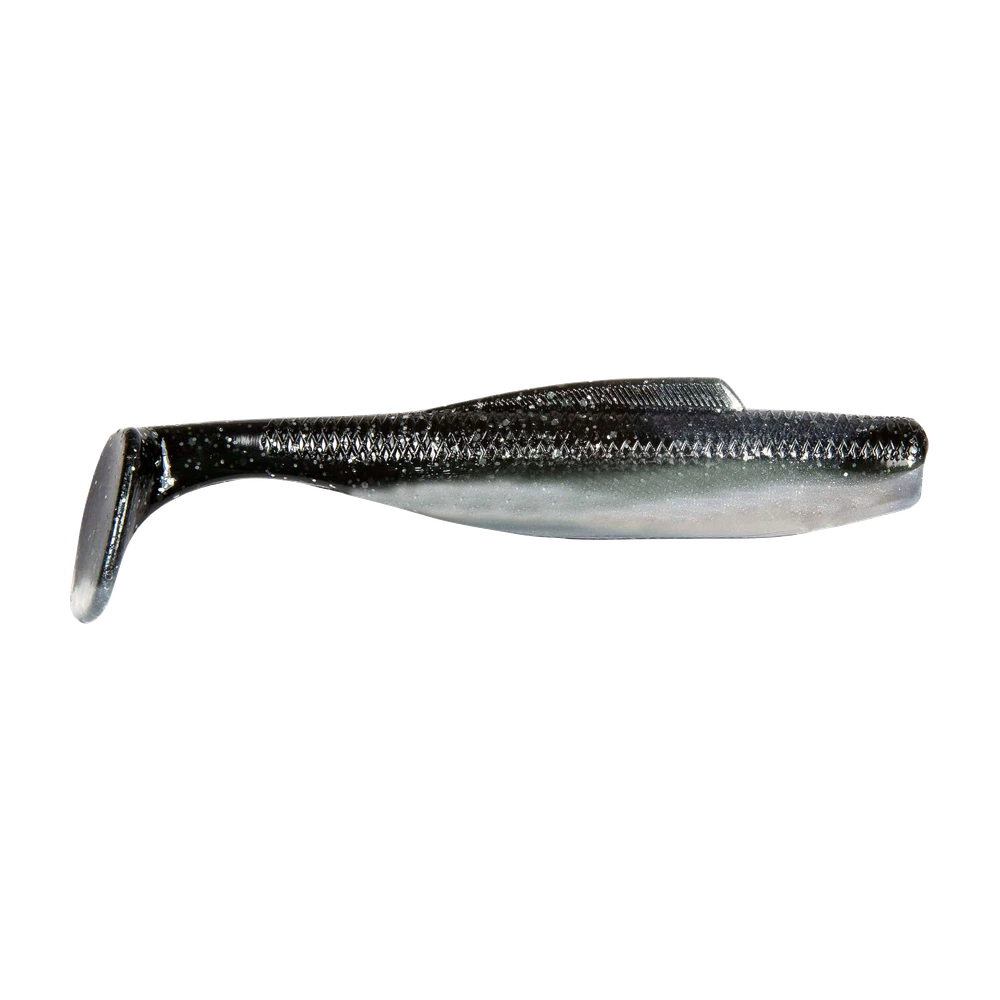
Z-Man DieZel MinnowZ: the ElaZtech swimbait that won't tear
This lure shines under specific conditions. CarnaFish tells you in 10 seconds if today is one of them.
A shad that survives a missed catfish strike, a zander's teeth sunk clean through the body, or three back-to-back perch hits without losing its shape: that's Z-Man's pitch with the DieZel MinnowZ. The US brand, known for its near-indestructible ElaZtech plastic, applied that material to a classic baitfish profile. The result is a lure that costs more up front but ends up cheaper than any standard plastisol shad you'd otherwise replace every other trip.
ElaZtech: a different kind of plastic
Most soft lures are plastisol: supple and effective, but fragile. One zander or perch tooth and they tear, and heat or prolonged contact with other baits melts them together in the tackle box. Z-Man's ElaZtech is a denser, far more elastic polymer — a bitten DieZel MinnowZ can often be pulled back into shape, and it floats naturally when rigged on a light jighead, giving a distinctive suspended action at rest.
One thing to know: this material is incompatible with standard plastisol. Never store a DieZel MinnowZ touching a regular soft plastic — it will melt it within days.
Four sizes, one principle
The DieZel MinnowZ comes in 4, 5, 6 and 7 inches. For zander, perch and bass, the 4-inch (10 cm) version is by far the most useful: it casts on light-to-medium gear and isn't oversized for an average perch. The 5-inch and up sizes lean more into pike and saltwater bass territory.
- 4": zander, perch, bass — the all-rounder.
- 5" and 6": bigger bass, pike as a bonus target.
- 7": reserved for larger predators, outside the scope here.
Matching jighead weight to depth
The DieZel MinnowZ body itself is light — the jighead controls depth and swim speed.
Sight fishing and shallow margins
A 7-10 g head is enough on a slow-to-medium retrieve. The lure stays high in the water column, good for perch holding near the surface in summer.
Standard open-water prospecting
10-15 g covers most zander spots between 2 and 5 m. This is the default setup when you don't yet know the bottom.
Deep water or strong current
18-21 g keeps you in contact with bottom without cranking too fast. Past 8 m, another lure type (deep jig, heavy spoon) becomes the better tool.
A DieZel MinnowZ that's rigged crooked swims off-line from the very first cast — always check body-to-hook alignment before writing off a spot that isn't producing.
The retrieve that matters
For zander, the baseline is a slow retrieve near bottom, with short bursts of speed to trigger reaction strikes. For perch, short rips followed by a one-second pause exploit the ElaZtech's natural buoyancy: the lure slowly rises during the pause, a motion most plastisol shads can't replicate. For active bass, a faster, continuous retrieve shows off this model's wide paddle-tail kick.

Not sure what to tie on?
Photograph your spot: CarnaFish reads the scene, cross-checks the conditions and gives you the zone, the lure and the retrieve. Free on iOS and Android.
Colour by water clarity
- Clear water: translucent, natural tones close to roach or bleak.
- Slightly stained water: add some flake or a bit more contrast without going full fluoro.
- Murky water: bright colours, trading realism for visibility — zander and perch respond more to silhouette and vibration than exact colour match here.
Where it hits its limits
In thick weed or brush piles, a plain jighead snags fast regardless of how tough the lure is. For that cover, switch to a weedless rig or reach for something like the Illex Squad Shad 65, better suited to a small-profile Texas rig. The DieZel MinnowZ does its best work in open water, along drop-offs or clean margins.
Picking the right lure never replaces reading the spot and the day's conditions first. That's exactly what CarnaFish does: you photograph your spot, the AI reads the scene and hands you a zone and a retrieve before you tie anything on. For more on zander specifically, our beginner's guide to lure fishing for zander covers the basics of spot reading.
Key takeaways before you tie one on
- The 4" (10 cm) size is the most versatile for zander, perch and bass.
- Match jighead weight to depth: 7-10 g near surface, 10-15 g open water, 18-21 g deep.
- ElaZtech resists teeth and floats at rest — use that buoyancy on your pauses.
- Never store it touching standard plastisol lures, it will melt them.
- In heavy weed, go weedless or switch lures entirely.
FAQ
Is the Z-Man DieZel MinnowZ really tear-proof?
It's far tougher than a standard plastisol shad thanks to ElaZtech, which stretches instead of ripping. It's not indestructible — a well-placed tooth will eventually mark the body — but one lure easily outlasts several standard shads.
What size DieZel MinnowZ works best for zander?
The 4-inch (10 cm) version: subtle enough not to spook a wary zander, big enough to stay visible in stained water.
Can I store the DieZel MinnowZ with other soft plastics?
No, never with standard plastisol — ElaZtech will melt it on contact over time. Store it separately or only alongside other ElaZtech baits.
What jighead weight should I use for perch?
Between 7 and 10 g for fishing near the surface or sight-fishing, heavier if perch are holding deeper. The lure stays active even on a slow retrieve thanks to its buoyancy.
Does the DieZel MinnowZ work in murky water?
Yes, provided you switch colour: go bright or flashy so zander or perch key in on flash and vibration rather than direct sight.
What's a good alternative for heavily snaggy spots?
In weed or brush, a weedless rig or a slimmer shad like the Illex Squad Shad 65 will snag far less than the DieZel MinnowZ's standard jighead.
The full zander lure guideSeason-by-season strategy: which family of lure, when, and why.Go from theory to fish
CarnaFish reads your spot from a photo and gives you the game plan: zone, lure, retrieve. Free on iOS and Android.