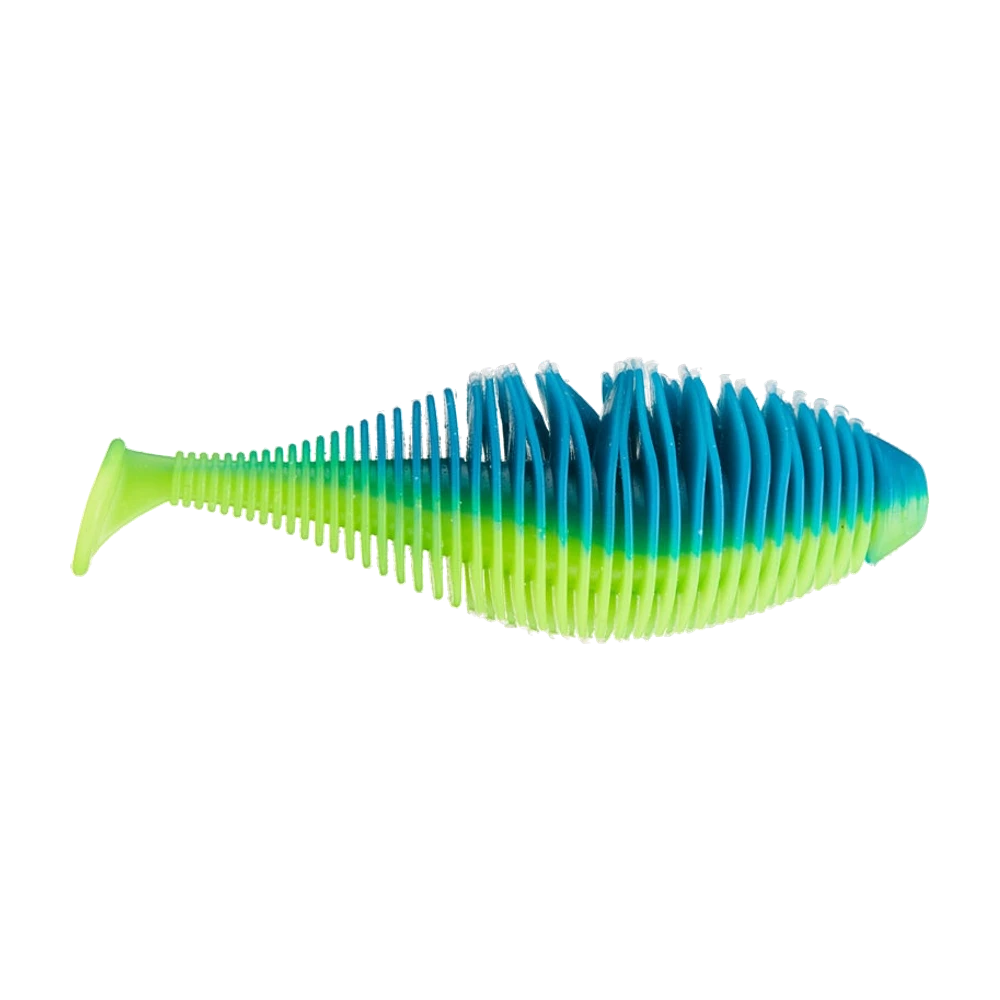
Geecrack Bellows Gill Swimmer: the bluegill paddle tail that swims upright
The right lure in the wrong spot still catches nothing. CarnaFish spots the zone that works, from a single photo.
A swimbait on a weighted hook lives on fine margins: a gram or two too much in the belly weight and the bait rolls onto its side at the first burst of speed. Bluegill imitations are the most exposed to that fault, because their body is deep and short, and therefore unstable by nature. The Geecrack Bellows Gill Swimmer is designed around that exact problem — right down to the way it tells you which hook to use.
What Geecrack publishes: a hook, not dimensions
Let's be blunt: Geecrack publishes no dimension for this bait. No length, no weight, no size range. The only number in the description is a hook recommendation: a 5/0 weighted EWG swimbait hook.
Read that figure carefully. It's a hook size, not a lead weight. Nowhere does Geecrack say how much the lead moulded onto the shank should weigh, and that's precisely what sets the running depth and the stability of the bait. So you'll be experimenting: start light, 3.5 to 5 g, and only go up if you can't reach the depth you want.
The 5/0 recommendation does give a useful sense of scale: nobody rigs a 5/0 on a 7 cm bait. But that's a deduction, not a specification, and we won't turn it into a length figure. If the exact size matters to you, check it with your retailer before ordering.
Heavy ribbing on top, fine ribbing underneath
Turn the bait over in your hand and the design makes sense. The back carries thick ribbing, almost a crest, and the belly much finer ribbing, split along its full length. The two textures don't do the same job.
The back ribbing acts as a stabiliser: it churns water above the bait's axis and fights the natural tendency of a deep body to roll. The fine belly ribbing is there to work with the slot and let the hook seat cleanly without creating a bump. That combination is what produces an upright swim — the bait stays on its feet, exactly like a juvenile bluegill or a small deep-bodied fish on the move — rather than a bait lying on its flank.
If your Bellows Gill leans over on the retrieve, don't change baits: shift the hook one or two millimetres along the belly slot and cast again. Nine times out of ten the problem is alignment, not the rig.
The SAF material and what Geecrack says about it
The plastic is the house SAF formula, which the manufacturer describes as combining salt, amino acids and flavour for a scent and texture that encourage fish to hold on. Geecrack adds that the formula also provides the right level of buoyancy to keep the bait running true.
Take that last sentence for what it is: a statement about behaviour, not a density class. The maker doesn't say the bait floats, it says the formula is calibrated for the overall balance. In practice the point barely arises: the intended rig includes a weighted hook, so the whole thing sinks, and what matters to you is how fast it drops when you stop reeling.
Rigging it, step by step
Enter the 5/0 point through the nose, bring it out on top of the back level with the belly slot, then tuck it back into the fine ribbing. Check visually that the bait's axis and the hook's axis line up, both in profile and from above. A bait twisted by a millimetre swims crooked as soon as you speed up.
For line, 15-20 lb braid with a 0.30-0.40 mm fluorocarbon leader is enough for bass. For pike a steel or titanium leader is mandatory: this kind of bait gets hit head-on and the fish closes its mouth over the knot.
The classic mistake
Working it. A paddle tail swimbait on a weighted hook is fished on a continuous retrieve, full stop. Sharp snaps knock the paddle out of rhythm and send the deep body spiralling. If you want to break the monotony, drop the rod for two seconds and let the bait fall, then start again — that's a pause, not an action.
Where and when it works
The Bellows Gill Swimmer is made for zones where fish are hunting deep-bodied, slow-moving prey: pad edges, sparse weed, shallow flats in spring and early autumn. The weedless rig lets it pass over vegetation without hanging up, and that's exactly where it should work, not out in open water.
In Europe it's a good pike bait along gravel pit edges, where the wide flat silhouette matches what the fish actually sees going past. Rig it there with slightly more lead to keep the swim steady into the wind.
Not sure what to tie on?
Photograph your spot: CarnaFish reads the scene, cross-checks the conditions and gives you the zone, the lure and the retrieve. Free on iOS and Android.
Colour by water
- Murky water or low light: the two-tone deep blue and chartreuse from the photo, a frank attractor colour that reads from a distance and makes no attempt at mimicry.
- Clear water: a natural bluegill with a dark back and barred flanks, playing imitation rather than contrast.
- Lightly stained water: Green Pumpkin, the compromise that works when you don't yet know what the fish wants.
Alongside the elastomer version and other swimbaits
The Geecrack Bellows Gill Floating Elastomer shares the same body but ends in a point: that's a dragging and hovering bait, fished very slowly on the bottom. The Swimmer is a retrieve bait. If you want a comparable swim on a longer rather than deeper profile, a Keitech Easy Shiner 3 does the job on a standard jighead. And for a stiffer, heavier bluegill imitation, look at the Bucca Baby Bull Gill.
Choosing the right swimbait doesn't replace knowing where to run it: CarnaFish turns a photo of the spot into a zone, a depth and a presentation type suited to conditions. And if bass is your main target, our beginner's guide to bass fishing lays the basics out again.
Key takeaways
- No dimensions published: neither length nor weight. The only figure given is a hook size.
- A 5/0 weighted EWG swimbait hook is recommended — that's a hook size, not a lead weight, which the manufacturer doesn't state.
- Heavy ribbing on the back to stabilise, fine ribbing and a slot on the belly to seat the hook: that's what produces the upright swim.
- Continuous retrieve only. Sharp snaps make the deep body spiral.
FAQ
How big is the Bellows Gill Swimmer?
Geecrack publishes no dimension for this bait. The 5/0 hook recommendation suggests a substantial size, but that's a deduction and not a specification: check the figure with your retailer.
Which hook should I use?
The one the manufacturer recommends: a 5/0 weighted EWG swimbait hook. Note that what's given is the hook size, not the weight of the belly lead.
How much lead should the hook carry?
Geecrack doesn't say. Start light, 3.5 to 5 g, and only go heavier if you can't reach your target depth or if wind is unbalancing the swim.
Why does my Bellows Gill swim on its side?
Almost always an alignment fault. Re-pin the hook one or two millimetres along the belly slot and check the bait's axis in profile and from above before casting again.
Does the bait float?
The manufacturer mentions a level of buoyancy calibrated to keep the swim true, without giving a density class. With a weighted hook the whole thing sinks regardless.
Can it be fished for pike?
Yes, along gravel pit edges and canal weed, with a little more lead. A steel or titanium leader is essential: this kind of bait gets attacked head-on.
The full bass lure guideSeason-by-season strategy: which family of lure, when, and why.Go from theory to fish
CarnaFish reads your spot from a photo and gives you the game plan: zone, lure, retrieve. Free on iOS and Android.