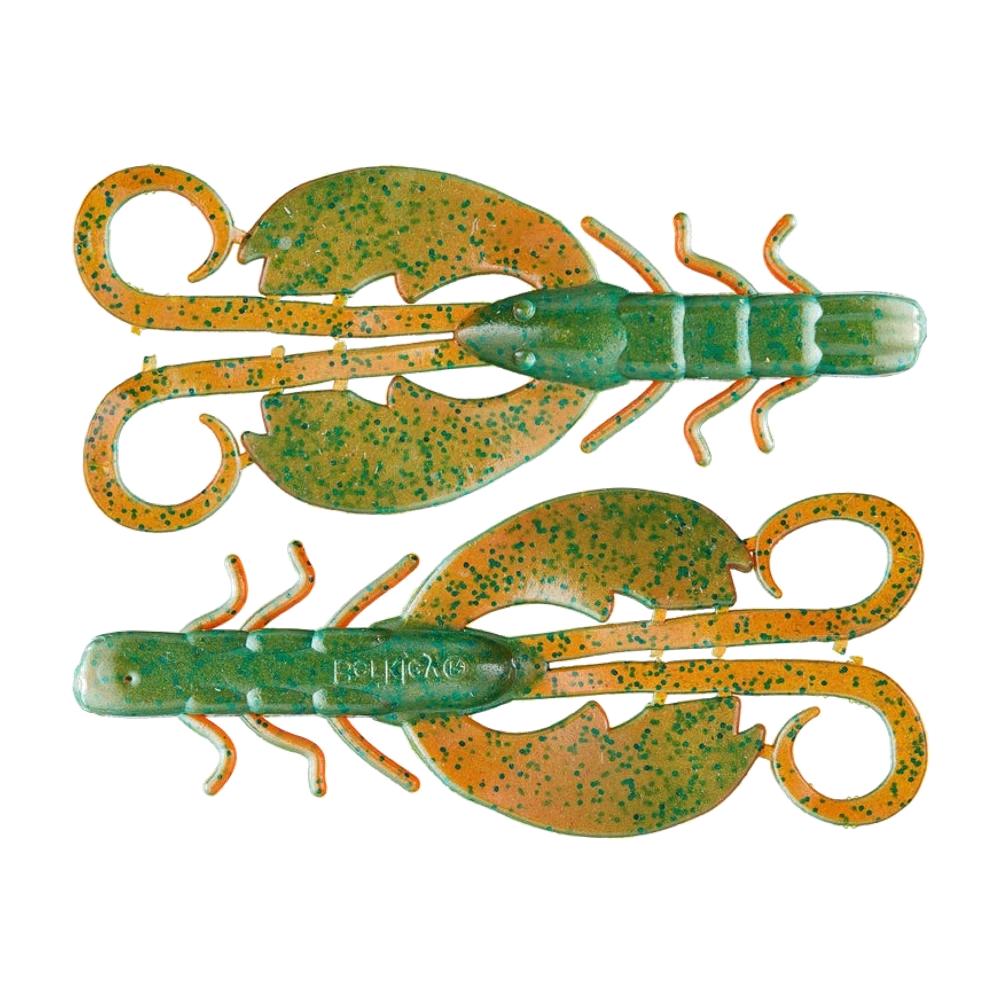
Berkley Crazy Legs Chigger Craw: the craw that lives on the fall
The right lure in the wrong spot still catches nothing. CarnaFish spots the zone that works, from a single photo.
You drop a 14 g jig against a dock piling. The lure sinks, hits bottom, you give it two short hops, nothing. You cast again a metre further along. That scenario repeats a hundred times a day, and the only variable you really control is what moves during the two seconds of fall. A soft craw that sits dead through that window is just bulk. The Crazy Legs version of the Chigger Craw is built for the opposite: to put movement where there normally is none.
Two sets of appendages doing two different jobs
You have to separate two things on this bait, because they do not act at the same moment. The flat pinchers are wide and thin at the edges, and they catch water as soon as the lure travels: on the drop they open and flap either side of the body; on a hop they snap backwards, then reopen the instant you give slack. That is a broad, far-carrying movement that takes up space in the water column.
The filament legs — the crazy legs the model is named for — work on a completely different scale. They are fine soft strands set along the body that tremble in the slightest current. Their value is not on the drop or on the hop: it is on the pause. With the bait sitting on the bottom and your rod perfectly still, the pinchers are motionless but the legs keep quivering for several seconds. For a bass that followed and did not commit, that residual signal is very often what triggers the eat.
That is the fundamental difference with a pincher-only craw such as the Strike King Rage Craw, which stakes everything on a violent action while moving and goes almost silent the moment you stop animating.
Count three seconds after every bottom contact without touching the rod. That is how long the legs take to stop quivering, and statistically it is when your line swims off sideways. Restart the retrieve after one second and you delete half the point of this model.
Alone or as a trailer: two different lures
As a jig trailer
This is the primary use, and the one the profile was drawn for. You thread the body onto the jig keeper, pinchers up or down depending on what you want: pinchers up and the bait sits like a craw squaring off on the bottom; pinchers down and it falls straighter and faster. On a Berkley Powerbait Flippin' Jig the pairing gives a compact package that slips through deadwood without flaring open.
Watch the balance, though. Wide pinchers slow the descent. A 10 g jig dressed with a Chigger Craw falls noticeably slower than the same jig bare. That is an advantage in cool water when you want to stretch the fish's decision window, and a handicap when you are fishing 6 m / 20 ft in a crosswind. In that case step up the jig weight rather than swapping trailers.
Rigged alone on a weighted Texas
Without a jig the Chigger Craw becomes a finesse search bait. A 3/0 to 4/0 wide gap hook, point buried in the back, and a 3 to 10 g bullet weight either sliding free or pegged. Rigged that way it clears moderate vegetation and brush without fouling, and the light weight makes the fall much slower and much flatter — the pinchers then have time to work through the whole descent.
This is the rig to favour on pressured fish, typically mid-day on a busy reservoir. Same logic as a Berkley Powerbait Pit Boss, except the Chigger Craw's pinchers push more water and suit slightly stained conditions better.
A bait that accepts both tempos
Most soft craws dictate a speed. This one does not. The manufacturer states it explicitly for a slow retrieve as well as a fast one, and that holds up on the water: on a steady mid-depth retrieve the pinchers and legs break into continuous flapping and the bait behaves like a small swimbait. It is a presentation anglers forget with a craw, even though it works very well for covering a grass edge on the move.
The practical gain is simple. You can sweep an edge quickly, find the stretch that reacts, then come back over the same stretch on a slow fall with exactly the same lure. No box change, no retying.
The classic mistake
Picking hook size off the thickness of the body rather than the width of the pinchers. A hook that is too short lets the pinchers fold over the point on the hookset and you lose fish without understanding why. Go wide, and after every missed bite check that the body has not slid down the shank — 5 mm of slippage is enough to kill the point.
Not sure what to tie on?
Photograph your spot: CarnaFish reads the scene, cross-checks the conditions and gives you the zone, the lure and the retrieve. Free on iOS and Android.
What the PowerBait scent actually changes
The body is moulded in Berkley's own flavoured formula. In practice that does not summon a fish that was not there: it lengthens the time a fish that has taken the bait keeps it in its mouth. On a slow bottom presentation, where you read the bite off the line and sometimes need a second to drop the rod and set, that extra second is far from trivial. It will never make up for badly placed animation, though.
Colours by water clarity
- Clear water, hard bottom, bright light: Green Pumpkin, the flecked olive that matches the real tone of a crayfish over gravel.
- Stained water or low light: Black Blue. That is the documented Chigger Craw finish that went with Skeet Reese's 2009 Bassmaster Classic win, and the black silhouette stays readable once visibility drops under a metre.
- Clear water, wary fish: Watermelon Red, more discreet, with just enough red flake to suggest a crayfish in moult.
Conditions decide, not the catalogue. That is where CarnaFish earns its place: one photo of the spot and the AI suggests the zone, the depth and the presentation type that suit the day — enough to tell whether a bottom jig approach or an edge-cranking approach has a chance before you cast. For the groundwork on tackle and bass holding spots, our guide to getting started in bass fishing covers it from scratch.
What to remember
- Pinchers work while the bait travels, filament legs work while it rests: two complementary signals, not one.
- As a jig trailer the pinchers clearly slow the descent — compensate with jig weight, never by changing trailer.
- Rigged alone on a light weighted Texas it turns into a finesse presentation for educated fish.
- The manufacturer publishes neither a length nor a weight for this model: check the size on the pack before choosing your hook.
FAQ
What hook size for a Crazy Legs Chigger Craw?
A 3/0 to 4/0 wide gap on a Texas rig, sized on the width of the pinchers and not just on body thickness. A hook that is too short lets the pinchers mask the point on the hookset.
Should the pinchers face up or down on a jig?
Pinchers up, the bait sits like a craw squaring off and falls more slowly. Pinchers down, it drops straighter and faster. Start pinchers up in cool water and switch down when you have wind or depth to deal with.
Can you retrieve it fast?
Yes, and that is one of its quirks. On a steady mid-depth retrieve the pinchers and legs break into continuous flapping and the bait behaves like a small swimbait, which is handy for covering an edge quickly.
How does it differ from the Champ Craw in the same range?
The Berkley Powerbait The Champ Craw relies on very wide pinchers to parachute a heavy jig. The Chigger Craw adds the filament legs, which keep quivering once the bait is down and motionless.
Does the PowerBait scent really do anything?
It does not attract a fish that is not there. It lengthens the time a fish holds the bait, which matters on a bottom presentation where you read the bite off the line and need a second to set the hook.
What sizes are available?
The manufacturer's description carries no size table for this model, and we would rather not quote a figure. Trust the length printed on the pack — it is the only reliable data point at the counter.
The full bass lure guideSeason-by-season strategy: which family of lure, when, and why.Go from theory to fish
CarnaFish reads your spot from a photo and gives you the game plan: zone, lure, retrieve. Free on iOS and Android.