Yum Spine Craw: the craw that slows its fall so you can flip heavy
Not sure this lure fits YOUR spot today? CarnaFish tells you in 10 seconds, from a photo.
A heavy weight sharpens your casting accuracy and punches through cover, but it usually turns the bait into a stone: the fall gets so fast the fish never has time to react. The Yum Spine Craw is built to dodge that trade-off. Its angled spines are not decoration — they brake the descent, which lets you fish a heavier sinker without losing the hang time that earns bites.
A compact body, bristling with spines
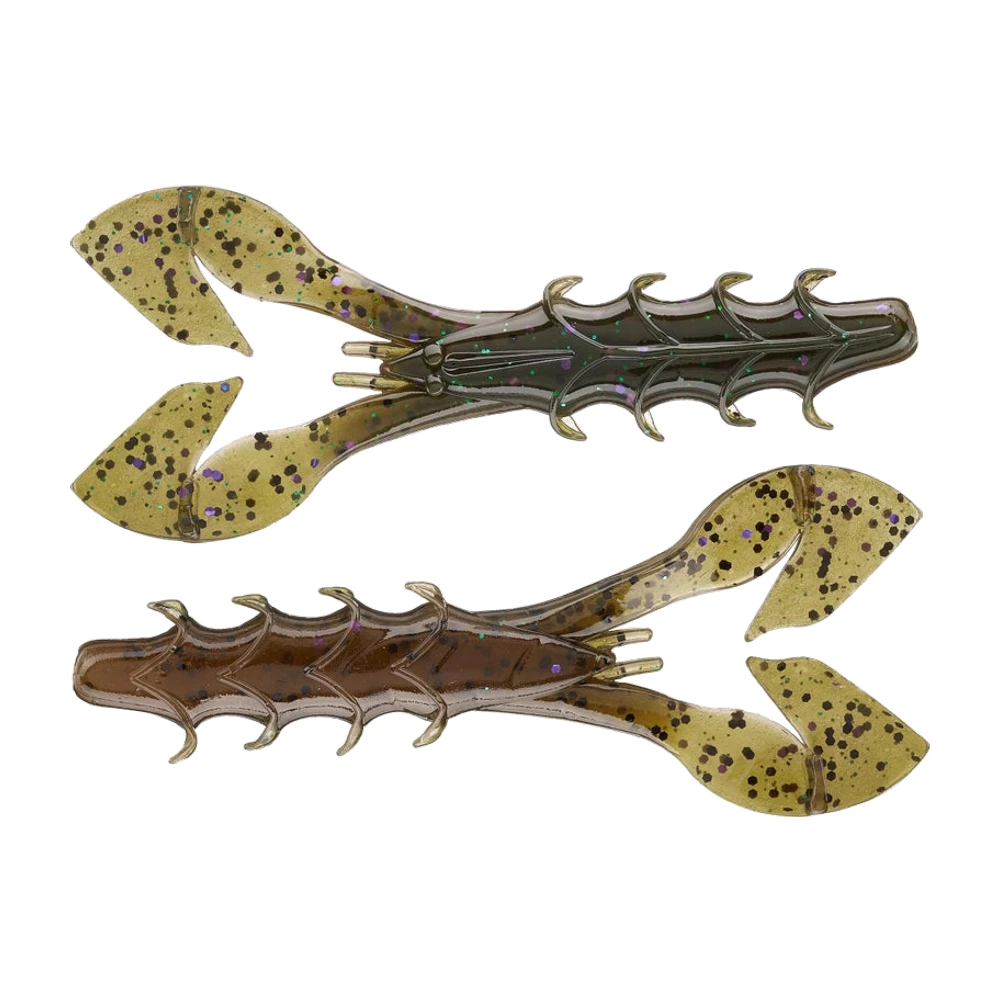
The Spine Craw measures 9.5 cm / 3.75 in and comes in packs of 8. The body is deliberately short and stocky, with two wide flat claws up front and, above all, rows of angled appendages running down each flank — the spines that give the bait its name and carry its whole concept.
Those spines do two jobs. They displace a lot of water for a bait this size, which puts out a pressure signal you can rely on even in stained water. And they slow the fall: by multiplying the surfaces working against gravity, they stretch the time the bait spends inside a fish's field of view. That detail changes the whole logic of weighting, as we will see.
The claws: a kick, not a quiver
Yum designed the Spine Craw around speed. The two wide claws do not quiver gently the way an imitation crawfish does: they kick hard the moment the bait moves, and that fast beat mimics fleeing forage rather than a crawfish standing its ground.
It is a deliberate break from a craw that rears up with claws raised, such as the Z-Man TRD CrawZ, which is built to sit still and look threatening. The Spine Craw wants to move. That calls for a slightly livelier animation, and it buys real versatility: a bait that swims on the pull works on a Carolina rig, something a purely static craw does badly.
Flipping heavy without killing the fall
This is the heart of it. In flipping and pitching, accuracy comes first: you want to drop the bait into a 30 cm gap between two branches at eight metres, without a splash. A light weight lobs and drifts; a 14 or 18 g sinker arrives straight and quiet. The catch is that it then crosses the strike zone in about a second.
The Spine Craw's spines offset that. With the same weight, the bait sinks more slowly than a smooth craw of comparable bulk, so you keep the accuracy without sacrificing presentation time. In plain terms, you can step up one size in weight compared with your usual choice.
Watch your line, not your bait. With a heavy weight and a bait that brakes, almost every bite comes on the drop, on a semi-slack line. If you wait to feel the tap in the rod, you will miss half of them.
The three other rigs
The Spine Craw is presented as a flipping and pitching bait, but the maker also lists it as a jig trailer, on a Texas rig and on a Carolina rig. Each one leans on a different quality.
As a jig trailer, the claws add the kick a skirted jig often lacks, and the spines broaden the silhouette without adding dead weight. This is probably the Spine Craw's most routine use outside tournaments.
On a standard Texas rig, without excess lead, you get a versatile craw for working grass edges and gravel bottoms. A 3/0 or 4/0 wide gap hook depending on how you want the body bulk to thread through.
On a Carolina rig, it is the fast claw kick on the pull that does the work, over a flat or a clean breakline. The bait stays well away from the weight, hovers just off the bottom, and the spines keep a continuous signal going.
The classic mistake
Treating the Spine Craw like a static craw. Dropped on the bottom and left alone, it says nothing: its action needs movement, however small. The opposite mistake is sticking with a light weight out of finesse habit. You then lose the bait's specific advantage, which is exactly its ability to carry a heavy sinker without falling like a rock.
Not sure what to tie on?
Photograph your spot: CarnaFish reads the scene, cross-checks the conditions and gives you the zone, the lure and the retrieve. Free on iOS and Android.
Where to use it
This is a cover bait: submerged wood, lily pad edges, docks, stumps. Its compact profile threads into gaps, and the claws fire as soon as it brushes a branch. Over clean bottom it still works on a Carolina rig or as a trailer, but it loses what makes it distinctive.
The most productive window in Europe runs from spring to late summer, when bass sit tight to cover and crawfish make up a real share of their diet. In cold water the Spine Craw gets harder to justify: the nervous claw action suits a sluggish fish badly. A plainer presentation such as a Berkley Chigger Craw on a slow Texas rig does the job better then.
Colours and water clarity
The manufacturer advertises a wide colour range without naming a single shade in its description. So we work by families, starting from what the photo shows: a two-tone bait with a dark body and speckled green pumpkin claws, the most universal crawfish shade there is.
- Clear water: the green pumpkin family, two-tone or not, with discreet flake. It is the reference shade for wary bass.
- Gravel bottoms and lightly stained water: the brown and orange family, close to the coat of a moulting crawfish and easier to pick out over a pale substrate.
- Dark water or low light: the black and blue family, which relies on a clean silhouette seen from below rather than on a colour actually perceived.
Which weight to rig depends first on what sits in front of you: a wood edge in two metres and a breakline in six do not call for the same lead. That kind of read is what CarnaFish delivers from a photo of the swim. To place it all inside a full season, our guide to getting started with bass fishing sets the frame.
Key takeaways
- 9.5 cm / 3.75 in, 8 baits per pack: a standard flipping size, not a finesse bait.
- The angled spines brake the descent, which lets you use a heavier weight without losing presentation time.
- The claws kick fast: the Spine Craw imitates fleeing forage, not a crawfish on the defensive.
- Four uses listed by the maker: flipping, pitching, jig trailer and Carolina rig.
FAQ
What size and pack count is the Spine Craw?
One size only, 3.75 in or 9.5 cm, sold in packs of 8. The number 8 in the maker's table is a bait count per bag, not a weight — a common misreading on this kind of spec line.
How heavy a weight should I flip with?
Heavier than your usual instinct, which is the whole point of the bait. The spines slow the fall, so 10 to 18 g stays workable depending on cover density and depth, without turning the drop into free fall.
Does the Spine Craw sink fast?
The manufacturer publishes no density rating for this plastic. What it does claim is that the appendages slow the fall compared with a smooth body: that is a relative figure, not an absolute one. In practice the weight decides.
Can I use it as a jig trailer?
Yes, that is one of the explicitly listed uses. The claws add a fast kick to a jig that often lacks one, and the spines widen the silhouette without adding dead mass. Just match the jig size to the finished bulk.
Is it any good for pike or perch?
It is a bass craw. A big perch may take it as a small jig trailer, but 9.5 cm is a size built around bass. For pike, this type of bait offers nothing over a shad or swimbait of the same length.
How does it differ from a soft craw with big floppy claws?
The Spine Craw's claws are made to beat fast and swim, not to undulate slowly or stand up. Against a craw like the Big Bite Baits Fighting Craw, you are choosing between two signals: the nervous movement of fleeing prey, or a calmer presentation.
The full bass lure guideSeason-by-season strategy: which family of lure, when, and why.Go from theory to fish
CarnaFish reads your spot from a photo and gives you the game plan: zone, lure, retrieve. Free on iOS and Android.