Lunker City Karate Craw: cut-out claws that snap on the fall
The right lure in the wrong spot still catches nothing. CarnaFish spots the zone that works, from a single photo.
There is one precise moment when a soft craw sells itself: when you drop it down the side of a boulder and both claws start kicking without you moving the rod. Plenty of craws on the market only do that in theory — claws moulded too thick stay stiff and sink pinned against the body. The Karate Craw solves the problem with one simple moulding decision, and that is most of what there is to understand about this bait.
Flat, cut-out claws rather than solid ones
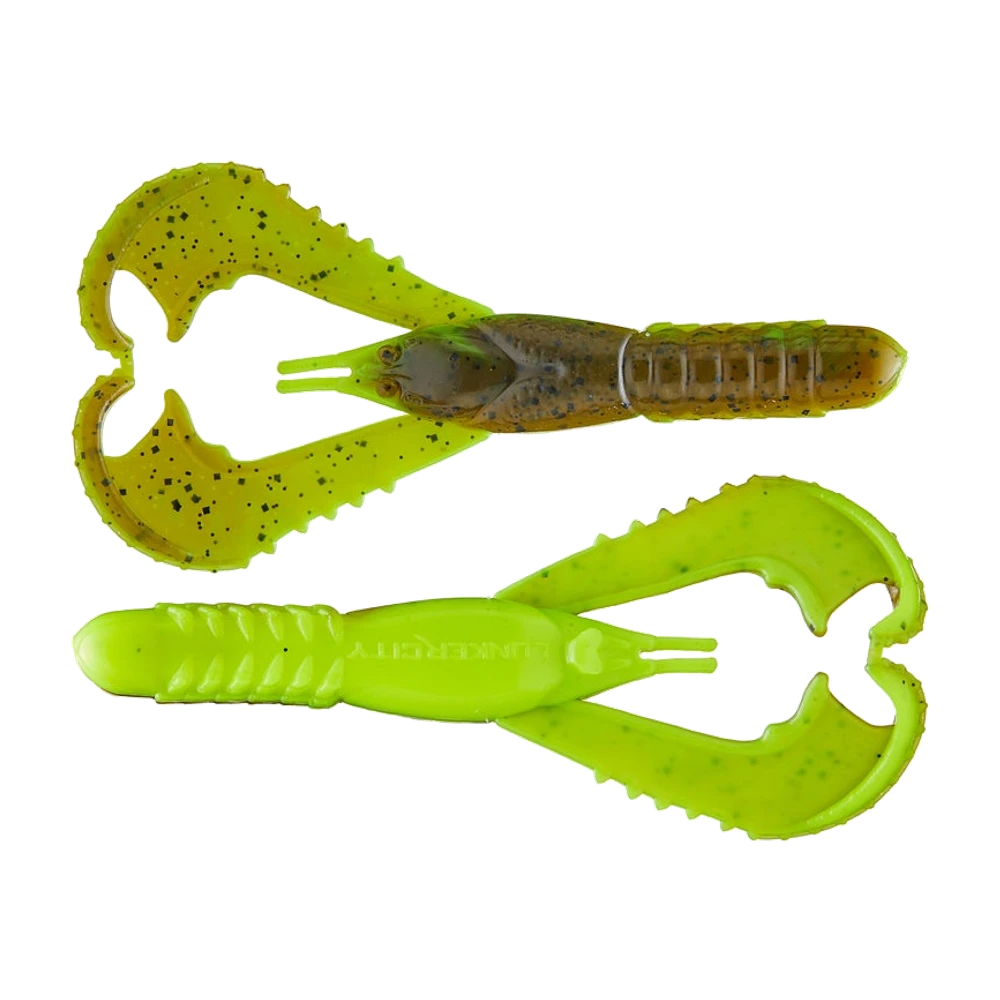
Look at a Karate Craw claw face on: it is a wide, thin paddle pierced in the middle by a large opening that leaves it shaped like a crescent. The outer edge is toothed, the inner edge is clean. That opening is not decoration. It removes material exactly where a solid claw would be stiffest, and it lets water pass through instead of simply pushing it.
The claw therefore folds far earlier. Lunker City claims erratic action on the fall and when dragged along the bottom, and that is precisely what this geometry delivers: during the descent, water resistance alone is enough to open and close both claws like scissors, with no input from you. On the drag, the same thing happens over every centimetre travelled across the substrate.
The rest of the body follows the same logic. It is ribbed along its whole length — regular ridges that grab water — and finishes in a thick, rounded abdomen. The maker explains that this blunt end makes a seamless transition with the tungsten sinker, so the weight-and-bait combination slips in and out of cover without catching on a step.
Two sizes, and a table worth reading in full
Lunker City publishes two formats, each with the number of baits per bag:
- 3 in / 7.6 cm, 8 per bag. The versatile size, equally at home on a Texas rig on its own or as a trailer behind a 7 to 10 g jig. In Europe it is also the size that genuinely interests perch over rocky bottoms.
- 4 in / 10.2 cm, 7 per bag. The big-fish size, to be rigged on a serious flipping hook. One extra bait per bag would have made sense if that figure were a weight; it drops from 8 to 7 precisely because it is a piece count, and a bigger bait eats more plastic at a constant bag price.
What the maker does not give is the weight of a single bait or its density. No mass column, no floating or sinking rating. For a bait whose whole argument rests on the fall, that absence matters: the drop rate of your rig will depend entirely on your weight, and you will have to measure it at the bank to know it. Do not build a fall-timing strategy on a number nobody publishes.
The heavy Texas rig is the reference
The maker's copy makes one concrete point: the body is thick enough to hold a heavy gauge flipping hook without tearing on the first hookset. That is a real difference from thin craws, which blow out at the entry hole by the second fish.
The rig
A tungsten bullet from 5 to 14 g depending on depth and cover, pegged or free, then a heavy gauge wide-gap hook in 3/0 for the 7.6 cm and 4/0 for the 10.2 cm. Enter through the rounded abdomen, exit a centimetre along, rotate, and re-enter flush with the back. The point should sit just under the skin, not buried two millimetres deep: with heavy wire, that is the difference between a clean hookset and a lost fish.
The retrieve that works
Cast to the edge of the cover, let it drop on a semi-slack line so you can watch the claws work, and above all do nothing for three or four seconds after it touches down. Then drag the bait twenty centimetres, pause, repeat. The Karate Craw does not want to be shaken: the claws produce their signal at the slightest movement.
The classic mistake
Working it with sharp rod-tip snaps, the way you would a shad. The flat claws fold back against the body and the bait crosses the zone telling no story at all. This is a slow-drag bait, not a jerking bait.
One reference point that wins bites: if you cannot feel the claws resisting slightly as you drag, you are either going too fast or your weight is too heavy for the slope of the bottom. Drop 3 g and start again — you will get the feel back, and with it the bites on the pause.
As a jig trailer, the other half of the bait
Lunker City puts its trailer use forward, and the 7.6 cm size is made for it. Behind a skirted jig it adds two things: silhouette volume that compensates for a thin fibre skirt, and a claw beat that starts the instant the jig lifts off the bottom.
One rigging detail matters here: thread the craw squarely along the shank, and trim a centimetre off the abdomen if needed so that jig plus trailer does not exceed the silhouette you are aiming for. An over-long trailer unbalances the jig and makes it tip onto its side during the fall, which is exactly what you want to avoid. If you want to compare claw signatures, a Strike King Rage Craw offers far louder claws, where the Karate Craw stays in a more measured register.
Not sure what to tie on?
Photograph your spot: CarnaFish reads the scene, cross-checks the conditions and gives you the zone, the lure and the retrieve. Free on iOS and Android.
Colours by water clarity
- Clear water over rock: natural brown, plain green pumpkin. The real crayfish is brown-green there, and a fish with time to inspect does not forgive an excessive contrast.
- Lightly stained water: a green pumpkin body with chartreuse claws, as in the photo. The claws become the focal point of the attack, which improves the hook-up rate since that is where the hook is not.
- Dirty water or high flood: solid chartreuse, the second colour in the photo. At that point you are no longer after imitation, you are after detection.
Which craw for which job
The Karate Craw is not the most demonstrative craw on the market, and that is deliberate. Next to a Zoom Z-Craw, which adds side appendages and moves more water, it stays more compact and slips through branches better. Next to an O.S.P Dolive Craw, designed for very slow and very finesse presentations, it accepts a heavier rig and a bigger hook. In short: take it when you want a craw that holds a flipping hook, goes through wood and still speaks on the drop.
Knowing where to put this kind of bait matters as much as the bait itself, which is exactly what CarnaFish is for: one photo of the spot and the AI suggests the zone, the depth and the type of presentation that match the day's conditions. To build a method around cover and crayfish water, our beginner's guide to bass fishing lays the groundwork.
Key takeaways
- The claws are flat and pierced with an opening: they scissor from the free fall onwards, with no input from you.
- Two published sizes, 7.6 and 10.2 cm, and the second figure in the table is the count per bag, 8 and 7 respectively.
- A thick body designed to take a heavy gauge flipping hook, and a rounded abdomen that seats flush against the tungsten bullet.
- No weight and no buoyancy published: the fall rate depends entirely on your weighting, so check it at the bank.
FAQ
Which Karate Craw size should I pick?
The 3 in / 7.6 cm covers the large majority of situations and works both on its own and as a jig trailer. The 4 in / 10.2 cm is for big fish and heavy rigs in dense cover.
Does the Karate Craw really work without being animated?
Yes, that is its main argument. The opening cut into each claw removes enough stiffness that water resistance alone makes the claws kick during the descent. Let it fall on a semi-slack line and watch.
What hook should I use?
A heavy gauge wide-gap, 3/0 for the 7.6 cm and 4/0 for the 10.2 cm. The body is deliberately thick to take that kind of wire without splitting, which is rarely the case with thin craws.
How many craws are in a bag?
Eight in the 3 in and seven in the 4 in. The right-hand column of the maker's table is indeed a piece count, not a weight and not a hook size.
What does a Karate Craw weigh?
Lunker City does not publish it, and does not state whether it floats or sinks either. If fall rate matters to your fishing, rig one and time it in a metre of water at the bank: that is the only reliable number.
Can it be used as a jig trailer?
That is one of its stated uses. The 7.6 cm behind a skirted jig adds volume and a claw beat that starts the moment the jig lifts. Just make sure to thread it squarely along the shank so the jig does not go off balance on the fall.
The full bass lure guideSeason-by-season strategy: which family of lure, when, and why.Go from theory to fish
CarnaFish reads your spot from a photo and gives you the game plan: zone, lure, retrieve. Free on iOS and Android.