Berkley PowerBait The Champ Craw: slowing down a jig's fall
Rather not fish it blind? Photograph your spot — CarnaFish cross-checks the conditions and points you the right way.
A 14 g jig dropped into two metres of water takes about two seconds to hit the bottom. During those two seconds, the bass sitting under the jetty has to see you coming, decide, and move. That is short. Far too short when the water is cool or the fish is full.
You have two ways to stretch that window. You can lighten the jig — but you then lose casting accuracy, penetration into branches, and sensitivity. Or you can add drag: keep the weight that lets you place the lure exactly where you want, and slow the descent through the shape of the trailer.
That is the Champ Craw's job. Its broad claws open during the fall and act like a parachute. The same jig then takes four to five seconds to go down, flapping the whole way, instead of dropping like a stone.
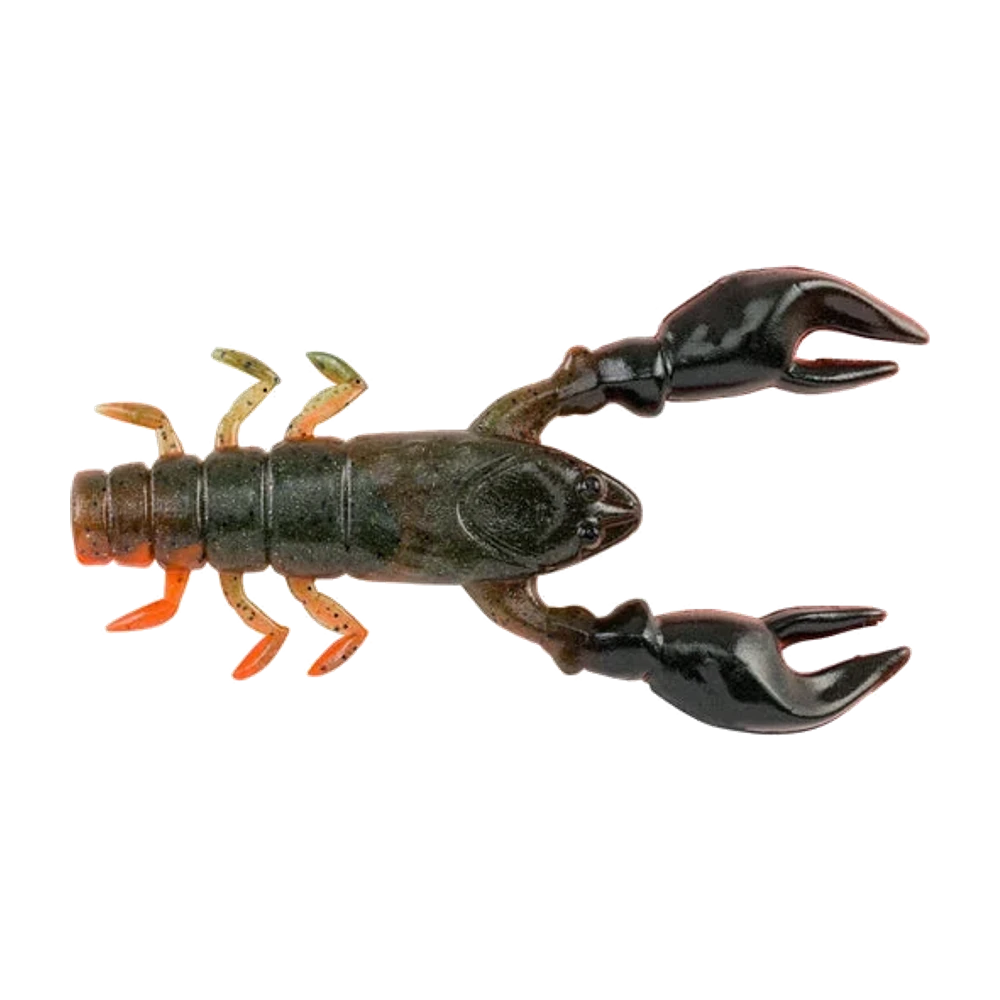
Broad claws designed for water resistance
The difference between one soft craw and another comes down almost entirely to claw geometry.
The Champ Craw's claws are broad and flat, with a large surface offered to the flow. They do not vibrate at high frequency: they spread, they arch under water pressure, and they oscillate slowly. In free fall, that slow, wide flapping is perfectly visible from a distance.
The body is bulky and ribbed. It brings the volume a jig needs for a coherent profile — too slim a trailer gives an unbalanced package, big head and skinny body. The ribs also hold the attractants this plastic is loaded with.
The plastic is dense and slightly stiff. This is not a lure that moves on its own at the slightest breath. It needs a fall or a pull to express itself, which makes it an action lure rather than a waiting lure.
The retrieve: the fall, then almost nothing
- Place the cast under the cover — jetty, low branch, lily pad edge. An accurate pitch beats a long cast.
- Let it sink on a semi-tight line, rod at eleven o'clock, watching the line with your eyes. The whole bite window is there.
- Wait two seconds on contact with the bottom doing nothing.
- Lift the rod forty centimetres, slowly, to pick the jig up.
- Let it drop back while following it: that is a second fall, often as productive as the first.
- Move fifty centimetres and start again. Three or four cycles per spot is enough: if the fish is there and active, it takes on the first two.
- Set hard, upwards and with power. A jig hook is thick and it takes force.
On the water: in fall fishing, do not take up slack with the reel during the descent. Take a step back or push the rod tip forward to keep the line slightly loose. A tight line pulls the jig towards you on a pendulum and makes it drop diagonally away from the structure instead of falling vertically against it — that is the main reason a fish sitting against a piling never sees your lure.
Matching jig weight to the situation
| Context | Jig weight | Trailer size | Target fall time |
|---|---|---|---|
| Margins, 1 to 2 m, cool water | 7 to 10 g | 8 cm | 4 to 6 s |
| Jetty and piling, 2 to 3 m | 10 to 14 g | 9 to 10 cm | 4 to 5 s |
| Dense weed, need to punch | 14 to 18 g | 8 cm | 2 to 3 s |
| Deep drop-off, 4 to 6 m | 18 to 21 g | 10 cm | 5 to 7 s |
The principle is to adjust the weight-to-drag pairing, not just the weight. If you have to punch a weed mat, you want a heavy jig and a short trailer: a fast fall is a means of access, not a fault. If you are fishing a clean piling, you want the opposite.
Where it excels, and where you should not use it
- Vertical structure: jetty pilings, submerged trees, quay walls. A slow fall down a vertical is its natural ground.
- Lily pad and weed edges, on a weighted Texas with a 7 to 14 g bullet.
- Cluttered hard bottom where a real crayfish is an obvious prey item.
- Good-sized bass, for which this bulky profile is a natural filter.
It is on the other hand unsuited to clean, open bottom, where you would spend your time fishing slowly somewhere nothing justifies fishing slowly. It is also too bulky for perch and for most mid-sized fish: bites turn into refusals or dropped fish. Finally, in very cold water below 8 °C, even slowed the fall stays too fast: a slower, lighter rig will be better.
Not sure what to tie on?
Photograph your spot: CarnaFish reads the scene, cross-checks the conditions and gives you the zone, the lure and the retrieve. Free on iOS and Android.
Champ Craw or Crazy Flapper: bulk against flapping
These two soft craws often cross paths in the same box, and they do not do the same thing. The Keitech Crazy Flapper relies on numerous fine appendages that beat at high frequency at the slightest movement: it produces a lot of motion for moderate bulk, which makes it excellent on a light Texas and on fish that respond to detail.
The Champ Craw relies on the opposite: claw surface and body volume, so drag and an imposing profile. It moves less quickly but displaces more water, and above all it genuinely slows a heavy jig — something a slim trailer does not do.
The practical rule is simple. If your problem is "the fish does not see my lure for long enough", take the Champ Craw. If your problem is "the fish sees my lure but will not commit", take the Crazy Flapper, or drop right down to finesse with a Savage Gear Ned Craw on a ned head.
Our beginner's guide to bass fishing covers how to read a cluttered margin before choosing your rig. And if you are unsure what jig weight to tie on in front of a jetty, CarnaFish analyses a photo of the spot and answers.
Weighted Texas rig
Away from jig trailer duty, the Champ Craw fishes very well on its own, on a weighted Texas.
- Hook: wide gap, 4/0 for the 8 cm size, 5/0 for the 10 cm. The mass of the body needs room to free the point on the hookset.
- Weight: 7 to 14 g tungsten bullet, pegged with a stopper if you are fishing weed, free over clean bottom.
- Line: 0.25 to 0.30 mm braid with a 0.35 mm fluorocarbon leader, or 0.35 mm fluorocarbon straight through if the water is clear.
- Claw orientation: facing up. Rigged facing down, they fold against the body during the fall and the drag disappears.
The Texas rig principle applies with no particular modification — it is the bullet weight and the claw orientation that make all the difference on this lure.
Key takeaways
- The broad claws slow a heavy jig's fall and double the bite window.
- Keep the line slightly loose during the descent so it falls vertically against the structure.
- Adjust the jig weight / trailer size pairing, not just the weight.
- Always rig the claws facing up, or they fold in and the drag disappears.
- Pointless over clean bottom, too bulky for perch, too fast below 8 °C.
FAQ
Is the Champ Craw fished on its own or as a trailer?
Both. As a jig trailer it slows the descent and completes the profile. On its own, on a weighted Texas with a 4/0 or 5/0 wide gap hook, it becomes a very effective margin lure in weed and lily pads.
What jig weight should you pair it with?
From 7 to 10 g in shallow margins, 10 to 14 g against a jetty, 14 to 18 g to punch dense weed, and up to 21 g on a deep drop-off. Aim for a fall time of four to six seconds on vertical structure.
Which way round should the claws face?
Facing up. It is the commonest mistake with this lure: rigged facing down, the claws fold against the body during the descent and stop slowing anything.
What is the difference with a fine-appendage craw?
Fine appendages beat fast and produce a lot of detail for little bulk. The Champ Craw offers surface and volume: it moves more slowly but genuinely slows a heavy jig and presents a more imposing profile.
Is it suitable for perch?
Hardly. The body volume and claw width are sized for a bass's mouth. On perch, bites often turn into refusals or dropped fish: a smaller craw profile is better.
What line for fishing a jig in cover?
A 0.25 to 0.30 mm braid with a 0.35 mm fluorocarbon leader, or 0.35 mm fluorocarbon straight through in clear water. Setting a thick jig hook takes power and a low-stretch braid.
The full bass lure guideSeason-by-season strategy: which family of lure, when, and why.Go from theory to fish
CarnaFish reads your spot from a photo and gives you the game plan: zone, lure, retrieve. Free on iOS and Android.