6th Sense Vega Frog: the keeled frog that walks and spits
One lure, endless conditions. CarnaFish reads your spot from a photo so you are not just guessing.
Frog fishing is not casting a topwater lure onto a weed mat and hoping. It is holding a lure dead still for three seconds over a hole in the pads, then making it leave in one movement. In between nothing visible happens — and yet it is during the pause that a bass sitting under the mat decides to come up. The 6th Sense Vega is built around that rhythm, with two features that push it firmly towards walking rather than hopping.
A belly keel, not a flat bottom
The Vega measures 7 cm / 2-3/4 in and weighs 18.9 g / 2/3 oz, a standard American frog size. What is less standard is the body shape: it is slim and keeled, with a pronounced belly ridge instead of the flat underside found on many models. That keel does two things. It gives the bait a pivot axis, which makes the zigzag walk far more consistent and far less tiring to produce: three or four sharp rod-tip strokes and the lure goes on its own, without you correcting the path at every move. It also improves the way the bait slides over a weed mat, because it rests on an edge rather than on a surface.
The front end is cupped. Pulled more firmly, the bait throws water ahead of it, a behaviour that moves it away from a conventional frog and towards a popper. 6th Sense describes that spray as imitating prey fleeing on the surface, and that is exactly what it looks like: now and then, in the middle of a walking sequence, a splash that pulls fish from several metres away.
Do not try to combine both actions constantly. The right sequence is three to five very short walking strokes, one wider pull to spit water, then a complete stop for two to three seconds. It is a rhythm, not a continuous retrieve, and most anglers do not hold the pause long enough.
Over mats and in open water, two different games
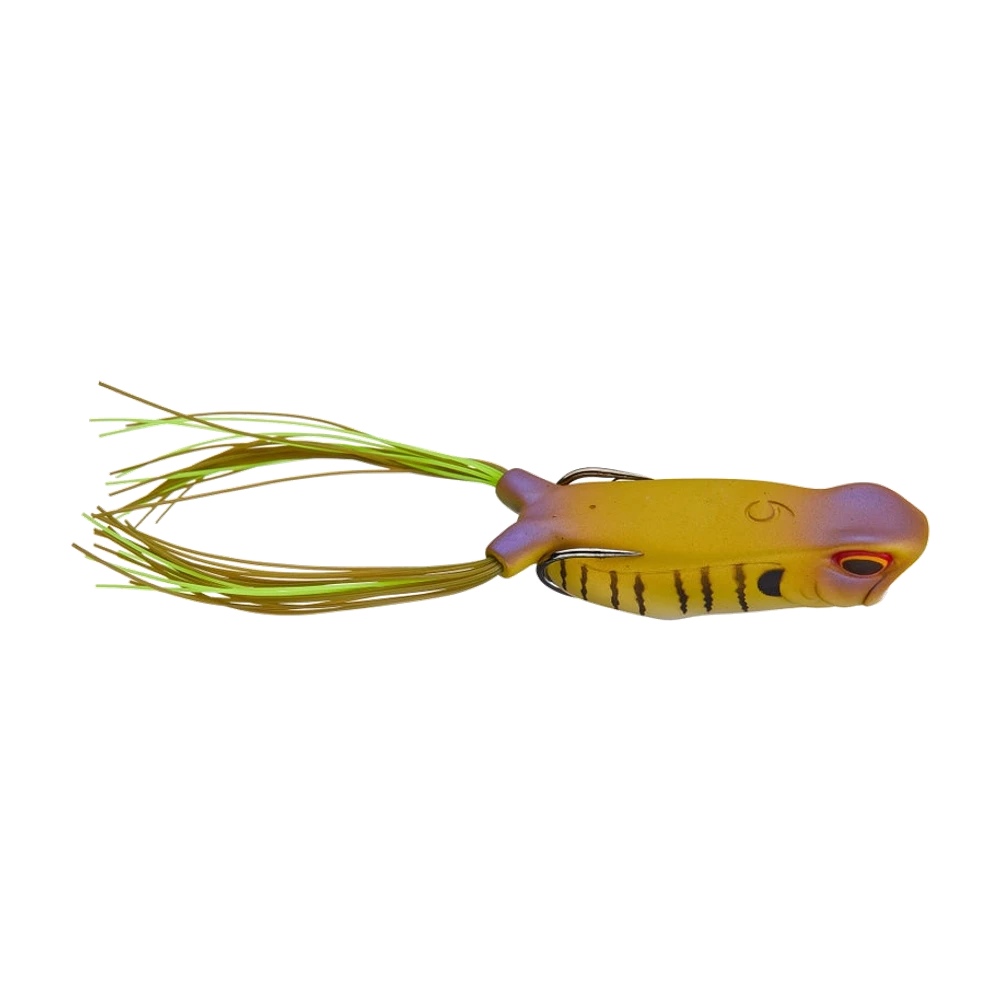
On dense vegetation — algae mats, packed lily pads, surface weed — the frog becomes the only lure that gets through. The double hook, whose points lie flat along the back as the photo shows, does not catch in the weed: the hollow body collapses on the bite and frees the points. The retrieve there is necessarily more broken, since the bait catches and then releases between open holes.
In open water the Vega works differently, and this is where the keel really shows. Along a clear margin, a reed edge or over a hump, the zigzag is clean, wide, and holds for several metres without correction. On that ground it competes directly with a SPRO Bronzeye Frog or a Molix Frog, and the choice comes down mostly to the size of fish you want and how cluttered the water is.
The hookset, where it all goes wrong
The costliest mistake in frog fishing is not the retrieve, it is the hookset. A bass coming up on a frog often produces a big, spectacular blow-up without actually having the lure in its mouth. Set on the sound and you rip the bait away. Wait until you feel the weight of the fish in the line — a one-second delay, no more — then set with a wide, firm sweep, sideways rather than vertical. Braid of 40 to 50 lb tied straight through, with no fluorocarbon leader, is essential: you have to pull the fish out of the mat in one go.
When to use it, and when not to
The frog is a warm-season lure, from the moment the vegetation establishes itself until it dies back. Outside that window a fish has no reason to look up, and a frog fished in cold water draws nothing. That is a genuine limitation of the lure, not a detail to wave away.
In Europe pike regularly attack frogs along weedy margins in summer. The problem is not the fish's interest but the hookset: a frog's double hook penetrates a bony jaw poorly, and the drop-off rate is clearly higher than with a treble-armed lure. If you are specifically after pike over vegetation, a 6th Sense Splash Back Topwater Popper over an open area converts more bites.
For an even more compact profile and better penetration into wood, the 6th Sense Vega Hush Frog applies the same logic at 5.9 cm.
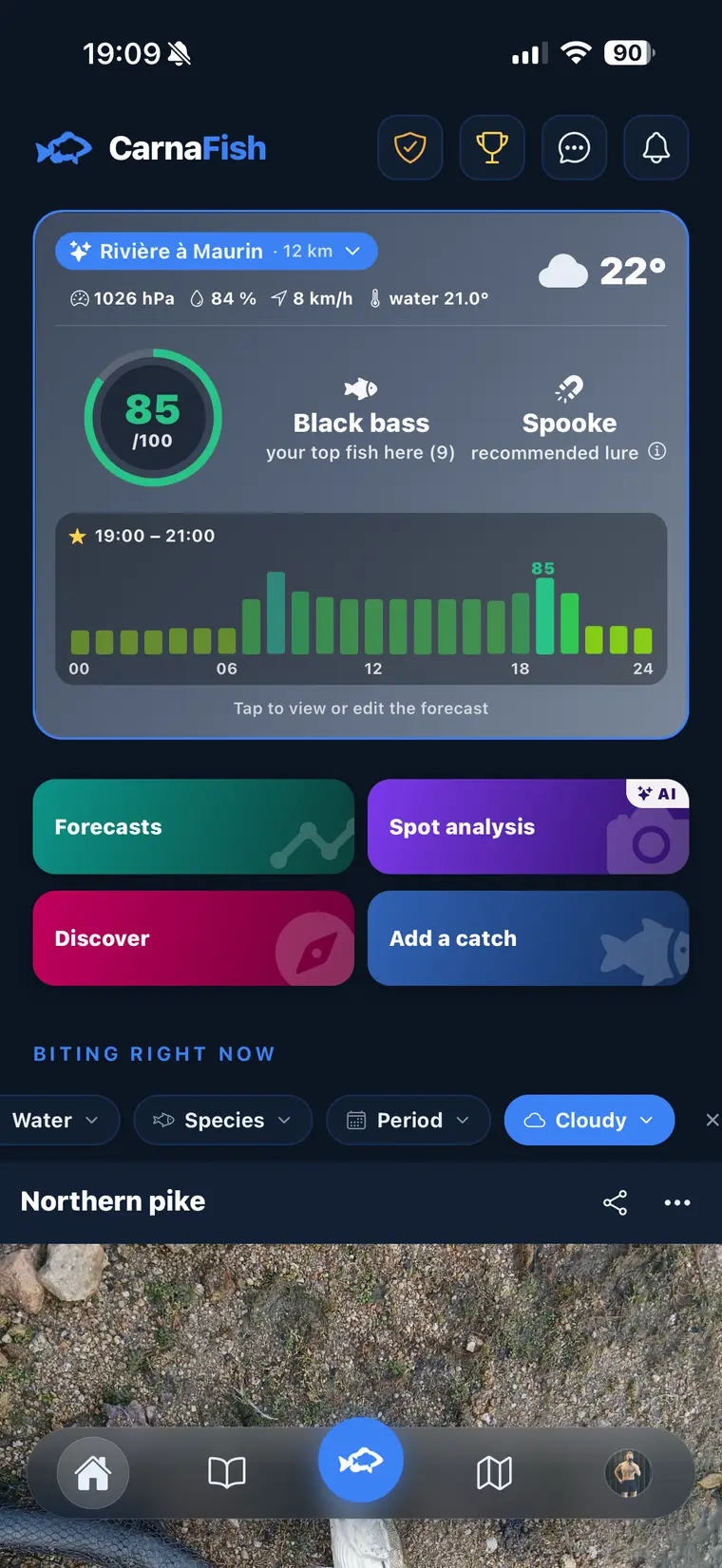
Not sure what to tie on?
Photograph your spot: CarnaFish reads the scene, cross-checks the conditions and gives you the zone, the lure and the retrieve. Free on iOS and Android.
Colours by light and background
- Stained water, weed mat: the dark-barred mustard yellow of the photo, with its brown and chartreuse skirt, which keeps a readable contrast against a green background.
- Clear water on an open margin: a green back with a white belly, the most direct imitation of a frog seen from below.
- Low light, dawn or very dark water: solid black. Seen from below, a frog is above all a silhouette, and black makes the cleanest silhouette there is.
Knowing whether the day's vegetation justifies a frog or whether an open margin calls for another topwater is exactly the kind of decision CarnaFish takes on: a photo of the spot, and the AI suggests a zone, a depth and a lure type suited to conditions. To build the rest of the reasoning, our guide to getting started with bass fishing covers the spots and the tackle.
What to remember
- A belly keel that makes the zigzag walk consistent and easy to produce, even for someone new to topwater fishing.
- A cupped mouth that throws water on a sharper pull: a second register to alternate with the walk, not to use continuously.
- 7 cm for 18.9 g, with a factory black nickel double hook, points lying flat along the back.
- A one-second delayed hookset is what separates a good session from a string of missed fish.
FAQ
How do you walk the Vega Frog?
Three to five short, sharp rod-tip strokes with the rod pointed down, taking up just the slack between each one. The belly keel pivots the bait from one side to the other on its own: the one thing not to do is force the amplitude.
When should I set the hook on a frog bite?
After you feel the weight of the fish in the line, so about one second after the blow-up. Setting on the sound rips the bait out of the mouth nine times out of ten, because the fish often comes up without having closed on the hollow body.
What line should I use with this frog?
Braid of 40 to 50 lb tied straight to the lure, with no fluorocarbon leader. You have to pull a fish out of a weed mat before it can wrap itself up in it, and fluorocarbon does not offer that abrasion resistance.
Does the Vega Frog work in open water?
Yes, and that is where its zigzag walk shows best, with no snagging or correction. Along a clear margin or over a hump, it fishes like a surface stickbait.
Can you fish for pike with a frog?
In Europe, yes, along weedy margins in summer. Pike attack readily, but the double hook penetrates a bony jaw poorly and many fish drop off. It is a secondary use, not what the lure is built for.
What is the difference with the Vega Hush Frog?
Size and register. The Vega is 7 cm for 18.9 g with a cupped mouth that throws water; the Vega Hush Frog drops to 5.9 cm for 14.2 g and relies on a compact profile that slips through wood and skips under branches.
The full bass lure guideSeason-by-season strategy: which family of lure, when, and why.Go from theory to fish
CarnaFish reads your spot from a photo and gives you the game plan: zone, lure, retrieve. Free on iOS and Android.