Gambler Walking Frog: the hollow-body frog that also walks in open water
One lure, endless conditions. CarnaFish reads your spot from a photo so you are not just guessing.
Late July, a backwater covered in lily pads across three quarters of its surface. Nothing conventional gets through: a crankbait picks up a stem within the first metre, a weighted Texas rig sinks under the mat and never comes back. One family of lures is left, and only one, the hollow-body frog. The Gambler Walking Frog belongs to it, with a twist that changes how you use it: Gambler also tunes it to walk in open water, where plenty of frogs do nothing but crawl over the salad.
Two kinds of water, one lure
The maker describes a very soft hollow body, shaped to clear thick matted vegetation without fouling, and tuned at the same time to produce a crisp left-to-right walk — the walk-the-dog action — the moment you leave the weeds. Those two requirements do not sit together naturally.
A frog built for mats needs a skin soft enough to collapse on the hookset and expose the hook points, and a belly flat enough to slide over pads instead of wedging between them. A frog built to walk needs precise mass distribution instead: too much weight forward and it noses down rather than pivoting, too much aft and it skates sideways. Gambler states the Walking Frog is weighted specifically for walking action, and that balance is what explains its behaviour once the cover opens up.
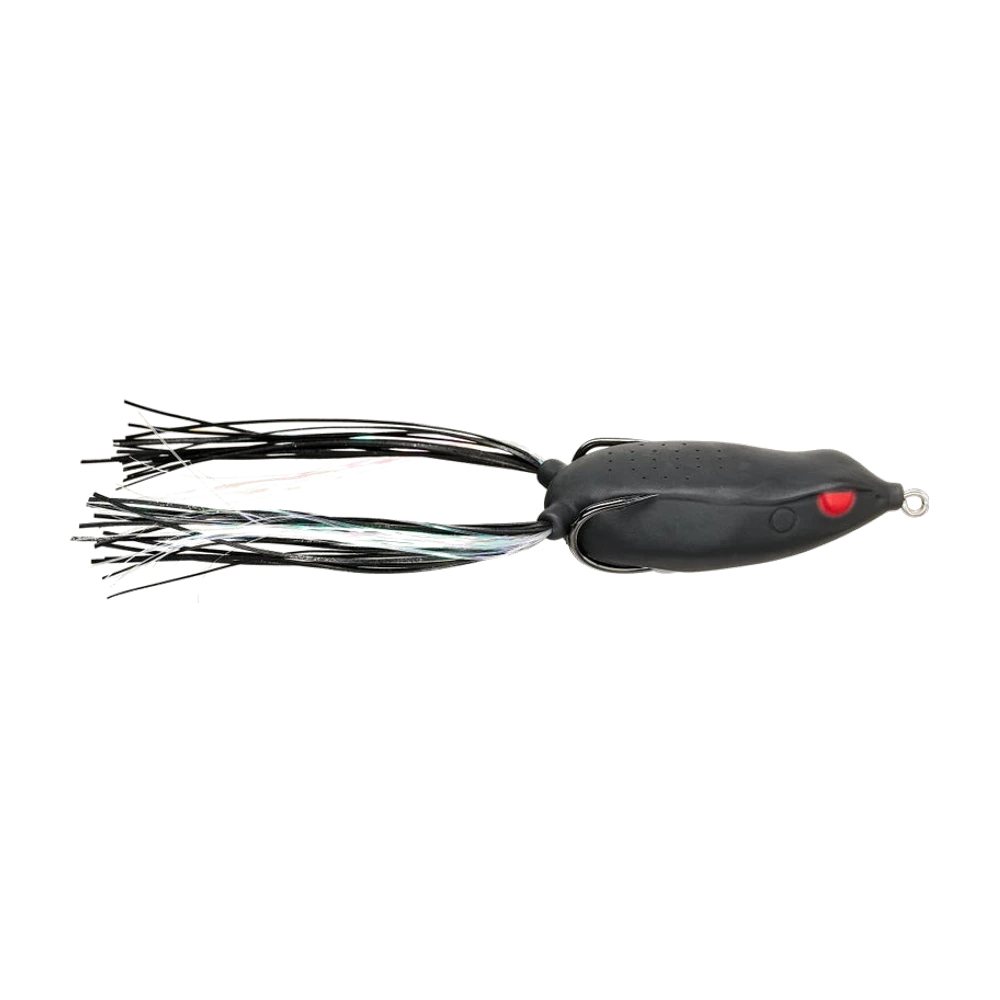
The body carries a built-in rattle chamber, which adds an audible signal to the wake it leaves on the surface. The legs blend rubber strands with flash material: on the black colour shown here, those iridescent fibres stand out sharply among the dark strands. They keep moving during the pauses, which is the whole point of a skirt on a topwater lure.
What the spec table actually says
Watch the column order in Gambler's table: weight comes first, length second. The Walking Frog weighs 7/16 oz, or 12.4 g, for a 2.5 in body — 6.3 cm, legs not counted. The listed class is Topwater, meaning a strict surface lure that does not sink.
That ratio deserves a moment. 12.4 g for a 6.3 cm body is dense for a frog. Two practical consequences: casting distance is very good, including into the wind on a fully loaded rod, and the lure sits low in the film instead of bobbing high like a cork. A frog that settles into the surface walks better, because the pivot happens on the water rather than above it. In exchange, on a thin duckweed skim or barely submerged grass it is more likely to drop between two leaves than a light frog would be. That is not a flaw, it is a working range.
Working a frog that does two jobs
The basic stroke is the same as for a hard topwater stickbait: rod tip pointed at the water, short sharp wrist snaps downward, a little slack between snaps. That slack is what lets the lure pivot; a permanently tight line drags it in a straight line and kills the walk.
Over matted vegetation
Here you are not after the walk but the wake. Slow, steady retrieve, the frog ploughing through the greenery and leaving a visible trail, broken by one to three second stops every time you cross an opening, a dead stem, a pad edge. Strikes almost always come on those stops, or just after you start again. When you feel the lure clear some resistance, stop every time: you have just crossed a transition, and that is where the fish sits.
In open water
As soon as the mat ends, string together bursts of five to eight wrist snaps followed by a long pause. This is the register where the Walking Frog separates itself from an ordinary frog: it sweeps a wide corridor either side of the line, covering far more water than a straight retrieve. On a shallow weed-free flat it becomes a genuine alternative to a hard stickbait, with the advantage of being completely snag-proof.
Change your cadence after the first refusal, not your colour. A bass that boils without eating has nearly always seen a lure moving too evenly. Two tighter snaps followed by a four second stop in the same spot trigger far more often than a colour change does.
Rigging and the hookset, the real subject
Gambler fits a BKK double hook described as stiff enough not to flex under heavy loads. In the photo the two points sit tucked flat against the back of the lure, in line with the body: that is what makes it weedless, and it is also what explains dropped fish when the tackle is wrong.
You need braid, 40 to 50 lb, tied straight to the nose eye — no fluorocarbon leader, which stretches and absorbs the hookset, and no snap, which will hang up in the weeds. The rod needs power and some length, around 7 ft, to drag the fish out of the mat within the first two seconds. A frog set on a soft rod means a bass that goes back under the pads and wraps you up.
The classic mistake
Setting on the sound. A topwater frog strike is spectacular and makes you want to answer instantly, but at that moment the lure is often still beside the fish's mouth. Wait until you feel weight in the rod — a second, sometimes two — then set wide and sideways, not vertically. In Europe this matters even more, because the frog is used at least as much for pike as for bass: a pike takes the lure sideways and needs longer still to load it.
Not sure what to tie on?
Photograph your spot: CarnaFish reads the scene, cross-checks the conditions and gives you the zone, the lure and the retrieve. Free on iOS and Android.
Colours by light
- Overcast skies, dark water, dawn and dusk: black, like the one photographed. The fish sees the lure from below, against the light: only the silhouette counts, and black is the sharpest.
- Full sun over open water: a white belly, which reads more like a small baitfish stunned on the surface than a frog and stays visible in the glare.
- Clear water, pressured fish: a natural green back over a pale belly, the compromise when the stretch gets fished every week.
Where it sits in a topwater box
The Walking Frog does not replace a popping frog like the Booyah Poppin Pad Crasher, which works in place with noise and sprayed water. It sits between that and a pure penetration frog like the SPRO Bronzeye Frog: less specialised for the heaviest mats, more comfortable the moment the water opens. For an even slimmer profile dedicated to walking, the Gan Craft DANGOKU Frog pushes the same idea further. And when a fish boils twice without committing, a quiet follow-up on the same spot with a soft craw like the Gary Yamamoto Yama Craw usually settles it.
Picking the right frog is useless if the mat you are aiming at holds no fish. That is exactly what CarnaFish does: one photo of the spot, and the AI suggests the zone to attack and the presentation that suits the day's conditions. To lay the groundwork before you start fishing the surface, our guide to getting started with bass fishing covers the water you should read first.
Key takeaways
- Two stated jobs: sliding over matted vegetation, and walking left to right as soon as the water opens up.
- 12.4 g for a 6.3 cm body: dense, so it casts a long way and sits low, and it is less at home on very thin surface weed.
- 40 to 50 lb braid tied straight and a powerful rod, otherwise the hookset never drives through the hollow body.
- Wait until you feel weight before setting, and set sideways: the sound of the strike is not the signal.
FAQ
Does the Gambler Walking Frog really float on lily pads?
Yes, Gambler lists it as Topwater, a strict surface lure. At 12.4 g for a 6.3 cm body it does sit fairly low in the film, though: on a very light duckweed skim it drops between leaves more readily than a lighter frog.
How big is this frog really?
The maker's table lists 2.5 in, or 6.3 cm, and that figure covers the body alone. The rubber and flash legs add several centimetres to the silhouette the fish actually sees.
Should the factory hook be changed?
No. The BKK double fitted at the factory is described as not flexing under load, which is exactly what a frog hook is asked to do. The weak link is almost never the hook, it is braid that is too light or a rod that is too soft.
Can you catch pike on this lure?
Yes, along pad edges and surface weed beds in summer. The hollow body takes the punishment well, but add a suitable leader if the stretch holds plenty of them: a frog tied straight to bare braid eventually gets bitten off.
Why won't my frog walk side to side?
Almost always because the line stays tight between strokes. Leave a little slack after each wrist snap and keep the rod tip low, towards the water. A high rod turns the walk into a straight pull.
Walking frog or popping frog, which one?
A popping frog works in place and suits a fish you have already located on a specific opening. The Walking Frog covers far more water thanks to its side-to-side sweep: it is the search choice when you still do not know where the fish are.
The full bass lure guideSeason-by-season strategy: which family of lure, when, and why.Go from theory to fish
CarnaFish reads your spot from a photo and gives you the game plan: zone, lure, retrieve. Free on iOS and Android.