Bucca Baby Bull Shad 3.75: the jointed swimbait that holds at any speed
Rather not fish it blind? Photograph your spot — CarnaFish cross-checks the conditions and points you the right way.
The most common complaint about jointed swimbaits fits in one sentence: they don't forgive a speed mistake. Too slow and the bait drags along lifeless; too fast and it blows out or climbs to the surface, leaving a usable window of two or three handle turns per second. The Baby Bull Shad was built around that exact problem, which is what makes it a bait you can hand to someone who has never fished a jointed lure.
Four segments, two joints per junction
The body is cut into four rigid sections linked by joints that are doubled at every junction. The doubling isn't an assembly detail: a single joint lets the next segment pivot on two axes, which is what causes blow-out as soon as you speed up. By constraining the movement to one plane, a double joint keeps each segment aligned and passes the wave cleanly from nose to tail.
The manufacturer claims a natural action at all speeds, and that's the direct consequence of the mechanical choice. In practice you can wind at a pace where the bait barely undulates — one segment moving, then two — and then accelerate hard without the bait rolling over. That's a huge convenience when searching: you cover a bank fast, and the moment a fish shows itself you slow right down on the spot without changing lures.
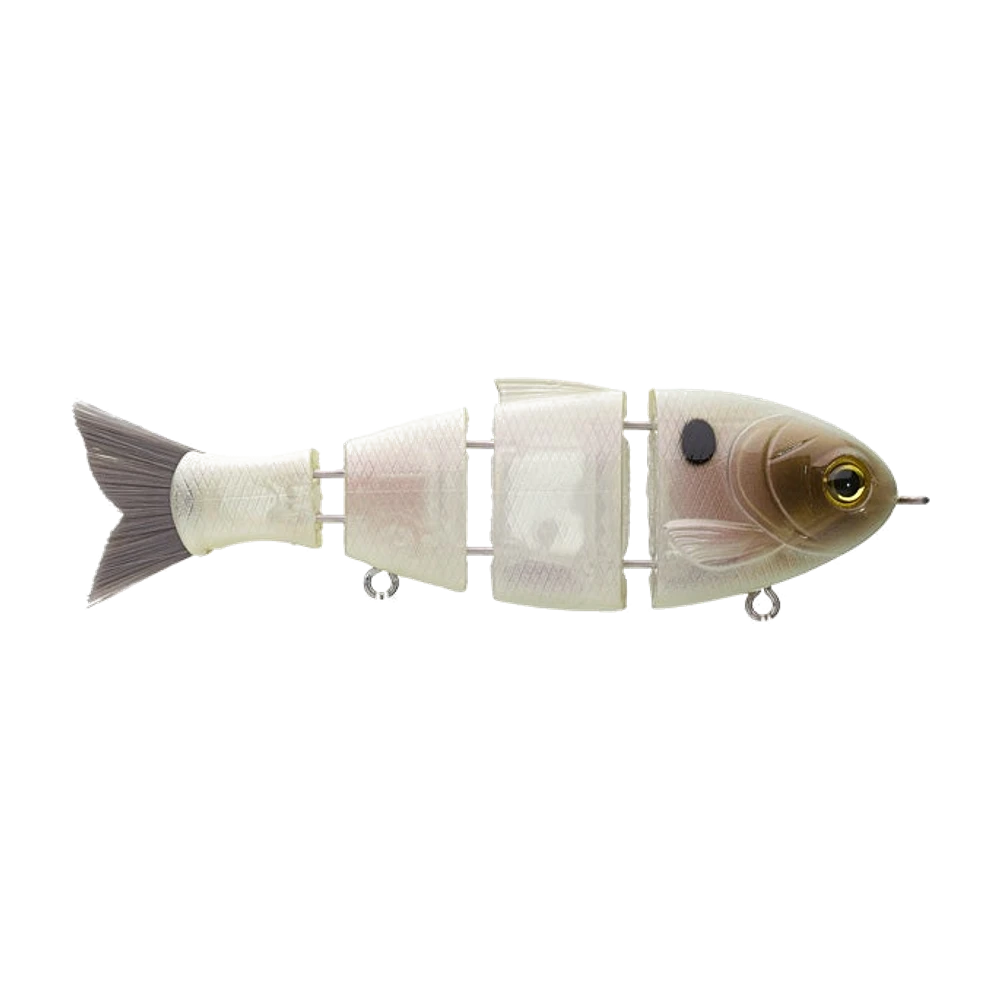
The soft grey fibre tail in the photo extends the movement one notch further. It doesn't generate vibration of its own, it damps: it keeps quivering half a second after the section carrying it has stopped, which gives the impression of a lure that never quite comes to rest.
The stated numbers
The manufacturer's table gives a single line: 3-3/4 in, 1/2 oz, slow-sinking, so roughly 9.5 cm for 14 g. It's the scaled-down version of a larger model, and the density gap against the same-length Bucca Baby Bull Gill — 14 g against 21 g — comes straight from volume: a slim shad body displaces less than a deep bluegill body.
Fourteen grams on 9.5 cm is a moderate density. The bait casts well on a medium casting outfit but stays sensitive to a headwind. From the bank in a stiff breeze you're better off fishing shorter and working it cleanly than forcing distance.
The body is ABS, not the poured resin of the original Bull Shads. That's the choice that makes this bait affordable. ABS also takes contact with wood and rock better, which matters on a lure you happily run alongside a laydown.
The first adjustment, before you even fish it: check the swim at the bank, three metres out, in open water. If the bait pulls to one side, it's almost always the nose ring sitting slightly bent. A quarter-millimetre of correction with pliers, opposite to the drift, and it tracks straight again.
How to work it by activity level
Straight retrieve, to cover water
Steady, medium to brisk, along a bank, a weed edge or over a flat. This is where the speed tolerance pays: you can fish at search pace without losing the action. Watch for follows — they're frequent, and they tell you which stretch deserves a second pass.
Stop and go, on visible or wary fish
Six to eight turns, then stop for two or three seconds. Because the bait is stated as slow-sinking, it neither rises nor noses down: it settles gently while holding its attitude, and that's the phase where a following fish commits. Count the drop on your first cast so you know how fast it loses height.
Climbing a breakline
Cast toward the deep side, count it down, then retrieve slowly up the slope. The bait follows the contour, and you sweep the whole band of water where fish might be holding without ever losing touch with the bottom.
Not sure what to tie on?
Photograph your spot: CarnaFish reads the scene, cross-checks the conditions and gives you the zone, the lure and the retrieve. Free on iOS and Android.
Rigging, hardware and tackle
The description specifies two sticky-sharp trebles. In the catalog photo the lure is shown bare: both belly hangers are empty and only the nose line-tie is fitted. Worth knowing if you're ordering on the strength of the image.
Tie a loop knot or use a slim snap. A knot cinched straight to the nose ring stiffens the first joint and cuts the amplitude of the wave: on a bait whose whole value lies in passing movement from one section to the next, that's the first thing not to get wrong.
For line, 15 to 20 lb braid with 80 cm / 2-3 ft of 30 to 35/100 fluorocarbon works well. Braid gives the sensitivity to feel the soft bites that come during the sink; the fluorocarbon leader handles abrasion and stays discreet in clear water.
In Europe this size genuinely interests perch, for which 9.5 cm remains a realistic prey item on waters where big roach dominate. Pike will take it too, but two trebles on a jointed body inside a toothy mouth demand a strong leader and long pliers — it's not the first bait I'd reach for on a known pike spot.
The classic mistake
Treating a jointed bait like a jerkbait and giving it sharp rod sweeps. The double joints aren't built for that: the bait folds like a concertina, sections collide and the action goes to pieces. Variations are given with the reel, not the rod.
Colors by water
- Clear water: the translucent pearl with pink highlights from the photo, which lets light through and gives the bait a low-density silhouette, close to a young roach.
- Fishing into the light or under cloud: a dark back. The fish reads the silhouette from below, and outline beats color.
- Lightly stained water: a gold or copper tone, which keeps some light return where a translucent body simply vanishes.
Choosing between a slim shad profile and a stocky prey profile depends first on what the fish are eating in your water. That's exactly the kind of read CarnaFish makes easier: photograph the spot and the AI suggests the zone, the depth and the lure family that fit the conditions. To put this size to work on perch, our guide to lure fishing for perch covers the holding spots and the retrieve rhythms.
The short version
- Four sections on double joints: the action holds from a dead crawl up to a search-speed retrieve, with no blow-out.
- Roughly 9.5 cm / 14 g, stated slow-sinking: the sink rate, not the speed, is what controls depth.
- ABS body instead of the original models' resin: cheaper and more impact-resistant.
- Reel-driven variations only: sharp rod sweeps wreck a jointed bait's action.
FAQ
Does this bait really swim at all speeds?
That's the manufacturer's claim, and the double-jointed construction supports it: constraining each segment to one plane is what prevents blow-out under acceleration. In practice you keep a clean action from a very slow crawl up to a search-pace retrieve.
How does it differ from the Baby Bull Gill?
Profile and mass. The Baby Bull Shad is a slim forage fish at around 14 g, while the Bucca Baby Bull Gill carries a deep bluegill body at around 21 g. At the same length they imitate two very different prey items and don't replace each other.
Do I need a dedicated swimbait outfit?
No. Fourteen grams casts easily on a medium casting rod with 15 to 20 lb braid. Into a headwind, though, the moderate density limits distance: fish shorter rather than forcing the cast.
Can I work it with the rod?
Best avoided. Sharp sweeps make the sections collide and break the transmission of the wave. Give your variations with the reel: speed changes and two- to three-second stops are more than enough.
Does it suit perch and pike in Europe?
Perch, very well: 9.5 cm matches a believable prey item on most waters. Pike will hit it too, but plan on a strong leader and long pliers, because two trebles on a jointed body make unhooking markedly harder.
My bait pulls to one side, what now?
It's almost always the nose line-tie sitting slightly bent, usually after contact with cover. Correct it with pliers, very gently, opposite to the drift you observed, and check the swim three metres from the bank before casting again.
The full bass lure guideSeason-by-season strategy: which family of lure, when, and why.Go from theory to fish
CarnaFish reads your spot from a photo and gives you the game plan: zone, lure, retrieve. Free on iOS and Android.