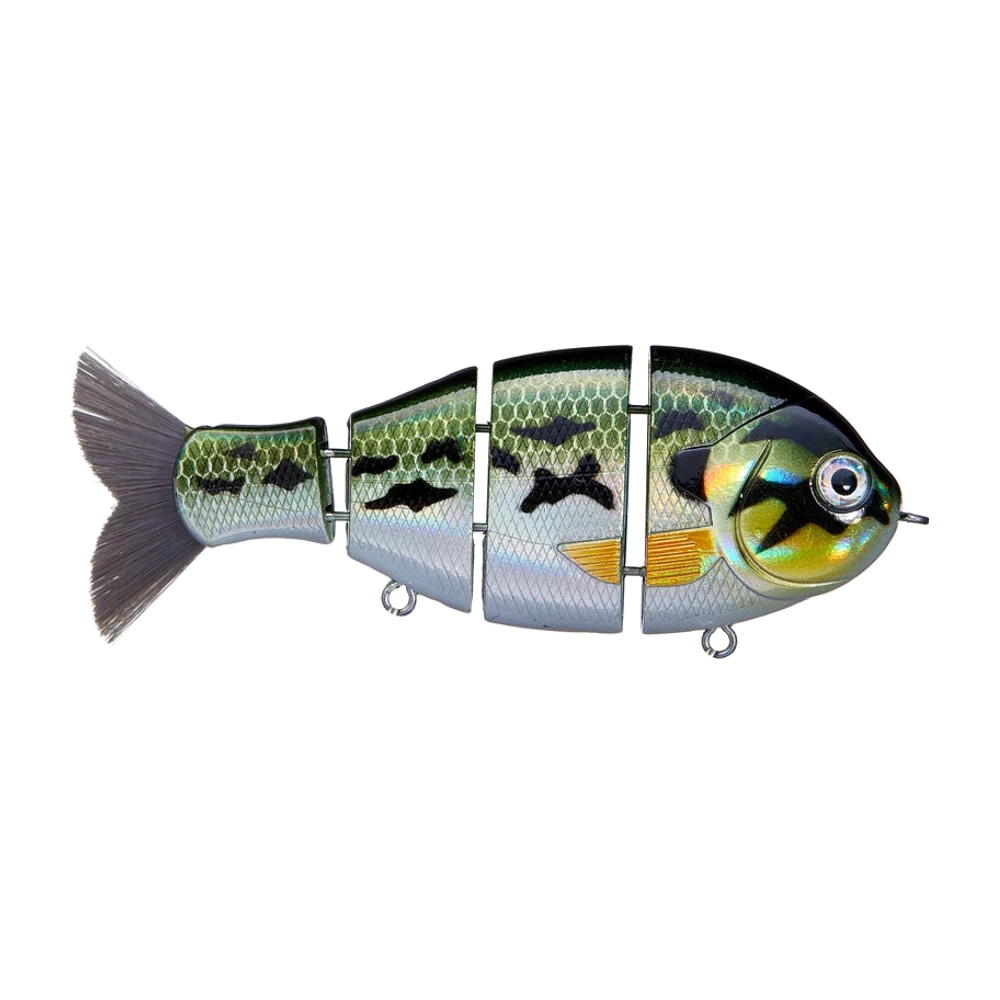
Bucca Baby Bull Gill 3.75: the jointed swimbait that reads as a bluegill
The right lure in the wrong spot still catches nothing. CarnaFish spots the zone that works, from a single photo.
Most anglers who want to try jointed swimbaits stall at the same barrier: an 8-foot rod, an oversized reel and a serious budget just to throw 150 g of plastic all day. The scaled-down format changes the equation completely. Ten centimetres for around twenty grams casts on the gear you already own, and it interests a 30 cm fish as much as a trophy.
A deep body, and why that matters
The Baby Bull Gill isn't trying to copy a slim baitfish. Its outline is that of a bluegill: a short, deep fish that in profile is nearly as tall as it is long. That's a prey family conventional lures represent badly — a soft paddletail or a jerkbait never gives you that lateral presence, that volume occupying the water.
The shape has three concrete consequences. First the swim: a deep body creates more resistance, so a wider wave at the same speed. Then visibility: pearl flanks throw back a far larger surface of light than a torpedo-shaped body, which makes the bait detectable from distance in lightly stained water. Finally selectivity: on waters where panfish or small perch dominate the biomass, this profile is simply the right one.
Development is credited to Mike Bucca, and the Baby version carries the original recipe into an ABS body instead of the poured resin of the premium Buccas. That material swap is what makes this bait affordable, and it brings a real advantage: ABS takes knocks against wood and rock better than resin does.
Four sections, double joints
The body is cut into four rigid segments, linked by joints that are doubled at every junction. That's the technical point worth pausing on. A single joint creates one hinge and can twist on itself; a doubled joint constrains the movement to a plane, which produces a cleaner, more repeatable wave.
What you see in the water is an S that travels from nose to tail without a stutter, and that already exists at a speed where a one-piece swimbait does nothing at all. The soft grey fibre tail visible in the photo extends that movement and keeps quivering through the pauses.
Count the sink rate on your first cast and remember the number. A slow-sinking bait isn't fished on feel: once you know it drops a metre in four seconds, you can set it 40 cm / 16 in above a weedbed and hold it in the right band for the whole retrieve.
Fishing a slow sinker: the pause does the work
The manufacturer classes this bait as a slow sink. That single figure matters more than length or weight, because it dictates the whole way you work it.
On a slow straight retrieve the Baby Bull Gill tracks true and waves without any help. That's the baseline for running a bank or crossing a flat. But the real difference comes from the stops: wind six to eight turns, stop for two or three seconds, and the bait settles flat while still moving. That descent is when a following fish commits.
On a fish that follows without striking
It happens constantly with swimbaits: a bass escorts the bait to the boat and turns away. The fix is counterintuitive — don't speed up. Stop dead. The bait tips and starts sinking right in front of the fish's nose, and eight times out of ten that's the exact instant the mouth opens.
Along a breakline
Cast over the deep side, count it down until it's brushing the slope, then retrieve slowly up the break. The bait follows the bottom contour and you cover the whole water column where fish might be holding.
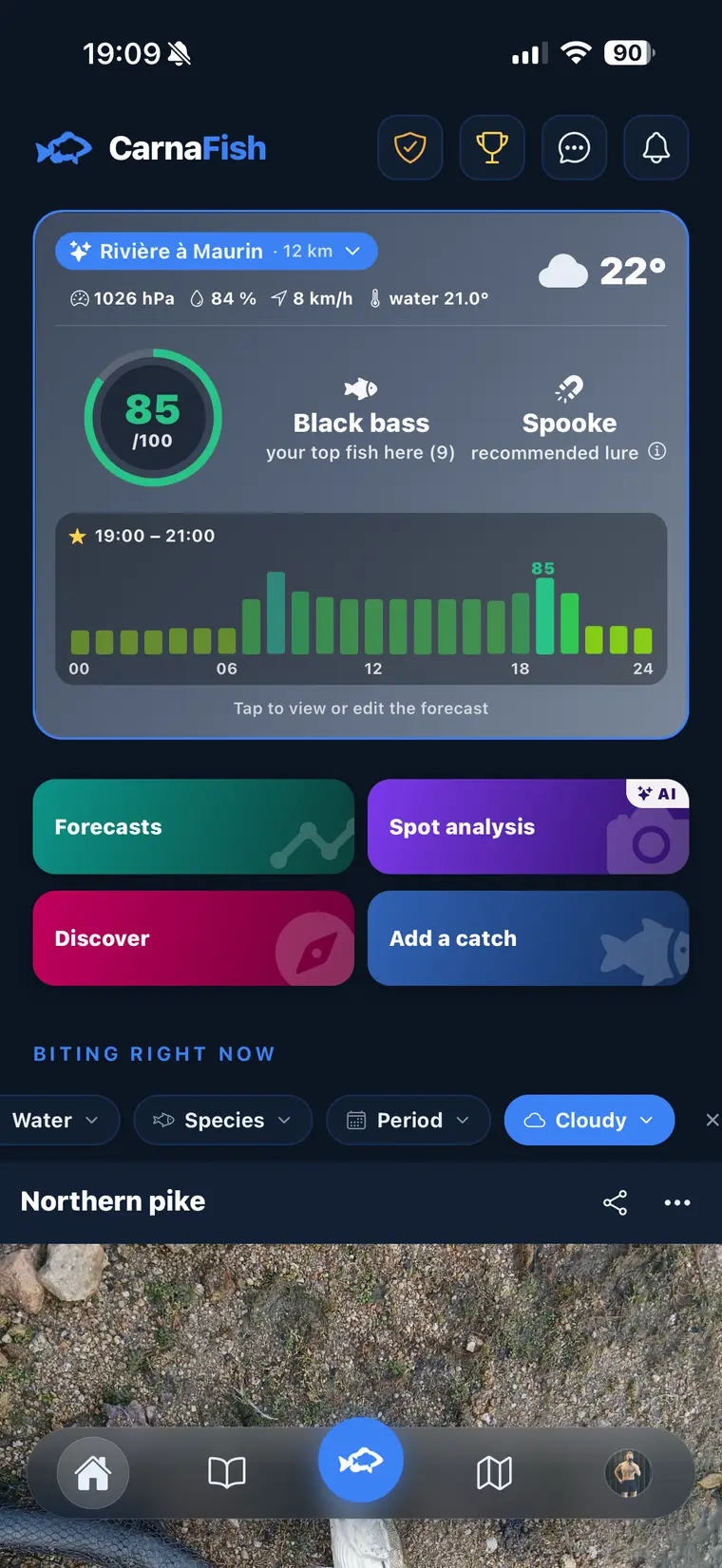
Not sure what to tie on?
Photograph your spot: CarnaFish reads the scene, cross-checks the conditions and gives you the zone, the lure and the retrieve. Free on iOS and Android.
Rigging and tackle
The description specifies the bait is armed with EWG trebles, whose wide gap improves hookup on a bulky hard body. In the catalog photo, though, the bait is shown bare: both belly hangers are empty and only the nose line-tie is fitted.
The thing that sets this apart from big swimbaits is that twenty-one grams asks for no specialist tackle at all. A 7-foot medium-heavy rod, a standard casting reel and 20 to 30 lb braid with 80 cm / 2-3 ft of 35/100 fluorocarbon are plenty. That's exactly the point of the Baby format.
Tie a loop knot or use a snap: a knot cinched tight to the nose ring stiffens the first joint and cuts the amplitude of the S. On a pike spot a strong leader becomes essential, and be aware that two trebles on a jointed body make unhooking a toothy fish markedly harder — bring long pliers and an unhooking mat.
The classic mistake
Winding too fast because it "doesn't seem to be doing much". A slow-sinking jointed bait is at its best at a speed that looks ridiculous from the bank. If you can see the bait swimming clearly at the surface, you're already too quick.
Colors by light
- Clear water, sun: the bluegill pattern in the photo, olive-green back barred with black over pearl flanks. It's a literal imitation, and in clear water the resemblance genuinely counts.
- Fishing into the light or under low cloud: a dark, plain tone. The fish reads the silhouette from below, and a back that's too pale erases the profile that makes this bait interesting in the first place.
- Stained water: a bright back, chartreuse green or strong gold, which keeps usable contrast as visibility drops.
Knowing whether panfish or small perch dominate your water decides on its own whether this profile beats a slim baitfish shape. That's the kind of read CarnaFish makes easier: photograph the spot and the AI suggests the zone, the depth and the lure family that fit. For groundwork on tackle and reading spots, our beginner's guide to bass fishing is a solid entry point. To compare against a slim forage profile, look at the Bucca Baby Bull Shad or a one-piece soft Megabass Magdraft.
The short version
- Bluegill profile, deep and short: a silhouette few lures reproduce, decisive where that prey dominates.
- Four sections on double joints: a clean S-wave present from very low speeds.
- Stated slow sink: count the drop and work the pauses, because that's where bites happen.
- Roughly 9.5 cm / 21 g: a jointed swimbait you can throw on ordinary tackle.
FAQ
Do I need dedicated swimbait tackle?
No, and that's the whole point of this size. Twenty-one grams casts fine on a 7-foot medium-heavy casting rod with 20 to 30 lb braid. Dedicated outfits only become necessary from around 60 or 80 g upwards.
Does this bait float at rest?
No, the manufacturer classes it as a slow sink. At rest it settles gently while keeping its attitude, which lets you work a precise band of water by counting it down before resuming the retrieve.
What retrieve speed should I use?
Slow, slower than your instinct says. The double joints make the bait swim at speeds where a one-piece swimbait stays inert. If the bait is visibly swimming at the surface, you're already winding too fast.
How does it differ from the Baby Bull Shad?
Outline and mass. The Bull Gill has a deep panfish body at roughly 21 g, while the Bucca Baby Bull Shad has a slim forage profile at roughly 14 g. The first imitates a stocky prey, the second a conventional shad.
Does it work on pike in Europe?
Yes, the deep profile reads well as a small perch, which is a prime prey item. Plan on a strong leader and long pliers: two trebles on a jointed body inside a pike's jaw demand a careful unhooking routine.
Why an ABS body instead of resin?
That's the choice that makes this bait affordable, since the original Buccas are poured resin. ABS also brings better impact resistance against wood and rock, which is no small thing on a lure you run close to cover.
The full bass lure guideSeason-by-season strategy: which family of lure, when, and why.Go from theory to fish
CarnaFish reads your spot from a photo and gives you the game plan: zone, lure, retrieve. Free on iOS and Android.